
Chapter 7 - The Carnival in the Pines
Morning made a decent attempt at normal.
It put steam above the campground sinks. It put a damp shine on the picnic tables. It sent a tūī somewhere up in the trees to declare itself with complete confidence, as though nothing in the wider world had spent the last two days rearranging roads, borrowing names, and tapping on caravan windows in borrowed voices.
Inside the caravan, normal was losing.
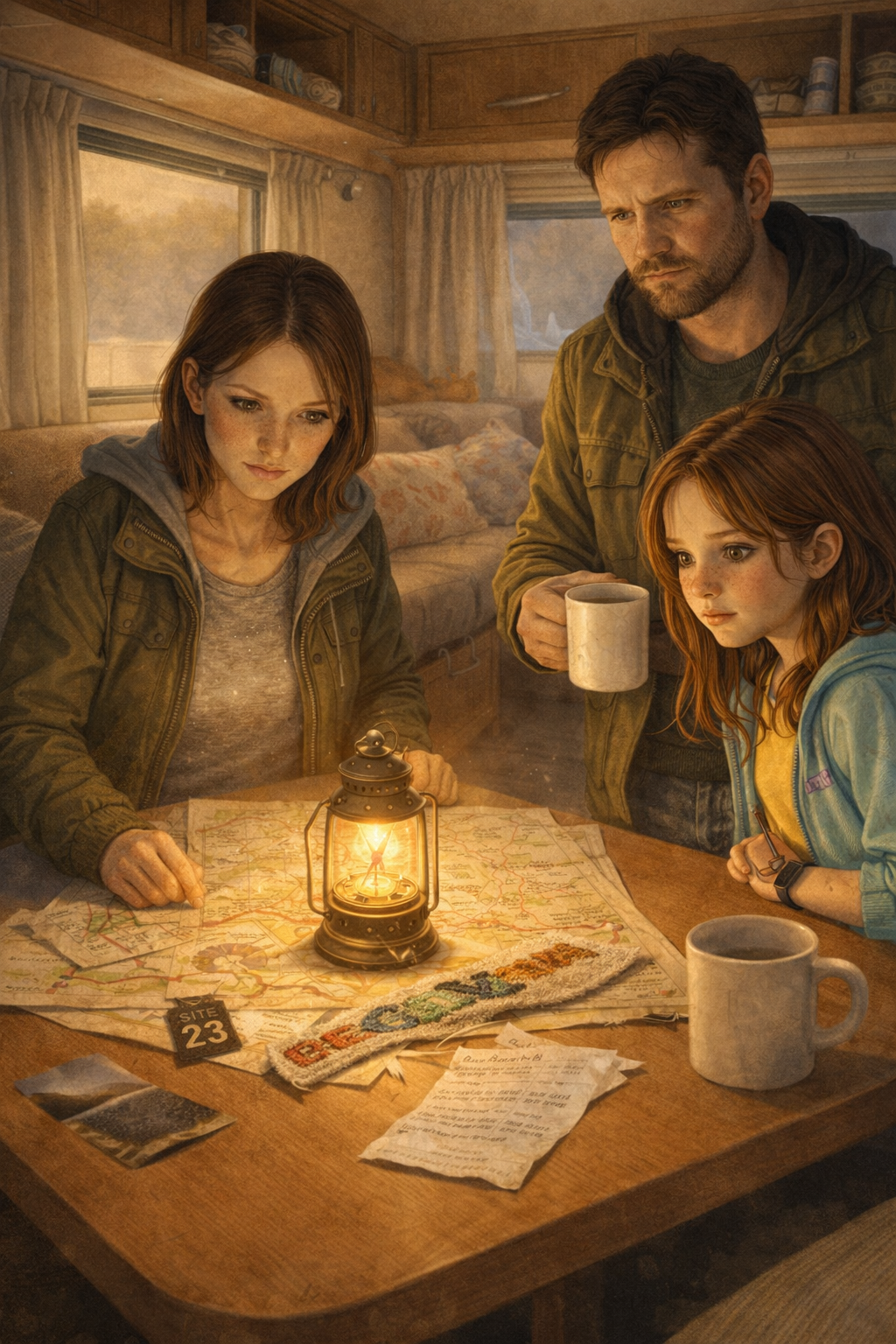
Dad stood over the little table with a mug of tea gone cold in one hand and the map spread open under the other. The route-strip lay across it like a narrow old scar. The Site 23 tag sat where Ivy had put it. The Lantern Compass rested at the top of the page, still and watchful.
“It is daylight,” Dad said. “That does not make it sensible. It makes it less stupid.”
Oakley, who had been lying upside down on the seat with one sock half off, nodded solemnly. “That is still good.”
“That is not what I said.”
“It is what I heard.”
Mum hid a smile behind her coffee and adjusted the route-strip by a fraction. The dark bypass line on Tane’s old map did not glow exactly. It was worse than that. It seemed to sit there with the confidence of something that had always been present and had only been waiting for them to stop being dense.
Off the fair road.
No bells. No bargains.
The little green-black guitar symbol waited farther in.
Amber leaned over the table, braid falling across her shoulder. “It still feels different from the bright road.”
Ivy glanced up from the window where she’d been watching campers move about in shorts and hoodies and jandals, carrying toast, wrestling chilly children into fleeces, arguing mildly about gas bottles. None of them knew there was a wrong carnival sitting in the pines not very far away. The unfairness of that itched at her.
“How,” she asked, “does a road feel bright in a bad way?”
Amber frowned, searching. “Like when someone is being nice too hard.”
That shut the caravan up for a second.
Dad set his mug down. “Excellent. Terrible. Useful.”
Mum slid the postcard and receipt into the map bundle. “We go in careful. We do not split unless we absolutely have to. We do not touch anything unless we know what it is. And if anything starts sounding like a deal—”
“We say no,” Oakley said at once.
“We say nothing,” Ivy corrected.
“We definitely do not accept a free sample,” Dad said.
Oakley looked offended. “What if it is a sample of chips?”
Dad gave him a level stare. “Then that is how they get you.”
That, finally, got a laugh out of everyone, even Ivy.
The Compass clicked.
It was not a dramatic sound. Just a neat little metallic tick under the morning clatter of plates and cutlery and distant campground life. But all five of them heard it.
The needle twitched toward the folded route-strip.
Then, faintly, from nowhere obvious at all, came the sound of one guitar string being plucked.
Not outside. Not on the radio. More like the table itself had remembered a note.
Amber’s eyes widened.
Dad closed his for one long second, reopened them, and said, “Right. Fine. Hate that. Still going.”
Mum reached for her phone before anyone could say anything clever and unhelpful.
Auntie Erin answered on the second ring, hair tied up messily, glasses on, expression already sharp enough to cut through nonsense.
“Well,” she said. “You all look moderately haunted.”
“That’s the nicest anyone’s looked at us all week,” Dad said.
Behind her, the downstairs hall at Woodend looked ordinary in the unsettling way ordinary things sometimes do after they’ve stopped being trustworthy. Meow Meow sat on the arm of a chair like a furious furry gargoyle, staring toward the stairs.
“He’s been glaring at the hallway since six,” Erin said, following Mum’s eyes. “I checked the cloth cupboard. Nothing else has started unravelling, but I found another of Granny’s thread cards.”
She held it up. Cream card. Old green thread. Tiny lantern stamped in one corner.
On the back, in Granny’s neat hand, were four words.
ASK. NEVER PAY TWICE.
Mum exhaled slowly. “That feels useful.”
“It also feels like the sort of advice you only write down after an absolute disaster,” Ivy muttered.
“Correct,” said Erin. “Also, before you all rush nobly into the haunted tree nonsense, I found a second note folded into the mending tin.” She glanced down and read it out. “If the fair is first to welcome you, it is not waiting for you. It is hungry before it is glad.”
Oakley sat up straight. “Bad party.”
“Very bad party,” Erin said.
Dad pointed at the screen. “Thank you. That helps exactly as little as I feared.”
“That’s what family is for.”
Meow Meow suddenly puffed up, all his fur going twice the size. He hissed at the hallway hard enough to make Amber flinch.
Erin turned her chair. For a split second the camera caught the downstairs wallpaper near the corner by the stairs, and Ivy saw it too: one seam in the paper lifting very slightly from the wall, as though a fingernail were teasing at the join from the wrong side.
Then Erin was moving, fast and calm at once. She reached for Granny’s old tin, pulled out the lantern-marked thimble and a reel of cream thread, and set the phone down facing the ceiling while she worked.
“Erin?” Mum said.
“Still here.” The phone view juddered, then settled. Erin had stitched nothing, exactly, but she had looped the cream thread across the corner bracket of a shelf and around the old newel post at the base of the stairs, making a taut little line that looked absurdly domestic and weirdly right. “There. It hates joins, so it can dislike mine instead.”
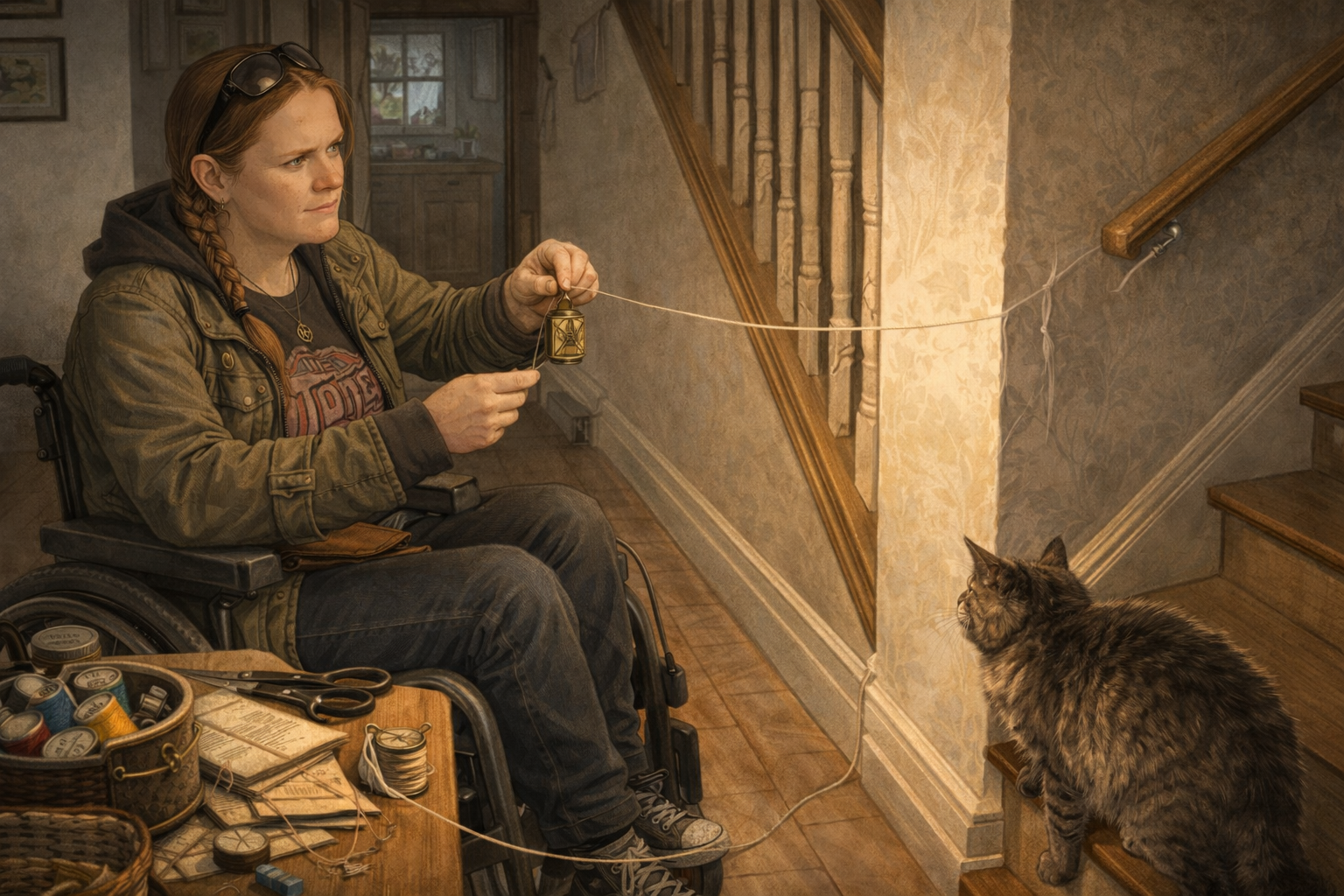
Meow Meow stopped hissing.
Not relaxed. Just stopped.
Erin wheeled back into view. “That bought me something. Don’t know how much.”
Dad’s expression flattened into the one he got when reality had annoyed him beyond words. “Great. Excellent. The house is now being defended by textile engineering.”
Erin lifted one eyebrow. “And yet it’s working.”
Nobody had much to say to that.
When the call ended, Dad disconnected the caravan from the RAV4 with the air of a man making an insultingly sensible decision under magical protest.
“The caravan stays here,” he said. “We’re not towing the entire family house into a bargain carnival.”
Oakley put both hands to his head. “But the caravan is mission base.”
“The caravan is staying unkidnapped,” Dad said.
That was harder to argue with.
By the time they drove back to the pine threshold, the sun had climbed properly. In ordinary daylight the roadside looked almost embarrassing. Gravel pull-over. Grass verge. Pine line. The restored PINES plate fixed between the old posts as though it had never been missing.
But the cracked bronze bell still hung there with its clapper bound in dark cloth, and the air on the far side of the posts had the wrong depth to it.
Mum checked the map bundle one last time. Route-strip. Tag. Postcard. Receipt. Compass.
Ivy had the unpleasant feeling they were less carrying the objects now than escorting them.
Dad eased the RAV4 through the posts and down the hidden track.
The sea sound cut off again.
Not faded. Not receded. Removed.
Oakley whispered, because even he seemed to feel the silence land, “That is rude.”
“Yes,” Mum said quietly. “It is.”
The clearing they’d found the night before looked worse in daylight, which was impressively annoying. The shelter stood where it had, old timber damp and greying, but the noticeboard had lost more of itself. Whole painted words were gone now, leaving blank boards with only ghost-shadows where letters had once been. Under the shelter roof, the box that had held the route-cloth sat slightly open.
And beyond the deeper archway in the trees, where the wrong road waited, colour flickered.
Not much. A glimpse. Red bunting where no bunting had been. Gold paint catching light. The edge of a striped awning between trunks.
Then came the smell.
Hot sugar.
Fried batter.
Toffee apples.
Ivy’s stomach made a stupid, traitorous little leap before common sense shoved it down again.
“Oh, absolutely not,” Dad said.
That was when the music reached them.
Not guitar. Not the clean single-note twang from the map-table. This was calliope-bright and cheerful in a way that made Ivy’s shoulders crawl. Something tinny and dancing and too eager to be liked.
Amber folded her arms over herself. “I hate it.”
“It sounds happy,” Oakley said, and then, after a beat, “in a bad way.”
Mum looked toward the deeper arch, not moving any closer. “We follow the bypass.”
The Compass agreed at once, needle dragging left of the bright sound, toward a darker run of trees and a track so slight Ivy would have missed it if she hadn’t been looking for what the obvious path was hiding.
There, on a low post half swallowed by moss, was the little green-black guitar mark.
Dad saw it too. “Good. Excellent. One clear thing.”
The bypass began narrow enough that they left the car in the clearing and went on foot. Needles softened the ground. Ferns brushed their legs. The bright music stayed to their right, sometimes close, sometimes far away in a way that didn’t obey distance.
The bypass should have felt quieter.
Instead it felt interrupted.
Bits of carnival kept turning up where no carnival should have fit.
A string of tiny brass bells hung from one branch ahead, polished and innocent. Mum stopped the whole group with one hand before Oakley could touch them.
“Not those.”
A stall appeared between the pines ten metresmeters later and was gone when Dad blinked. Ivy had still seen it clearly enough: striped roof, shelves of prizes, rows of little glass jars each holding something that moved like trapped smoke.
Then Amber caught Dad’s sleeve.
On the left, just off the path, a painted sign leaned against a stump:
FOUND THINGS RETURNED HERE
Below it hung a neat bunch of tags. Luggage tags. Key tags. One old enamel site tag with the number scratched off.
Ivy’s chest went tight.
“Keep moving,” Mum said, and her voice was calm enough that everybody obeyed it.
The path bent.
The music swelled.
And suddenly the trees opened.
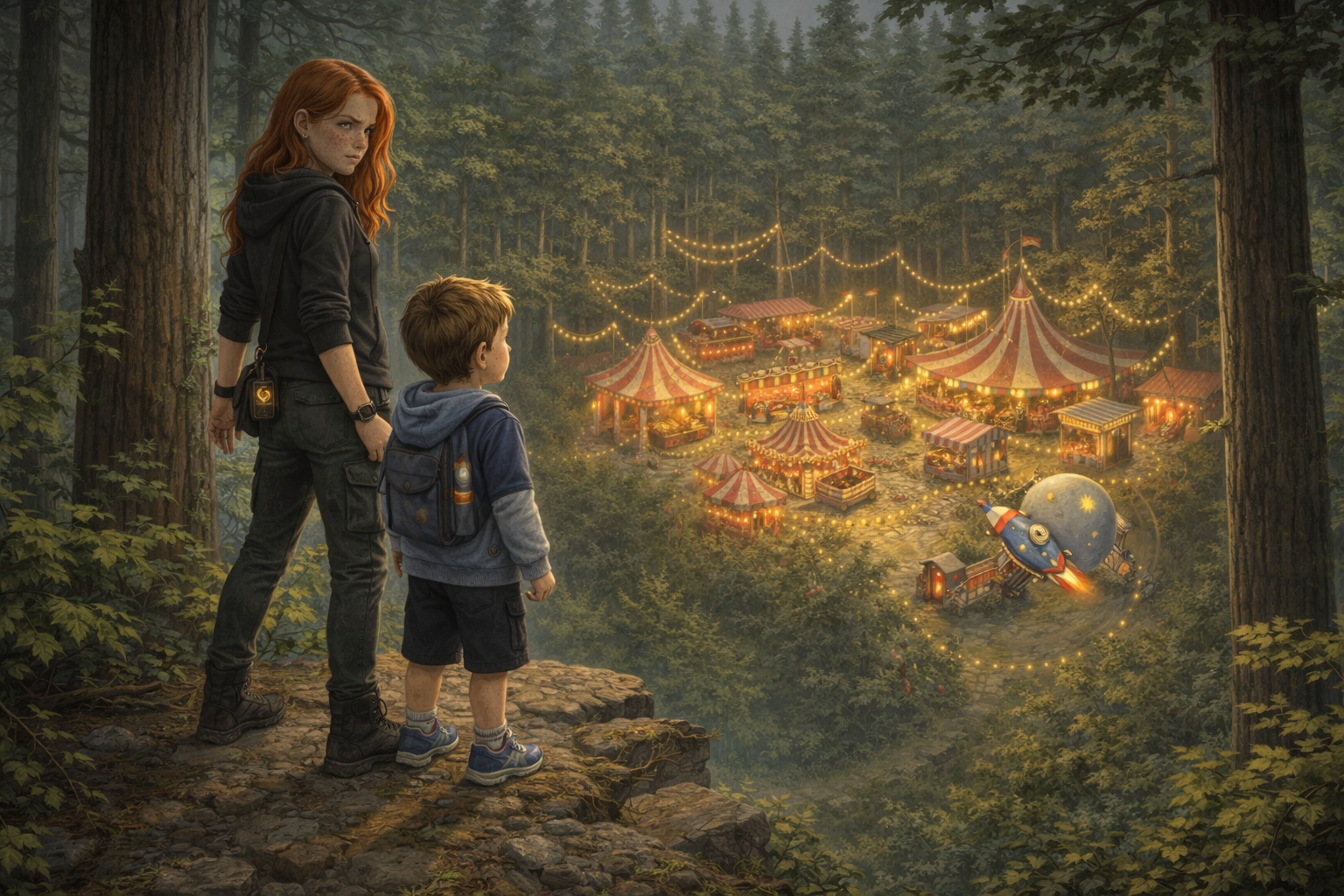
The carnival lay below them in a hollow between pines, bright as a lie. Strings of bulbs looped from tree to tree. Painted wagons stood in rings. A small carousel turned without any visible engine, horses going round with their mouths open in cheerful carved surprise. Stalls spilled with ribbons, tin toys, sweets, stuffed prizes, glass tokens, ridiculous wonders.
Children ran between the lights.
At least, from a distance they looked like children.
A woman in a red coat rang a handbellhand-bell at the entrance and called, “Welcome, travellers!travelers!”
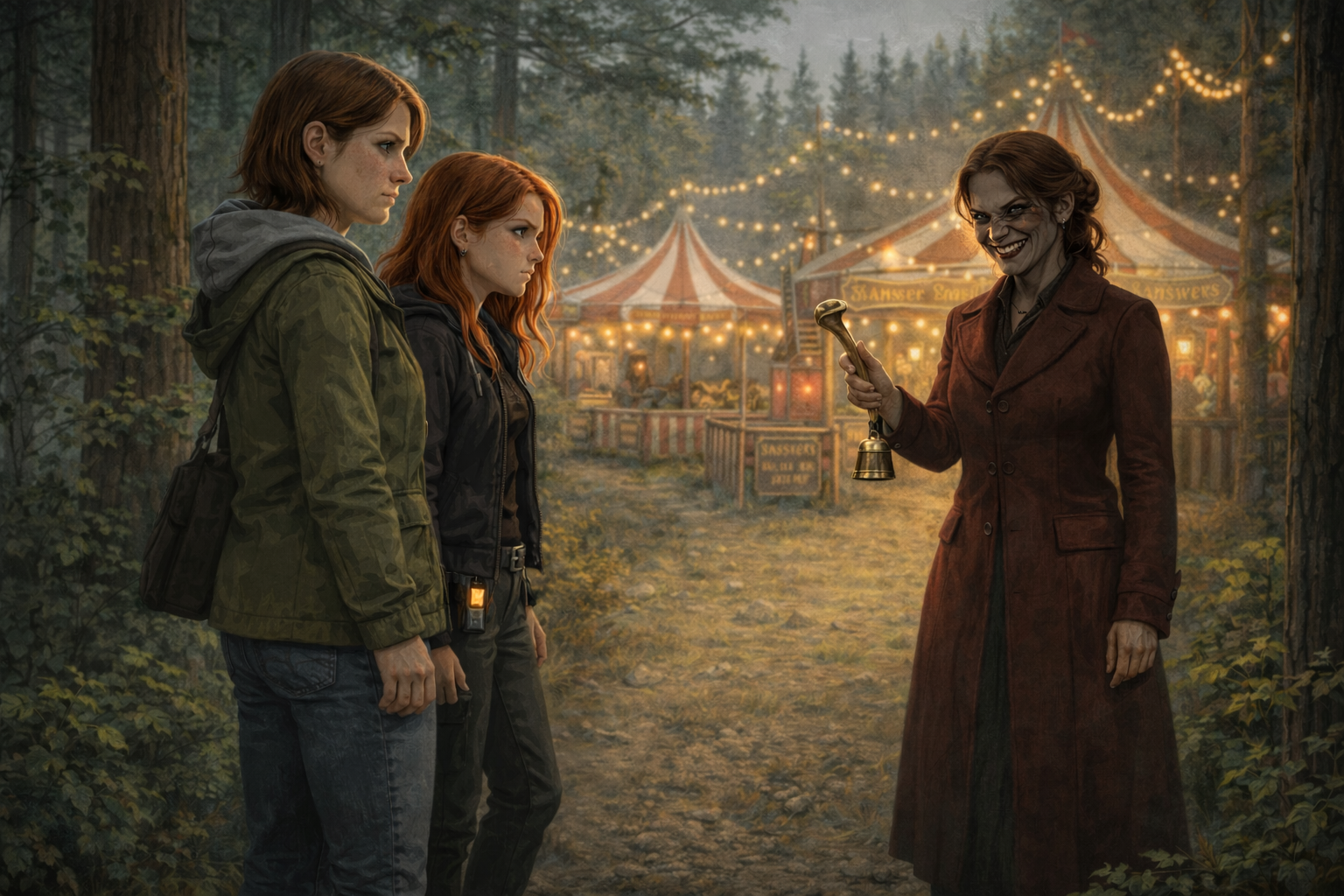
Every muscle in Mum’s shoulders hardened.
“Don’t answer,” she said.
No one did.
The woman smiled anyway. Her face was almost right. Pleasant. Warm. Human. Only the smile lasted one second too long, as if it had been shown a description of friendliness and was trying to do it from memory.
“Everyone welcome,” she called. “First ride free.”
“No,” Dad said, not loudly, but with enough flat contempt to make Oakley stare at him in admiration.
The woman’s smile widened, just a touch.
“Perhaps not a ride,” she said. “Perhaps a little help.”
The stalls nearest them seemed to shift.
One now held maps. Stacks and stacks of them. Perfect maps. Marked routes. Clear legends. Safe roads in tidy ink.
Another displayed little framed signs: NO MORE WRONG TURNS, NAMES KEPT SAFE, HOLIDAY FIXED BY TEATIME.
To Ivy’s right a taller board unfolded itself with impossible politeness.
ANSWERS FOR THE ELDEST CHILD
Her pulse jumped hard enough to hurt.
She could feel the trap in it and still feel the pull.
What did the adults know? Why had Granny hidden things? Who was the boy in Site 23? What was his real name? Why her?
The painted board shimmered again.
ONE QUESTION HONESTLY ANSWERED
No charge, obviously. Nothing honest was ever written in that sort of gold.
Beside her Amber had gone still too. Ivy followed her gaze and found a different stall lit in softer colours. Sketchbooks that drew by themselves. Little creatures made of ribbon and moss. Shelves of books with blank spines that somehow still looked familiar. An old woman behind the counter smiled with heartbreaking kindness.
“Come and see,” she called gently. “Only looking. No need to decide.”
Oakley made a strangled noise of pure longing.
Straight ahead, beyond two striped tents, a tiny rocket ride went in patient circles around a painted moon.
“Oh, that is criminal,” Dad said.
The handbellhand-bell rang again.
Ivy felt it in her teeth.
Then, from somewhere off to the dark side of the hollow, came a different sound.
One low guitar note.
The carnival lights twitched.
Only for an instant. But in that instant Ivy saw under things. The painted horses on the carousel had too many teeth. The bunting was stitched together from ticket strips and scraps of old route-cloth. One of the smiling children running past had no face at all until the light steadied and gave it one again.
Amber made a small horrified sound.
The woman with the bell turned her head toward the dark trees, smile slipping.
Dad moved closer to the kids. “That,” he said, “is the most reassuring thing that’s happened all day.”
Another guitar note. Higher this time. Funny, almost lazy.
The bell-woman’s expression sharpened. “This path is closed.”
A voice answered from the trees beyond the hollow.
“Mm,” it said. “Only if you’re standing in it.”
Then a large figure stepped out between the pines and sat down on a stump as though he had been planning to do that all morning.
Ben Jammin looked, at first glance, like the sort of thing Dad should have objected to on principle. Big. Broad. Hair to his shoulders. Massive beard. Patched clothes. Boots that had seen weather and possibly history. In his hands lay the strangest guitar Ivy had ever seen: driftwood body, scavenged metal plate, bent pegs, strings that looked individually unrelated.
Then he looked up.
And the whole threat of him went to pieces on contact with his expression.
Kind eyes. Bashful little half-smile. The air of a man who might apologiseapologize to furniture if he bumped into it.
“Oh,” Amber whispered, relief rushing into the word before she could stop it.
Ben Jammin gave them a small wave with the hand not holding the guitar. “Morning.”
No one said anything for a second.
Then Oakley breathed, full of awe, “Banjo wizard.”
Ben Jammin’s eyes crinkled. “Close enough.”
The bell-woman lifted her handbellhand-bell and rang it hard.
It made no sound.
Ben Jammin plucked two strings in answer, and the silence around the bell landed with a satisfying little thud, like a door closing in the right face.
“Now,” he said mildly, “that’s just awkward for everybody.”
The carnival changed shape.
Not completely. Enough.
The stalls nearest him lost some of their glow. Paint peeled at the edges. The smell of sugar soured. One prize shelf became a row of bottle tops and bones and somebody’s old bus card before glamour slid back over it.
Dad let out a breath that might once have hoped to become a laugh. “You’re Ben Jammin.”
Ben scratched his beard with his shoulder, because both hands were occupied. “I am when I’m behaving.”
Mum, unlike the rest of them, did not look relieved exactly. Interested, yes. Careful, definitely. But also like someone recognisingrecognizing a pattern finally stepping into view.
“You’re the Mender.”
He tilted his head. “Sometimes.”
The bell-woman took one step toward them. “They entered by welcome.”
“No,” Mum said at once. “We didn’t.”
The woman’s smile thinned. “They looked.”
“That’s not the same thing,” Mum said.
Ben Jammin’s glance flicked to Mum with obvious approval. “Good catch.”
The carnival music tried to rise again, brighter, pushier.
Ben laid one broad hand over the odd guitar body and damped the strings. “You lot do love making yourselves the first thing people see.”
“Because they choose joy,” the bell-woman said.
“No,” said Ivy, before fear could stop her. “You choose first.”
The whole hollow seemed to listen.
The woman’s face altered by a grain. Not monstrous. Worse. Offended.
Ben gave Ivy a tiny nod, almost hidden in his beard. “Also a good catch.”
Then he looked back at the family properly. “You’ll want the side way through. This one’ll sell you what you’re already frightened of losing, then charge in pieces too small to notice until later.”
Oakley looked betrayed by the rocket ride. “That is bad business.”
“It is,” Ben agreed. “Very flashy though.”
Dad moved first, practical even now. “What do we need to do?”
“Not much talking to them.” Ben glanced at the handbell woman. “And one or two honest bits in the correct places.”
He nodded toward the map bundle in Mum’s hands, then toward a post near the hollow edge where a run of ticket-bunting had been tied across the darker track, blocking it like cheerful webbing.
Ivy saw the join at once. Not rope. Not wire. Stitched cloth. Old cloth beneath the bright scraps.
A route seam.
Amber saw it a heartbeat later. “That’s not decoration.”
“No,” said Ben. “It’s a wound dressed up for company.”
Something in the carnival laughed. Too many voices. Not enough people.
“Lovely,” Dad muttered.
Ben pointed with his chin toward a low marker stone half hidden in pine needles near the blocked side path. The top of it had been scraped nearly blank, but there was a shallow oval in the centre.
“Tag there,” he said to Ivy.
She did not need telling twice. The Site 23 enamel tag felt warm in her palm as she crossed to the stone. The carnival noticed. She could feel that too. Feel attention turning.
From the answer-stall behind her came a voice she knew at once and hated for existing.
“Just ask,” it said in almost-Granny’s voice. “You deserve to know.”
Ivy shoved the tag into the oval slot in the stone.
It fit with a neat, final click.
Light did not burst out. No dramatic nonsense. Instead the darker side path simply became more itself. Edges sharpened. Ground steadied. The blocked seam in the bunting gave a strained little pull.
“Amber,” Ben said.
She looked up.
“Front of the route-strip.”
Amber blinked. “Why me?”
“Because you know which bit means what.”
That was true and annoying and she knew it. Amber took the torn embroidered strip from Mum, studied it only a second, then crossed to the bunting seam and laid the strip against the old cloth hidden under the bright scraps.
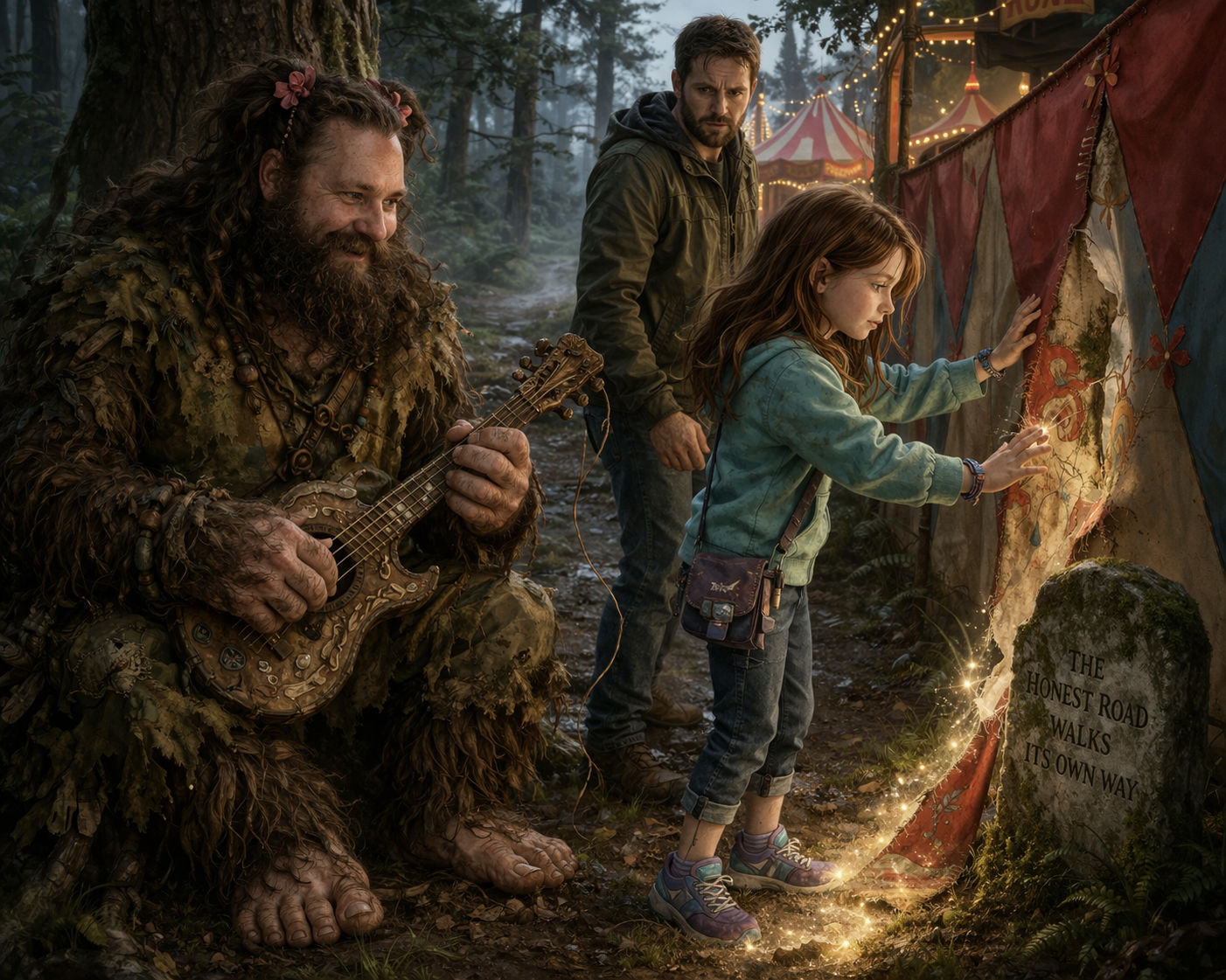
Pine. Lantern. Crossing lines.
The pattern matched.
The carnival lights shuddered harder this time. A few bulbs popped.
The bell-woman came toward them for real now, fast enough that Dad stepped in without thinking. Mum caught Oakley back by the hood. Ivy turned, ready to do something stupid and probably ineffective.
Ben Jammin struck one full chord.
The sound rolled through the hollow like a hand put flat against a tearing thing.
Every bell in sight went dead.
Every painted grin lost some of its certainty.
The woman stopped dead at the edge of the darker track as though she had hit glass.
Ben winced very slightly. One of his guitar strings snapped with a tiny bright twang and curled loose.
“Right,” he murmured. “That was the expensive version.”
Dad stared. “You all right?”
“Ask me after lunch.”
He nodded to Mum now. “Ask properly.”
She understood at once. Of course she did.
Mum stepped to the edge of the darker path, one hand on the map bundle, the other still braced near Oakley.
“We’re asking for the honest road,” she said clearly. “Passage only. No bargains. No welcome from the fair.”
The pines answered.
Not with words. With movement. With a breath of colder air down the side path. With the smell of damp earth replacing sugar and grease. With the little green-black guitar mark appearing again, this time on the next post in.
Ben smiled. “There we are.”
Behind them the carnival had gone very still.
Not beaten. Just watching.
At the far side of the hollow, between the striped tents, Ivy saw a small figure standing half in shadow. Child-sized. Thin. Still.
The boy from Site 23.
He lifted one hand.
Not a wave. A warning.
Then he pointed deeper into the carnival, where something taller had begun to move behind the lights.
Something with a grin catching where there should have been no light at all.
Ivy’s breath stopped.
The figure vanished before she could make sense of it.
“Go on,” Ben said quietly, and the lightness had gone out of his voice. “Side way’s open, but it won’t stay polite if we waste it.”
Nobody argued.
They moved into the darker path together, the family bunching close without needing to discuss it. Dad first, because of course he was. Mum beside him. Oakley between them this time whether he liked it or not. Amber with the route-strip still in her hand. Ivy last for one second only, because she looked back.
The carnival had already begun smiling again.
But badly now.
Hungrily.
The bell-woman stood at the edge of the hollow with her soundless bell in one hand and watched them leave as though memorising the shape of each of them.
Ben Jammin rose from the stump with a grunt, slung the odd guitar carefully over his shoulder, and followed them into the bypass.
Up close he was even larger and somehow even less alarming.
“Sorry about the theatrics,” he said. “They do insist.”
Dad let out a breath through his nose. “You arrived sitting on a stump with a haunted guitar beside an evil carnival.”
Ben considered that. “Fair.”
Oakley looked up at him with complete devotion. “You are real.”
“Only on weekdays,” Ben said.
That earned a small startled laugh from Amber and, to Ivy’s disgust, one from herself.
The path narrowed again under darker branches. The carnival sound fell behind them, muffled now, as though the trees were choosing not to repeat it.
Ben walked a little hunched, perhaps from habit, perhaps so he didn’t loom more than necessary. After a while he glanced at the snapped string curling from his guitar and sighed.
“Annoying,” he said.
Mum looked at him sidelong. “Can you mend that?”
“Yes,” he said. “Question is whether I should do that before or after I tell you lot why Twenty-Three is still trying to come home.”
No one spoke.
Even Oakley went quiet.
Ben Jammin’s expression softened at whatever he saw on their faces. “Mm,” he said gently. “Thought so. Best keep moving, then.”
Ahead, the honest road bent out of sight under the pines.
And somewhere beyond the turn, something knocked once—far off, wooden and hollow, as if a closed door in the dark had just heard their names and wasn’t sure yet what to do with them.