Chapter 8 - Signs That Eat Themselves
The honest side way did not look impressive.
That was the first thing Ivy noticed once the carnival lights had fallen properly behind them and the last of the bright music had thinned into something mean and far away. The track ahead was only a narrow run of damp earth under pines, dark with old needles, stitched with moss, and lined here and there with marker stones so weathered. No glowing tents. No painted arrows. No cheerful promises. Just bush hush, filtered daylight, and the feeling that the path was waiting to see whether they meant what they’d said back there.
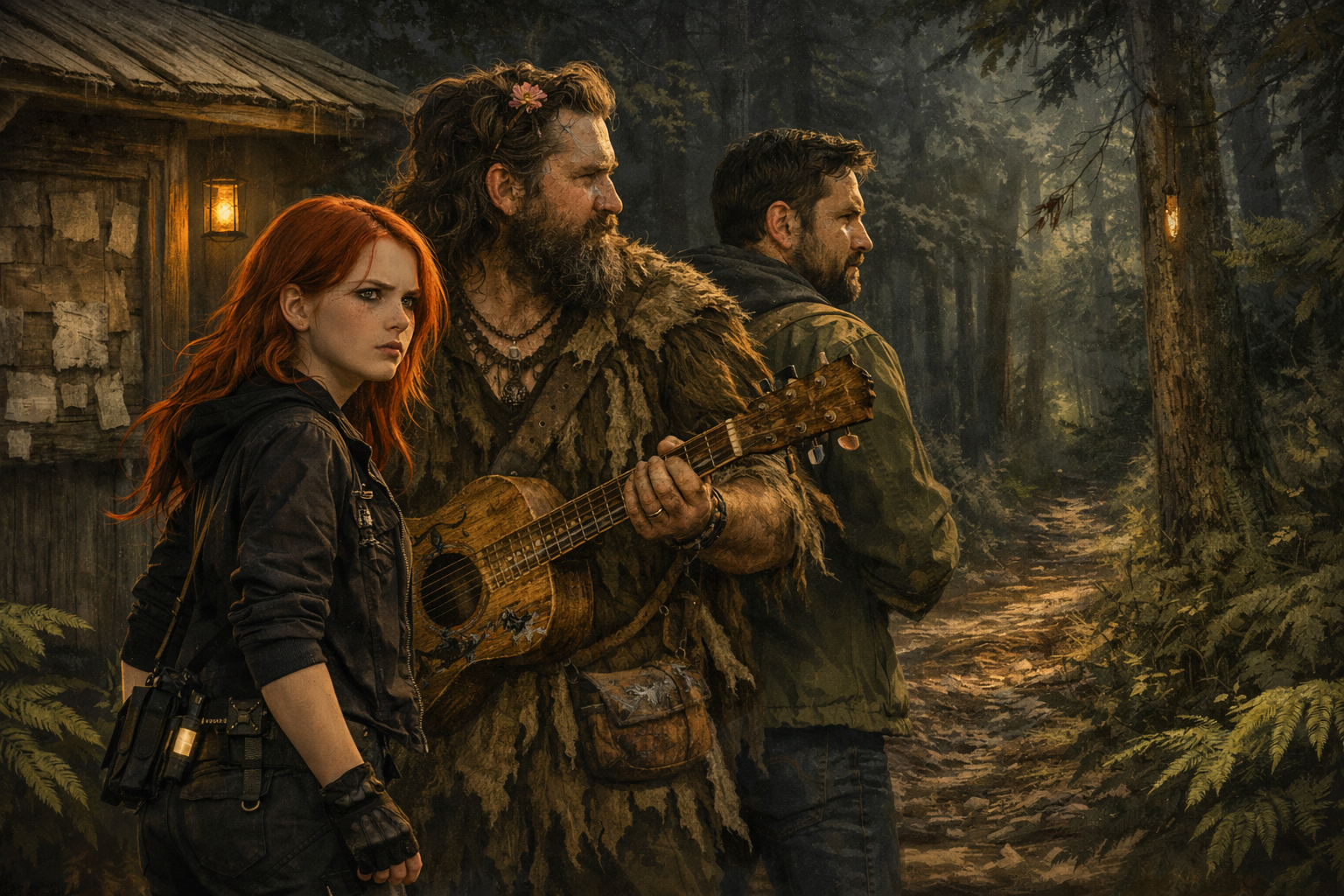
Oakley held Dad’s hand with one fist and his rocket hoodie with the other.
Ben Jammin walked a few paces ahead, broad shoulders nearly brushing the fern tips, his odd homemade guitar slung carefully so the broken string would not catch. Up close, the snapped wire looked worse than it had in the hollow. One bright curl had sprung loose from the peg and lay against the timber body like a bit of angry fishing line.
Amber kept glancing at it.
Mum noticed. “You all right there?”
Amber nodded, then shook her head, which was more honest. “Did that hurt?”
Ben looked back over one huge shoulder. His beard shifted when he smiled. “Bit.”
They kept moving.
The side way gave no sign of impatience, but the stillness under the pines had a deliberate quality to it. Ivy had the unpleasant feeling that if they all stopped and planted themselves in the middle of the path like tourists at a scenic lookout, the road might simply change its mind about them.
The Lantern Compass rested in Mum’s hand, quiet now except for the occasional tiny twitch that nudged its needle forward. The Site 23 tag sat in Ivy’s pocket, Every now and then she put her fingers around it, just to make sure it was still there.
Behind them, somewhere beyond too many trees, a bell rang once.
Not loud. Not near. Just enough to prove the fair road had not packed up and gone home in a huff.
Oakley leaned hard into Dad’s leg. “Bad party’s still there.”
“Yep,” said Dad.
“Can it come here?”
Ben hummed under his breath before answering. “Not cleanly.”
“That is also not a proper answer,” said Ivy.
Ben’s eyes flicked to her, amused and a little sorry at the same time. “No. That one’s the proper answer. Proper answers are just often rude to the nerves.”
Dad adjusted his grip on Oakley’s hand. “Try us anyway.”
Ben nodded once. “This road’s quieter than the fair. Quieter means slower. Slower means truer. But the bright road doesn’t like being refused. It’ll keep leaning where the joins are weak. Not all the way in, if the side way holds. Just enough to bother.”
“Bother,” Dad repeated. “That’s one word for it.”
“It is,” said Ben.
They passed a marker stone half-buried in pine needles. Ivy looked down as she went by and saw three neat grooves cut into the rock, then a fourth that stopped halfway through as if the stone-cutter had been interrupted and never come back.
Mum slowed. “Ben.”
“I know.”
He crouched with surprising grace for someone his size and pressed two fingers to the broken groove. For a second nothing happened. Then the Compass needle in Mum’s hand gave a small worried twitch.
“Fresh?” Mum asked.
Ben stood again. “Fresh enough.”
Dad’s shoulders tightened. “Fresh enough for what?”
“For something hungry to have passed this way after the fair dressed its little wound up for company,” Ben said. He glanced ahead into the trees, then back at the family. “We should talk while we walk.”
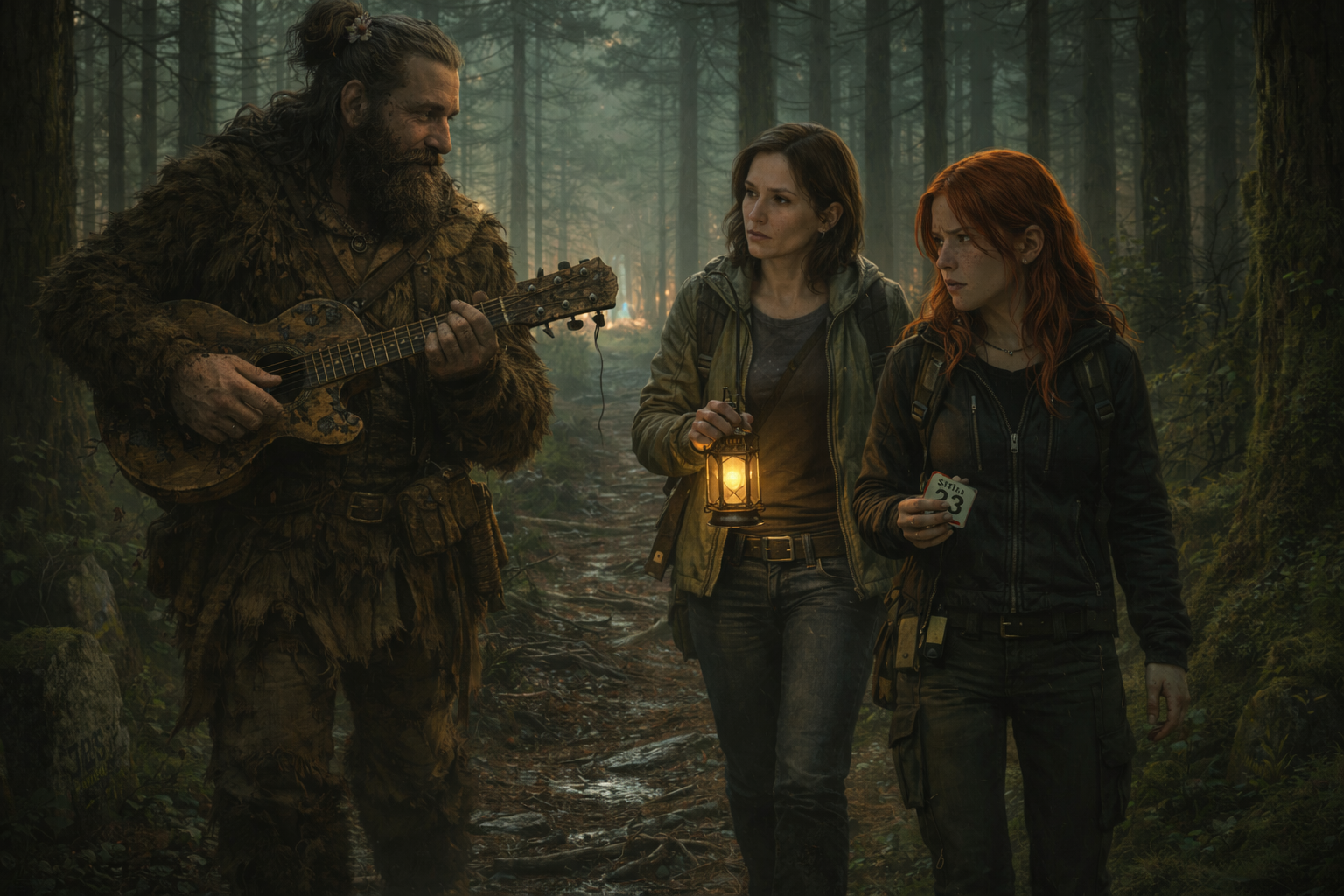
Ivy had been waiting for that sentence since the hollow.
“About Twenty-Three,” she said at once.
Ben did not sigh, which made him instantly more likeable than most adults. “About Twenty-Three.”
He set off again, slower this time so they could keep level with him.
For a while all Ivy could hear was the soft drag of shoes on pine litter, Oakley’s occasional sniff, and somewhere above them a tui giving one startled note and thinking better of a second.
Then Ben said, “Site Twenty-Three wasn’t just a campsite.”
Nobody answered. Even Oakley seemed to understand this one needed room.
“It wore a campsite shape,” Ben went on. “That’s the sort of thing the Lantern Roads do near everyday places. They lean. They borrow. A hidden berth might cast a campground shadow, or a back road might sit under a farm lane, or a waiting-place might tuck itself under the manners of a dairy that knows enough not to put its name on the sign.”
Mum’s fingers tightened around the Compass. “A berth.”
“A counted place,” said Ben. “A safe stopping-point. Somewhere travellers could come in, be marked present, and go out whole. Not grand. Not fancy. Just honest. Berths mattered because the roads are old and not always kind to the lost. A berth says: you are here, you are known, and the road owes you a fair return.”
Amber frowned. “Like a promise.”
“Exactly that.”
Ivy was already two thoughts ahead. “And Twenty-Three broke.”
Ben’s head dipped once. “Yes.”
“How?”
He took longer with that answer.
“Bit by bit at first,” he said. “That’s how the bad things like it. A marker rubbed thin. A number plate gone missing. Someone fails to come back by the same rule they came in under. Then something hungry finds the weak edge and starts chewing where no one’s mending proper.”
Dad let out a breath through his nose. “Track Eaters.”
“Some of it.” Ben’s voice had gone flatter. “Some of it not mindless enough to call just hunger.”
Ivy thought of the taller grinning shape beyond the carnival lights and felt her stomach go cold again.
“So the boy’s from there,” she said.
Ben looked at her properly now, and there was no easy humour in his face. “Yes.”
“Who is he?”
“That’s where it gets ugly round the edges.”
“Try me.”
“I know you would,” Ben said. “That’s half the trouble.”
They walked another ten paces. Twenty, maybe. Long enough that even Ivy nearly snapped at him to spit it out.
Then he said, “When a berth breaks badly, the road doesn’t always lose everything at once. Numbers can hang on after names go. Shapes can hang on after time ought to have done with them. A place remembers what stood there last and longest. Or what mattered most when the break came.”
Amber’s expression had gone thin and hurt. “You mean the boy is a memory?”
“Not only.” Ben shook his head. “More than a memory. Less than a life lived tidy from one day to the next. He’s bound up in the break. Twenty-Three keeps trying to count him home, and failing.”
Oakley looked up, solemn as a tiny judge. “He got left behind.”
Ben’s eyes softened. “Yes.”
Nobody said anything after that.
The pines seemed to close a little tighter around the track.
Dad was the one who forced the next question out. “Are we talking about a ghost?”
Ben scratched at his beard with one thick finger. “Not in the sheet-rattling story way. Not exactly. Roads don’t make tidy ghosts. They make leftovers. Echoes. Waiting-shapes. Pieces held too long because a promise was interrupted.”
Ivy hated how sad that sounded.
She hated more that it matched the boy’s face in the caravan doorway, that bleak fixed way he’d looked at the Compass and said You brought it as if they had shown up carrying the only working handle on a locked door.
“So when you said Twenty-Three is trying to come home…” Mum began.
“I meant the berth,” said Ben. “And the boy. Hard to separate them now. The place wants back into the road where it belongs. The child-shape tied to it wants the count finished. One proper return might help the other.”
“Return to where?” asked Amber.
Ben’s answer came quiet. “That’s the question that’s been hurting everything else.”
Ivy pulled the enamel tag out of her pocket. The chipped number sat dull in the shade, but the lantern mark on the reverse caught a smear of green light through the trees.
“This,” she said.
Ben nodded. “Anchor piece. Official enough that the road still listens when it sees it. That’s why the fair wanted it hidden, or scratched blank, or hung up with all the other stolen bits and bobs to make the damage look decorative.”
Dad’s mouth hardened. “And the boy gave it to Ivy.”
“He would,” said Ben.
“Why?”
“Because she looked like someone who’d pocket the right thing even while being a bit cross about it.”
For one terrible second Ivy thought he was joking, and then she realized he wasn’t joking at all.
Mum gave Ivy the briefest sideways look. “He’s not wrong.”
“Traitor,” Ivy muttered.
That, finally, eased some of the tightness in the air.
Only some.
Ahead, the side way bent left around a stand of older pines. The ground there changed. Less moss. More bare roots. The smell shifted too, damp and metallic beneath the resin, as if rainwater had sat too long in rusted tin.
Ben slowed to a stop and lifted one hand.
Everyone obeyed instantly.
At first Ivy thought the path just widened into a rougher patch of trees. Then she saw the signs.
There were five of them.
One stood crooked on a leaning post, another lay fallen in the ferns, another was nailed directly into the trunk of a pine long since grown around its edges. They should have looked harmless enough: old track markers, route boards, bits of painted timber no one had bothered to replace.
Instead they were wrong in a way that made her scalp prickle.
The nearest sign had once been lettered in white. The first two words still showed: COUNT IN.
The rest of the message was missing.
Not worn off. Missing.
The painted space where more letters should have been looked nibbled. Ivy had never seen absence look bitten before, but that was exactly what it was. Little crescent chunks of nothing had taken clean mouthfuls out of the words and left the wood behind.
Amber whispered, “Oh.”
Another sign further back read RETU and then nothing.
The nailed one on the tree had three lines of text, but the lower two were sliding. Ivy stared, and one pale letter actually loosened under her gaze, curled inward at its own edge, and disappeared into the blank grain as if the board had swallowed it.
Oakley made a noise halfway between a gasp and a deeply offended squeak. “It ate the word.”
“Yep,” said Dad, very quietly.
The bell rang again. Closer this time.
Ben un-slung his guitar and held it against his chest, not playing, just listening through the timber. “Don’t read aloud anything you can’t finish.”
Mum’s head turned. “Because?”
“Because half a sign is half a rule, and half a rule’s just bait in tidy clothes.”
That would have sounded ridiculous in any other week of Ivy’s life. In this one it made immediate, awful sense.
She looked again.
There were arrows on two of the boards. One pointed ahead. One pointed right, straight into a darker run between the pines. The paint on both arrows was peeling, but not evenly. The right-hand arrow was brightening as she watched, as if some hidden hand were polishing it from the inside.
Beneath it, new letters were appearing.
Not on the wood. In the air just above it.
THIS WAY
Then: IVY THIS WAY
Mum stepped in front of her before Ivy could suck in a breath.
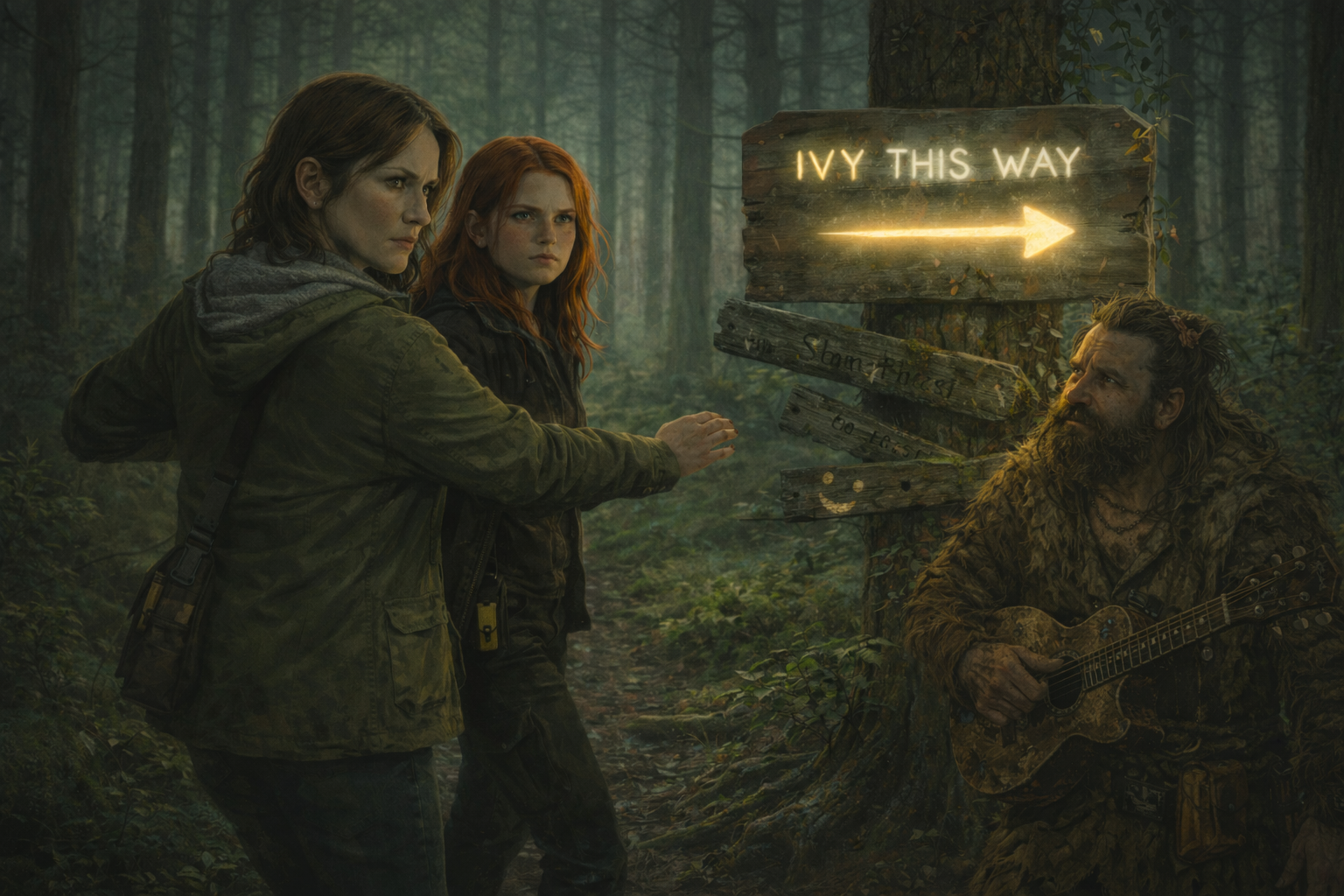
“No,” Mum said, not loudly, but the word landed like a shut gate.
The letters shivered and thinned. The board underneath them smiled in fresh paint.
Not a real smile. Just a curve. Just two white hooks and a line.
Ben’s hand came down on the guitar strings in a single blunt muting press.
The little painted smile vanished.
“Fair’s leaning through,” he said. “Told you it’d bother.”
Dad looked from the signs to the trees to the signs again, the way he did when a computer error had produced such ridiculous nonsense he was briefly considering whether the machine might just be offended on principle. “Can we go round this?”
“We are round it,” said Ben. “This is the better way.”
“Marvelous.”
The fallen sign in the ferns jerked.
Not much. Just a dry tick of movement. But enough to make Amber flinch back into Mum’s side.
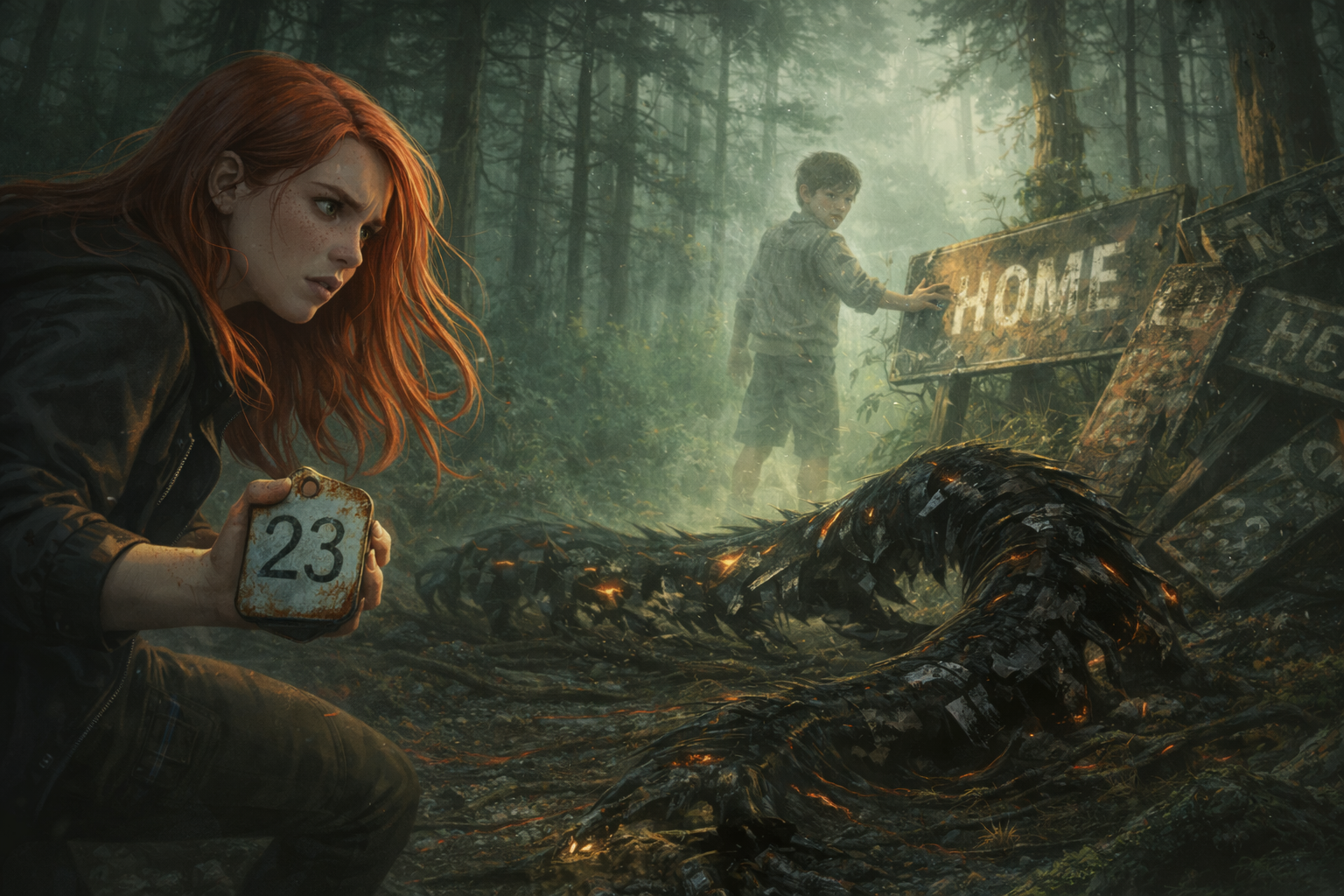
Ivy crouched before anyone could stop her. The sign lay face-up in the needles. Most of its lettering had gone, but one word remained in the lower corner, faint and hand-painted in red instead of white.
HOME
Her throat tightened.
“Ben.”
He looked down. The humour had gone right out of him now.
“That’s why Twenty-Three keeps surfacing near places folk stay,” he said. “Berths are for returns. If a return goes bad enough, the road starts throwing its homesickness about.”
Ivy straightened with a jolt as movement flashed to the right.
A child-shaped figure stood between two trunks, pale in the green dusk under the branches.
The boy from Site 23.
He looked thinner than before. Not thinner in body, exactly. Thinner in certainty. The edges of him kept fuzzing, as if the trees could not quite decide where he ended. He did not look at Ivy this time. He looked past her, toward the nailed sign on the tree.
Then he shook his head once.
The nailed sign split down the middle with a crack like dry ice.
Out of the split came a spill of blackness, low to the ground and moving too smoothly over roots.
Track Eater.
Ivy had never seen one properly. Nobody had. That was half the point. But now she saw enough: a length of wrong dark, jointed in places nothing built to live in daylight ought to be jointed, head or tail impossible to pick, body made more of missing than matter. It slid over the bark and the white lettering dimmed under it, sucked inward, vanishing bite by bite.
Amber cried out.
Dad shoved the kids back in one movement, Oakley scooped off the ground and tucked under one arm like a furious small parcel. Mum grabbed Ivy by the shoulder. Ben stepped forward and hit one string with the side of his thumb.
The note that came out was ugly and flat, but the Track Eater recoiled as if the sound had struck it broadside.
“Don’t run,” Ben said.
This was not the sort of instruction Ivy enjoyed hearing while the forest attempted to unwrite itself around her.
“It’s eating the signs,” she snapped.
“Yes.”
“That seems bad.”
“It is.” He hit another note, sharper this time. “Worse if it eats the count.”
Dad’s voice came clipped and hard. “Translate.”
Ben did not turn. “Signs first. Numbers next. Then direction. Then who went in and who came out. If it gets a clean chew through the count, this patch of road starts forgetting what travellers look like in the correct amount.”
There was a tiny pause.
Then Oakley, tucked under Dad’s arm, said, “That’s stupid.”
“Very,” said Ben.
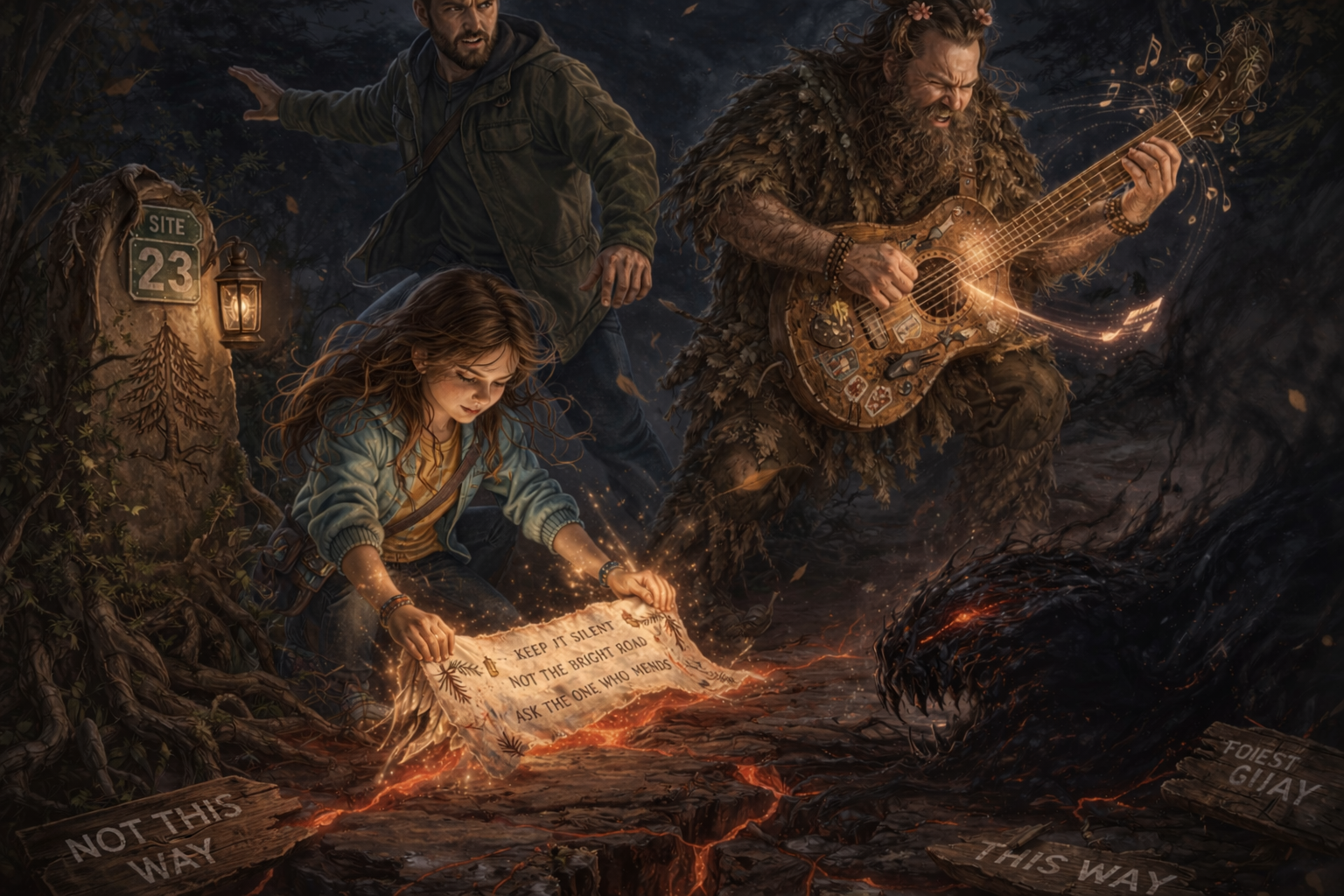
The Track Eater slid off the broken sign and went for the leaning post marked COUNT IN.
The white letters dimpled under it.
Mum was already moving.
“Tell us what to do.”
Ben pointed with his chin. “Marker stone there. Other side of the root flare. Ivy, tag. Amber, the route-strip if your mum’s got it. Justin, keep everyone on the same bit of ground. Belinda, count us aloud. Full and steady. Don’t let the count break.”
That was it. No grand speech. No dramatic nonsense. Just jobs.
Which, weirdly, helped.
Mum had the route-strip out almost before Amber reached for it. Dad set Oakley down, kept one hand welded to the back of his hoodie, and physically herded them toward the half-hidden stone Ben had indicated. It stuck up only a little above the needles, square-cut and old, with a groove in its face exactly the size of the Site 23 tag.
Of course it did.
“Count with me,” Mum said, voice level in the way that meant she was doing battle under the surface and would prefer not to discuss it. “Dad. Me. Ivy. Amber. Oakley. Ben.”
“Hairy wizard too,” Oakley said at once.
“Yes,” said Mum. “Hairy wizard too.”
Ben’s mouth twitched despite everything.
The Track Eater hit the leaning sign.
The word COUNT lost its O.
Mum did not look at it. “Dad. Me. Ivy. Amber. Oakley. Ben.”
Ivy jammed the tag into the stone.
For one foul second it refused to go in.
The black thing was already turning toward them, the missing place in it opening and closing as it moved, and Ivy had the absurd thought that if she messed this up now she would personally throttle history.
Then Amber grabbed her wrist.
“Turn it,” Amber said. “Lantern side.”
Ivy twisted.
The tag dropped home with a hard enamel click.
The stone flared underneath the moss, not bright, just definite. A red line ran out from it along a crack in the ground, then another, tracing old hidden edges.
“Route-strip,” Ben said.
Amber pressed the torn embroidered strip over the glowing seam on the stone face.
The thread in it caught.
Not with fire. With tension. The strip pulled taut between her fingers, every stitch suddenly alive, as if something on the other side had taken hold and was pulling back.
The Track Eater lunged.
Ben struck the guitar with all four good strings.
The chord that came out was rough, nearly broken, but it shook the air hard enough to spray pine needles off the roots. The Track Eater folded sideways, its shape stuttering. For one instant Ivy saw something under the blackness: not skin, not fur, not anything normal. Just a whole mess of erased numbers, crawling over each other like ants.
She wished very much she had not.
“Count!” Ben barked.
Mum’s voice sharpened. “Dad. Me. Ivy. Amber. Oakley. Ben.”
Dad picked it up with her, louder. “Dad. Mum. Ivy. Amber. Oakley. Ben.”
Oakley yelled, “And me!”
“You are in the count,” said Dad.
The nailed sign on the tree spasmed. Half-letters sprayed off it like white moths and vanished before they hit the ground. The fallen sign reading HOME began to blur at the edges.
The boy from Site 23 moved.
Not toward Ivy this time. Toward the sign.
He put both hands on the warped timber as if bracing a door.
The Track Eater jerked, distracted, and Ben hit another brutal chord.
Amber’s eyes were fixed on the route-strip. “It wants another word.”
“What word?” Ivy demanded.
Amber swallowed. “I don’t know.”
Ben looked at the stone, then at the blurring HOME sign, then at Mum. “Say what you asked before.”
Mum understood before anyone else.
“Passage only,” she said, clear as a bell that was actually on their side. “No bargains. No welcome from the fair. Return counted.”
The glowing line in the ground brightened.
The Track Eater writhed as if the last word had hooked it somewhere tender.
“Again,” said Ben.
“Passage only. No bargains. No welcome from the fair. Return counted.”
Dad’s hand tightened on Oakley’s shoulder. Ivy could feel the tag vibrating inside the stone now, the enamel ticking against old carved edges. Amber did not move. She held the strip steady with both hands, face pale and fierce.
Ben struck the strings once more and the broken one snapped fully loose, whipping free with a metallic ping.
The sound that followed was not music.
It was a road deciding.
Every sign in the clearing shuddered at once.
The white-painted missing bites in the boards sealed over, not repaired, exactly, but held. Just enough. The word COUNT came back whole. RETURN reassembled on the farther sign. The little painted smile on the false arrow blackened and flaked away.
The Track Eater convulsed, then streamed sideways off the post and into the roots, dragging a tail of missing letters behind it. The darkness slid deeper under the pines and was gone.
Silence dropped after it.
Not peaceful. Just stunned.
Somewhere behind the family, a bell tried to ring and came out dull.
Ben bent double, one hand braced on his knee, the other still gripping the guitar neck.
Dad moved on instinct. “You good?”
Ben raised a thumb without looking up, which was not convincing but was at least informative.
Oakley wriggled out from under Dad’s hand and toddled three steps closer before anyone could stop him. “You are a bit broken.”
Ben laughed once into the dirt. “Welp.”
Mum exhaled slowly. “Amber?”
“I’ve got it.” Amber’s voice shook, but her hands stayed rock-steady on the strip. “I think if I let go too soon it’ll wobble.”
“You’re probably right,” said Ben.
Ivy turned to the boy from Site 23.
He still had both hands on the HOME sign, though now his fingers were half-transparent in the wood. He looked at her at last.
His mouth moved.
No sound came out.
Then he lifted one hand and pointed past the signs, deeper along the honest side way.
Not toward the fair.
Forward.
And then he was gone.
Not vanished in a dramatic puff. Just thinned into the green light between the trunks until there was nobody there at all.
Ivy stared at the empty space for a second too long.
“Did he—” Amber began.
“Yes,” said Ivy, because she did not have a better answer.
Ben straightened slowly, wincing as he pulled the fully snapped string clear and wrapped it around his fist so Oakley would not immediately try to turn it into a space gadget.
“Right,” he said. “Now we keep going.”
Dad blinked at him. “After that?”
“Especially after that.” Ben nodded at the repaired signs. “That wasn’t a random bite. Something wanted this patch of route dumb and uncounted before you got to the next marker.”
“Why?” asked Mum.
Ben looked along the path the boy had indicated. “Because there’s something ahead it would rather you didn’t read.”
At Home, the cream thread across the hall seam had started to tremble.
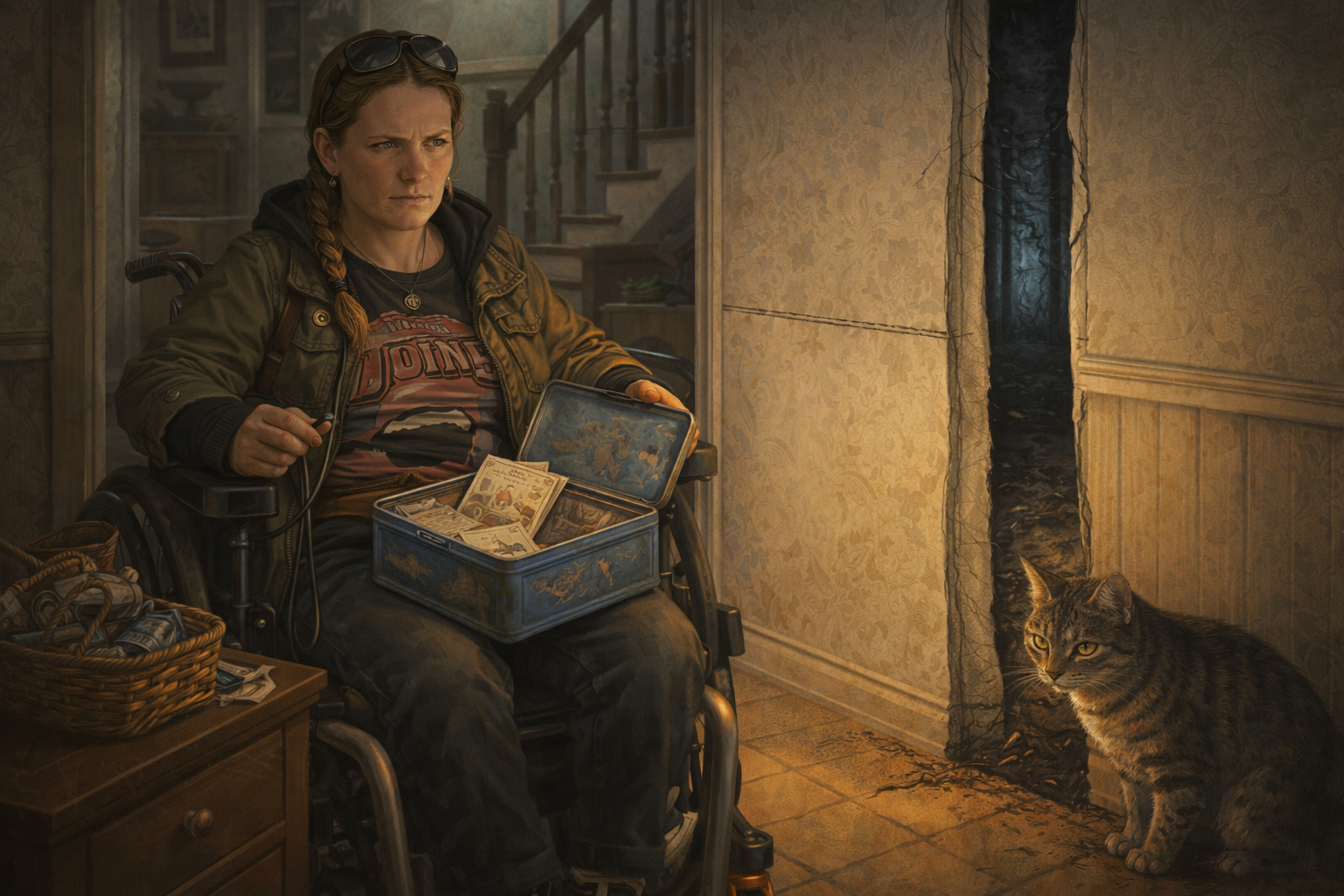
Not violently. Not enough for anybody sane to call the police and say hello, my wallpaper is behaving like a liar. But enough that Auntie Erin stopped mid-wheel turn at the kitchen doorway and backed up for another look.
Meow Meow sat four feet away, tail wrapped hard around his paws, glaring at the wall with the cold concentration of a cat who had elected to be everyone’s worst little prophet.
“Don’t like it either, eh?” Erin muttered.
The thread had held all morning. She had checked it three times while making tea and once while pretending not to worry, which was less effective than she would have liked. Now the line sagged in the middle, then drew itself tight again with a tiny plucked motion, as if something on the far side had just tested it with one claw.
Erin rolled closer.
The wallpaper seam beside the stairs had opened by perhaps the width of a fingernail.
That should not have mattered.
Except the dark in it was wrong.
Not plaster dark. Not shadow dark. Pine-dark.
Forest-under-boughs dark.
Erin’s jaw tightened. “Oh, absolutely not.”
Meow Meow made a low complaining noise that sounded like a kettle beginning to boil.
“I know.”
She wheeled fast for the downstairs worktable, baskets and tins knocking softly as she went. Granny’s lantern-marked thimble still sat beside the mending tin. So did the older cloths, neatly stacked because Erin had decided the universe was quite chaotic enough without adding her craft pile to the list.
She reached for the cream thread, stopped, and chose a darker spool instead: deep red-brown, almost the colour of dried pōhutukawa bark.
“Let’s try less polite,” she said.
The cat approved this immediately and leapt onto the chair she wasn’t using.
Erin set the thimble on, threaded the needle, and rolled back to the hall. The seam pulsed once as she arrived. Not big. Just bold.
“Mm-hm.” She set the first stitch.
The second tugged strangely. The third hit resistance in empty air.
Not empty, she corrected herself. Somewhere else.
The hair rose on her arms.
She stitched anyway.
By the sixth pull Meow Meow had gone from simmering kettle to flattened gargoyle. Erin kept working, eyes narrowed, following the opening upward until the thread line crossed an old umbrella stand nobody had moved in years.
Something wedged behind it caught her eye.
A biscuit tin.
Old. Blue. Dent in one corner.
Erin frowned, shifted the umbrella stand with her footplate, and dragged the tin free using the hooked end of her scissors. Dust streaked her fingers. The lid had been shut with two thick rubber bands gone brittle with age.
“Now what were you doing under there?”
The seam in the wall gave a small nasty twitch.
“Rude. Wait your turn.”
She slipped the bands off and opened the tin.
Inside lay a stack of old holiday photos, two folded campground maps, and an enamel tag with the number 12 on it.
Erin went very still.
Under the tag sat a photo turned face down. On the back, in Granny’s handwriting, was a single sentence.
Kev said never to mention Twenty-Three unless it came back first.
For a moment Erin could only stare.
Then Meow Meow yowled.
The thread across the hall seam went tight as piano wire.
Erin snapped fully back into herself, shoved the photo and note onto her lap, and reached for her phone.
“Right,” she said. “That’s enough out of all of you.”
The next marker was a shelter.
Or what was left of one.
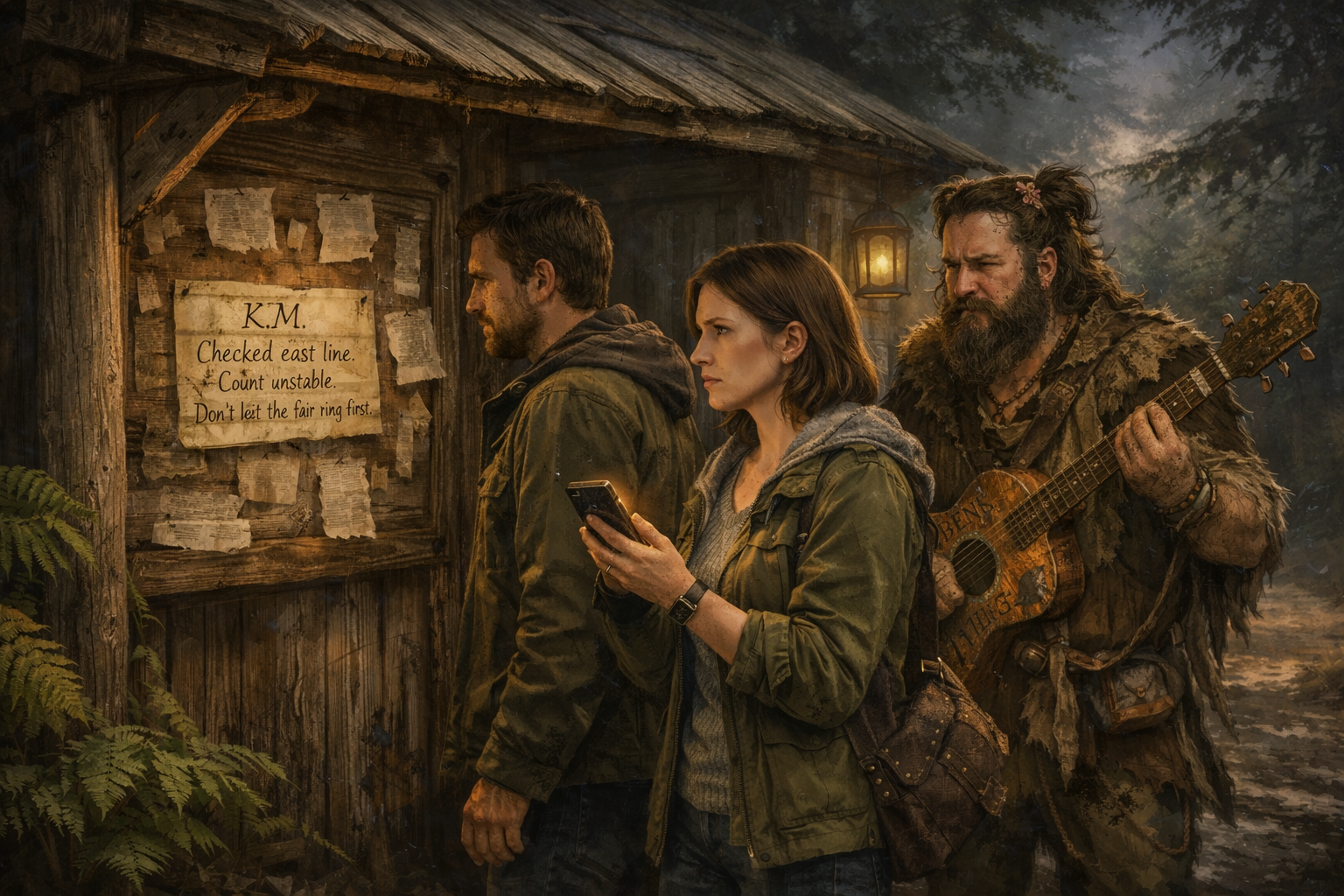
It sat in a shallow dip beyond the sign clearing, little more than a slanted roof over two posts and a bench silvered by age. Ferns crowded the edges. Moss had climbed halfway up one post and taken the lower half of a painted lantern symbol with it. A noticeboard hung inside, its paper strips pinned under rusted tacks.
Every strip had been chewed blank except one.
Dad saw it first.
“Tell me that says what I think it says.”
Mum stepped in beside him. Ivy crowded the other side before anyone could claim an adult right to interpret.
The surviving strip had been written in pencil, not paint. The letters were rough and blocky, pressed hard enough to dent the card.
K. M. checked east line. Count unstable. Don’t let the fair ring first.
Ben went so quiet the whole shelter seemed to notice.
Ivy looked from the note to him. “You know those initials.”
Ben nodded once.
Dad’s face had changed in a way Ivy did not like. Not fear, exactly. Recognition wearing a fear-shaped coat.
“K. M.,” he said. “Kev Morgan.”
No one corrected him.
At that exact moment Mum’s phone buzzed.
Everyone jumped.
She got it out fast, eyes scanning the screen, and her expression sharpened into something beyond worry.
“It’s Erin.”
Dad swore softly. “Speaker.”
Mum answered and held the phone between them.
Erin’s voice came through clipped and clear. “Good news first. Home hasn’t opened into a forest. Bad news second. I’ve found a tin Granny hid behind the hall stand, and unless I’ve suddenly become very stupid, Gampa Kev knew about Twenty-Three.”
Silence.
Then Ivy looked at the penciled note on the board again.
Dad looked too.
Mum spoke carefully. “What did you find?”
“A note in Granny’s writing. Old photos. A route tag for another berth. And one line saying Kev told her never to mention Twenty-Three unless it came back first.”
Dad shut his eyes for a second.
Oakley tugged his sleeve. “Gampa did a secret?”
“Apparently,” Dad said.
Ben rested his big hand on the shelter post, staring at the penciled card as if it might explain itself if he gave it long enough. “He came here,” he said quietly. “Your Kev. Helped hold the east line when Twenty-Three started slipping.”
Mum’s gaze shifted to him. “You knew him?”
“Met him twice. Maybe three times. Long while back.” Ben’s mouth flattened under his beard. “Practical bloke. Drove like the road had personally annoyed him.”
Despite everything, Dad made a short helpless sound of agreement. “That tracks.”
Erin’s voice crackled faintly through the speaker. “I assume by your horrible collective silence that this is not new information to only me.”
Dad opened his eyes. “No.”
Ivy stared at the board, at the dented pencil marks, at the rule about the fair ringing first.
Questions were piling up so fast they were nearly physical now. What did Gampa Kev know? Why had he kept quiet? Had he seen the boy? Had he known Site 23 would come back? Had he left the Compass? Had he been trying to protect Dad, or just avoid telling the truth until it walked back into the family holiday and knocked on the caravan door?
The honest side way stretched on beyond the ruined shelter, dark and quiet and absolutely not finished with them.
Behind them, from very far off and still much too interested, came the thin dead sound of a bell trying again.
Ben lifted his head.
“We keep moving for now,” he said. “But when you get the chance—”
“We talk to Gampa Kev,” Mum finished.
Ben nodded.
Dad looked at the penciled initials one more time, then at his children, then at the road ahead.
“Right,” he said. “I am getting extremely tired of relatives knowing things in installments.”
Erin, still on speaker, said, “Join the club.”
And somewhere beyond the shelter, deeper on the honest road, something knocked again from inside the trees.