Chapter 1 - Leaving

By eight-thirty in the morning, the house in Woodend looked less like a home and more like a very small country trying to evacuate.
The front hall was full of bags. The kitchen bench was full of snacks. The dining table was full of things nobody could agree on. Rain jackets. Chargers. A torch with no batteries. A packet of marshmallows that had already somehow been opened. One gumboot. Nobody knew where the other gumboot was, which felt about right.
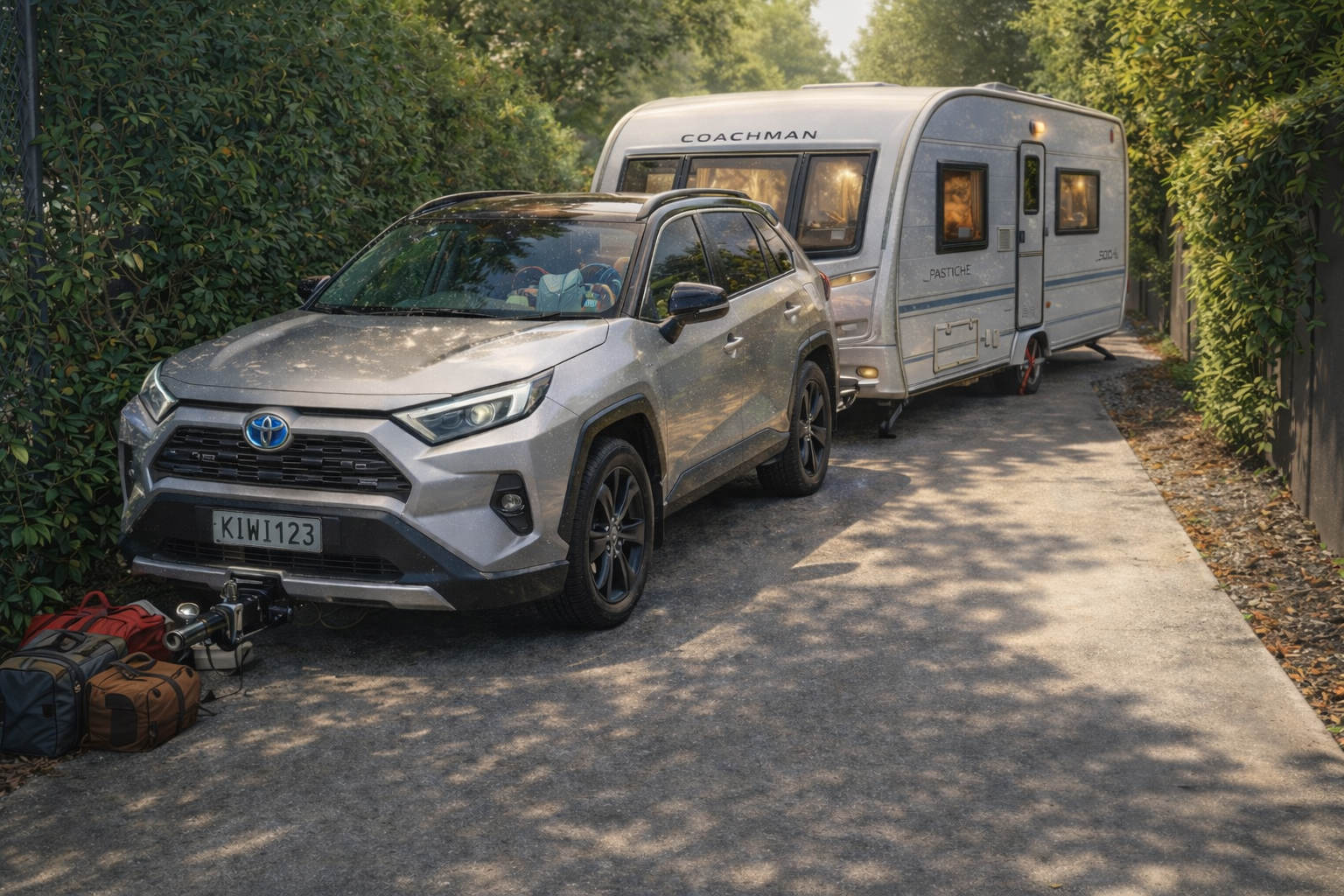
Outside, the silver RAV4 sat in the driveway with the Coachman Pastiche caravan hitched behind it, both of them damp with the kind of South Island morning mist that made everything look as if it had not quite woken up yet.
Inside, everyone else had.
“Who packed six books and no toothpaste?” Mum called from the kitchen.
“I packed toothpaste,” Amber said, offended.
“You packed your toothpaste,” Ivy said, dragging a duffel bag across the floor with both hands. “That glitter one that tastes like bubblegum and regret.”
“It does not taste like regret.”
“It tastes like a unicorn died in a lolly aisle.”
“It tastes like berries.”
Oakley shot through the hallway in one sock and a NASA hoodie, holding a plastic rocket above his head like it was escaping re-entry.
“T-minus nine minutes!” he shouted.
“We are not launching in nine minutes,” Dad said from outside.
“We have to,” Oakley yelled back. “The mission window is closing!”
Dad’s head appeared through the open front door. His hair was already damp. He had a ratchet strap over one shoulder and the expression of a man who had entered battle against luggage and was beginning to understand the enemy.
“The mission window,” he said, “can wait until somebody tells me why there are three pillows in the fridge.”
There was a beat.
Amber blinked. “To keep them cold?”
Mum closed her eyes for one second. Not dramatically. More in the way people do when their soul steps outside for fresh air.
At the bottom of the stairs, Meow Meow sat like a small furry landlord, tail wrapped around her paws, watching the entire disaster with contempt.
From the downstairs door, Auntie Erin rolled out into view with a travel mug in one hand and a permanent expression of highly selective patience.
“I’d like the record to show,” she said, “that I am not surprised by any part of this.”
“You never are,” Mum said.
“That is because I plan for reality, Belinda, instead of whatever this is.”
Dad came back inside, boots squeaking faintly on the floorboards. “This,” he said, “is a family holiday.”
Erin looked past him at the teetering bags, the open pantry, Oakley climbing onto a box marked GAMES, and Ivy trying to zip a bag so stuffed it looked medically unwell.
“No,” Erin said. “This is a hostage situation with snacks.”
That got a laugh out of Mum, which was probably why Erin said things like that. She had a way of throwing a dry little joke into the middle of chaos and making the whole room feel less likely to explode.
Ivy shoved the zipper one last time and won. Barely. She pushed her red hair out of her face and stood up, already too warm in her black hoodie. She had insisted on wearing it because the morning was cold and because it made her feel less like she was being dragged on a family holiday and more like she was choosing to attend one. Those were not the same thing.
She liked holidays. Usually. She liked beaches and camp kitchens and late-night card games and torchlight in caravans when rain hit the roof. She did not like being treated as free labour by every other person in the house simply because she was the oldest and apparently knew where things went.
“Ivy,” Mum said, “can you grab the blue bag from your room?”
“I already did.”
“The other blue bag.”
“There are four other blue bags.”
“The toiletry one.”
“That narrows it down to three.”
Dad picked up a packet of pegs from the bench and pointed it at her. “Attitude.”
“That’s rich coming from the man who tried to pack the wheel chocks in the cereal cupboard.”
Dad looked offended. “That happened once.”
“It happened this morning.”
Oakley was now halfway into the caravan, making spaceship noises.
“Do not touch anything in there,” Dad called.
“Copy that!” Oakley yelled, which in Oakley language meant the opposite.
Mum went to the fridge and started checking things off on her phone. Ivy saw the tiny crease between her eyebrows that meant she was thinking about twelve things at once and pretending she wasn’t stressed about any of them.
Amber came through carrying her sketchbook, a pencil case, a paperback fantasy novel with a cracked spine, and her VR headset case.
“No,” Mum said at once.
Amber stopped. “No to which one?”
“The headset.”
“But there might be rain.”
“There will be beaches.”
“There can be both.”
“There cannot be you tripping over a caravan step because you’re trying to fight digital zombies.”
“They’re not zombies. They’re corrupted moon knights.”
Dad put a hand over his face.
Ivy smirked. “That does sound more educational.”
Amber stuck her tongue out at her, then ruined the effect by hugging the headset case to her chest like a Victorian orphan.
From inside the caravan came a sharp metallic clink, then Oakley’s voice.
“I found treasure!”
Dad dropped his hand. “That sentence has never once led to anything good.”
He went out fast. Ivy followed, because treasure in Oakley’s hands usually became damage in everybody else’s lives.
The caravan smelled faintly of cold upholstery, plastic containers, and the lemon wipes Mum always used before trips. Oakley was kneeling on the floor by the dinette seat with one arm buried in the storage compartment.
“Do not pull random things out of mystery holes,” Dad said.
Oakley looked over his shoulder, grinning. “But I already did.”
He yanked his arm free.
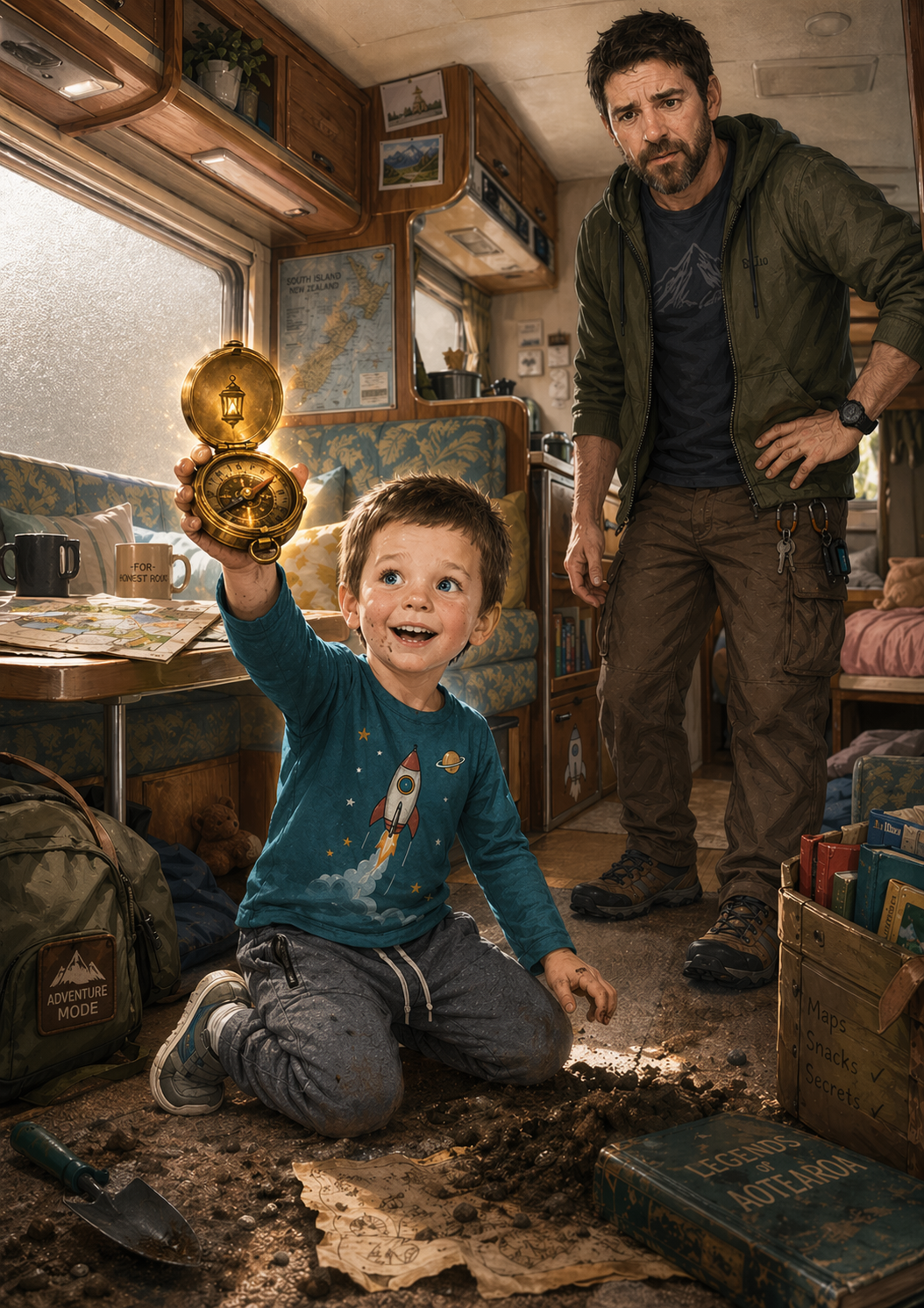
In his hand was a small brass compass.
Not new-brass shiny. Old-brass. Dull in places and rubbed bright in others, with a glass face cloudy around the edges. It was heavier-looking than a normal toy-shop compass and stranger somehow, though Ivy could not have said why at first. Then she saw the lid.
A tiny lantern had been engraved into the metal.
Not printed. Cut in, carefully, with lines so fine they looked like they belonged on something expensive or important or both.
“Huh,” Dad said.
“Treasure,” Oakley repeated, delighted with himself.
Amber leaned in at once. “That’s cool.”
“Let me see,” Ivy said.
Oakley held it above his head. “No. I’m the finder.”
“You’re four.”
“I’m four and a finder.”
Dad took the compass gently before Oakley could drop it into a cereal box or a toilet. He turned it over in his hand. On the back, beneath the lantern symbol, there were words scratched in tiny letters.
He frowned.
“What does it say?” Mum asked from the caravan door.
Dad angled it toward the light. “Bit worn out. Something about… honest?”
Ivy stepped closer. The letters were old-fashioned and cramped, but she could make them out.
FOR THE HONEST ROAD
“That’s not creepy at all,” she said.
“It’s not creepy,” Amber said immediately. “It’s interesting.”
“Those are cousins.”
Dad snapped the lid open. The needle spun hard, flicking once, twice, three times, then settled.
Not north.
Dad checked again, holding it flatter.
The needle pointed sideways. Towards the caravan wall.
“That’s useful,” he said dryly.
“Maybe it’s broken,” Mum said.
“Maybe it’s magic,” Amber said.
“Maybe,” Ivy said, “it came free with a haunted caravan.”
Auntie Erin rolled up to the caravan door and raised an eyebrow. “Now that,” she said, “would be a decent sales angle.”
Dad held the compass out to her. “Ever seen this before?”
Erin took it, and for the briefest moment, something in her face changed.
It was small. So small Ivy might have missed it if she had not been watching. Erin’s joking expression thinned, just for a second, into something sharper. Not fear exactly. Recognition, maybe. Or the shape of a memory she did not want.
Then it was gone.
“No,” Erin said, too casually. “But if your haunted caravan starts demanding sacrifices, use the cheap marshmallows first.”
Mum gave her a look. “Helpful.”
“I’m full of help.”
Erin ran her thumb over the lantern engraving once before handing the compass back. “Keep it,” she said. “Old things like that always turn up for a reason.”
Dad laughed. “That sounds ominous.”
“It was meant to.”
“I nailed it then.”
Ivy looked from Erin to the compass and back again. Auntie Erin was very good at sounding like she was joking when she wanted to avoid a question. That did not mean Ivy knew why. It only meant she noticed.
Dad slid the compass into the shallow tray under the dashboard. “Right,” he said. “No more mystery treasures. We are already late.”
Oakley puffed out his chest. “I found the mission artifact.”
“You found dirt and old receipts first,” Ivy said.
“That was the practice artifact.”
An hour later, against all logic and several laws of physics, they actually left.
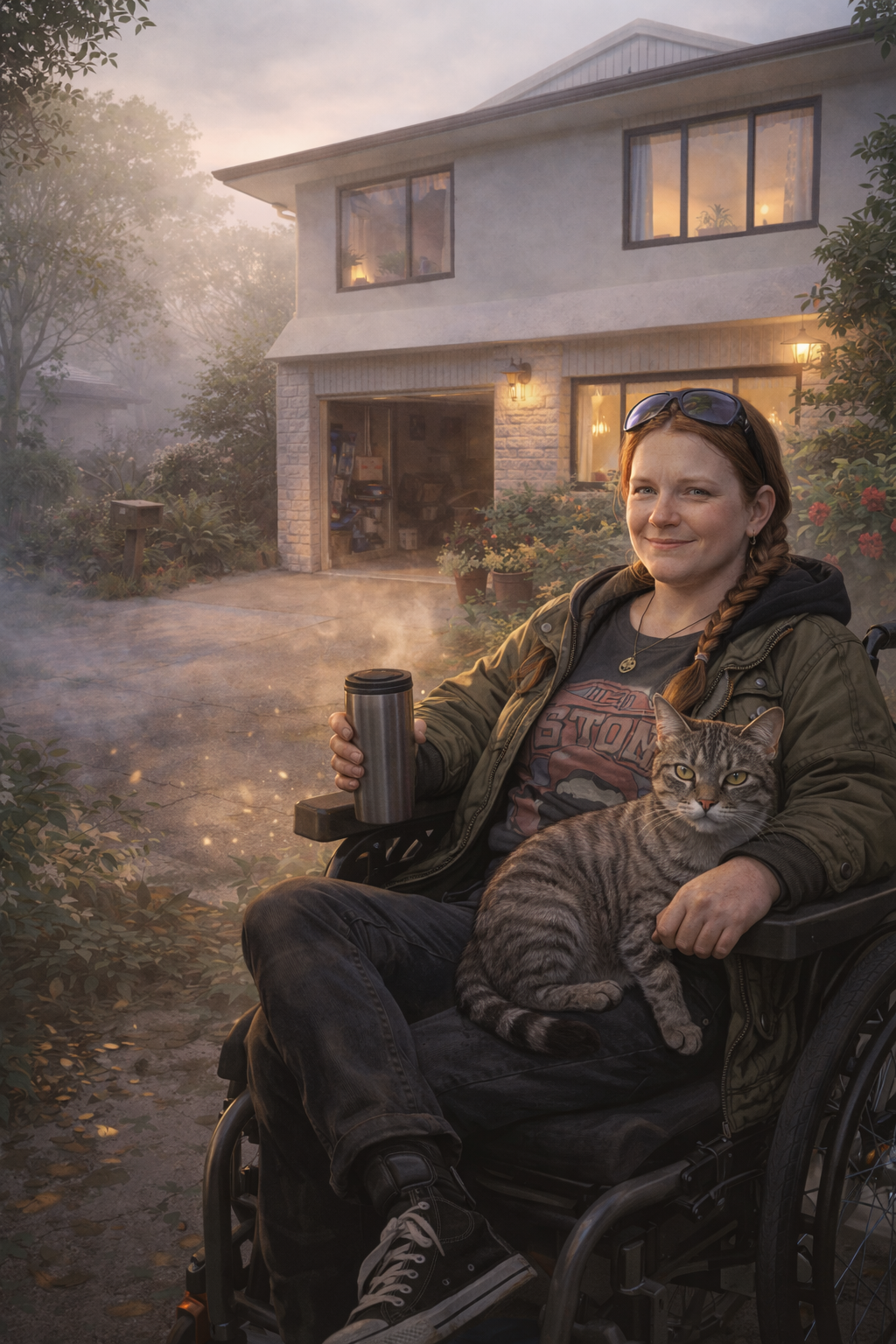
Mum locked the front door. Erin waited under the porch overhang with Meow Meow tucked like a smug scarf in her lap. The cat’s ears were turned back, which probably meant she disapproved of holidays, weather, or people in general.
“Text when you get there,” Erin said.
“We always do,” Mum said.
“You text three hours after you get there.”
“We’re building suspense.”
Erin snorted. Then she looked at Dad. “Check the hitch again after the first stop.”
“I already did.”
“Good. Do it again.”
Dad gave her a salute. “Yes, boss.”
She leaned sideways and looked into the car at the kids. “No summoning ancient evils till after lunch.”
“That’s such a weirdly specific rule,” Ivy said.
“That’s how you know it’s a good one.”
Amber smiled. “Can you send me a photo of Meow Meow if she sits in my room?”
“No. I will send you a photo of Meow Meow judging your room.”
“Same thing.”
Oakley pressed both hands to the window. “Bye, Erin! Bye, Meow Meow! Defend the base!”
Meow Meow blinked once, as if to say she already did everything around here.
Dad eased the RAV4 out of the driveway, caravan following with a soft tugging weight, and the house slipped behind them.
Ivy twisted in her seat for one last look.
Two-storey house. Wet hedges. The porch. Auntie Erin lifting her travel mug in farewell. Meow Meow like a small dark ornament in her lap.
Then they turned the corner, and home was gone.
For a while, the trip was normal in exactly the loud, cramped, slightly sticky way family trips were supposed to be.
Oakley demanded the launch playlist, which meant movie soundtracks and anything with drums. Amber demanded something less “boom boom apocalypse.” Ivy demanded headphones. Mum demanded that nobody open snacks that would instantly coat the car in orange powder. Dad demanded silence for six seconds while he got used to towing.
No one got exactly what they wanted, which was how family democracy worked.
The road unwound north. Houses thinned. Paddocks spread out wet and green under the low cloud. Sheep stood around in groups, chewing with the blank confidence of creatures who had never packed a caravan in their lives.
Amber drew in her sketchbook for a while, her hair bent over the page. Oakley did countdowns for bridges. Dad drove with both hands on the wheel and the serious face he used when trailers were attached to his existence. Mum passed back muesli bars and fruit and reminders to drink water.
Ivy watched the world slide by and tried not to think about the start of school next term, or whether her friends would post things without her while she was away, or whether she had packed the black nail polish she was pretty sure she had packed and now no longer trusted at all.
At Amberley, the compass in the dashboard tray rattled softly.
Ivy looked down.
The tray was flat. Nothing else was moving. But the compass lid had clicked open by itself.
“You see that?” she said.
Dad glanced over for half a second. “Probably the bumps.”
There had not been a bump.
The needle spun once, slow as if thinking, and settled pointing straight ahead.
“Still broken,” Dad said.
Mum turned slightly in her seat. “Maybe put it in the glovebox if it’s going to slide around.”
Amber craned forward. “No, leave it. I want to watch.”
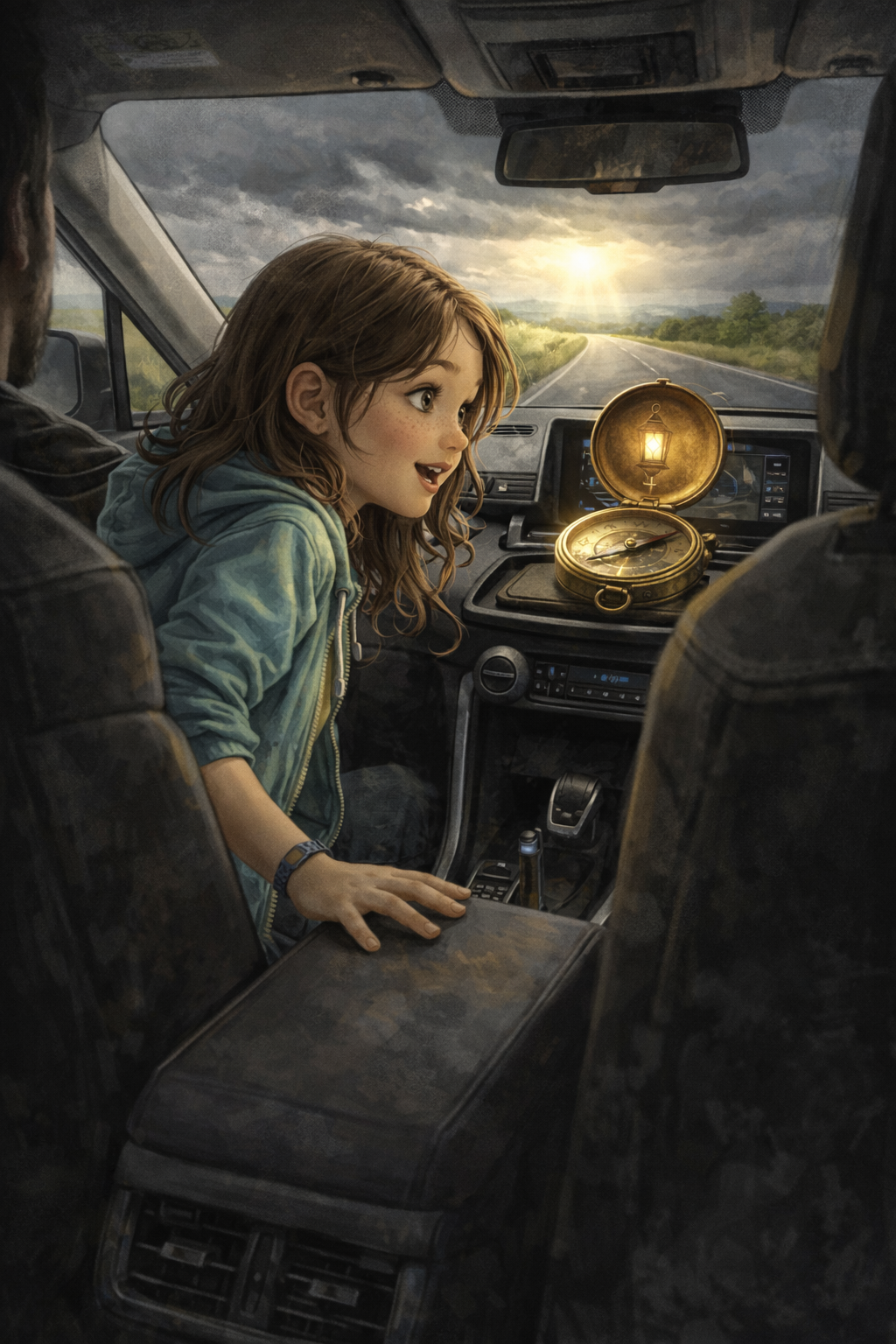
“It’s a compass,” Ivy said. “Not a livestream.”
Amber ignored her. “Maybe it only works in certain places.”
“Sure,” Ivy said. “Maybe it’s waiting for a side quest.”
Oakley gasped. “I want a side quest.”
“You are a side quest,” Ivy muttered.
They stopped late morning at a roadside pull-over with toilets, a picnic table, and a view over damp fields toward the sea. The wind smelled cold and salty. Dad crouched to check the hitch because Erin had told him to, which meant he was definitely going to pretend it was his own excellent idea.
Mum poured tea from a thermos into a cup and stood with her shoulders tucked up against the breeze.
Amber found a line of snails along the concrete edge and tried to name them.
Oakley held his rocket into the wind and shouted, “Crosswinds! Crosswinds!”
Ivy wandered a little way to the signboard near the fence. Local walks. Tide times. The usual stuff.
Except one of the laminated maps had been drawn on.
Not with vandal-scribble. With a thin red line, neat as if it belonged there.
The line began at a point marked YOU ARE HERE and slipped off the printed road entirely, curving through blank green space toward a tiny symbol Ivy did not recognise. It looked like a lantern.
She frowned. “Mum?”
Mum came over, cup warming her hands. “What is it?”
“There.” Ivy pointed.
Mum followed her finger. “A lantern?”
“So you can see it too.”
Mum gave her a look. “That’s a strong opening line.”
Ivy leaned closer. Beneath the little lantern, in writing so faint it might have been old or might have just been damp, were the words:
safe if welcomed
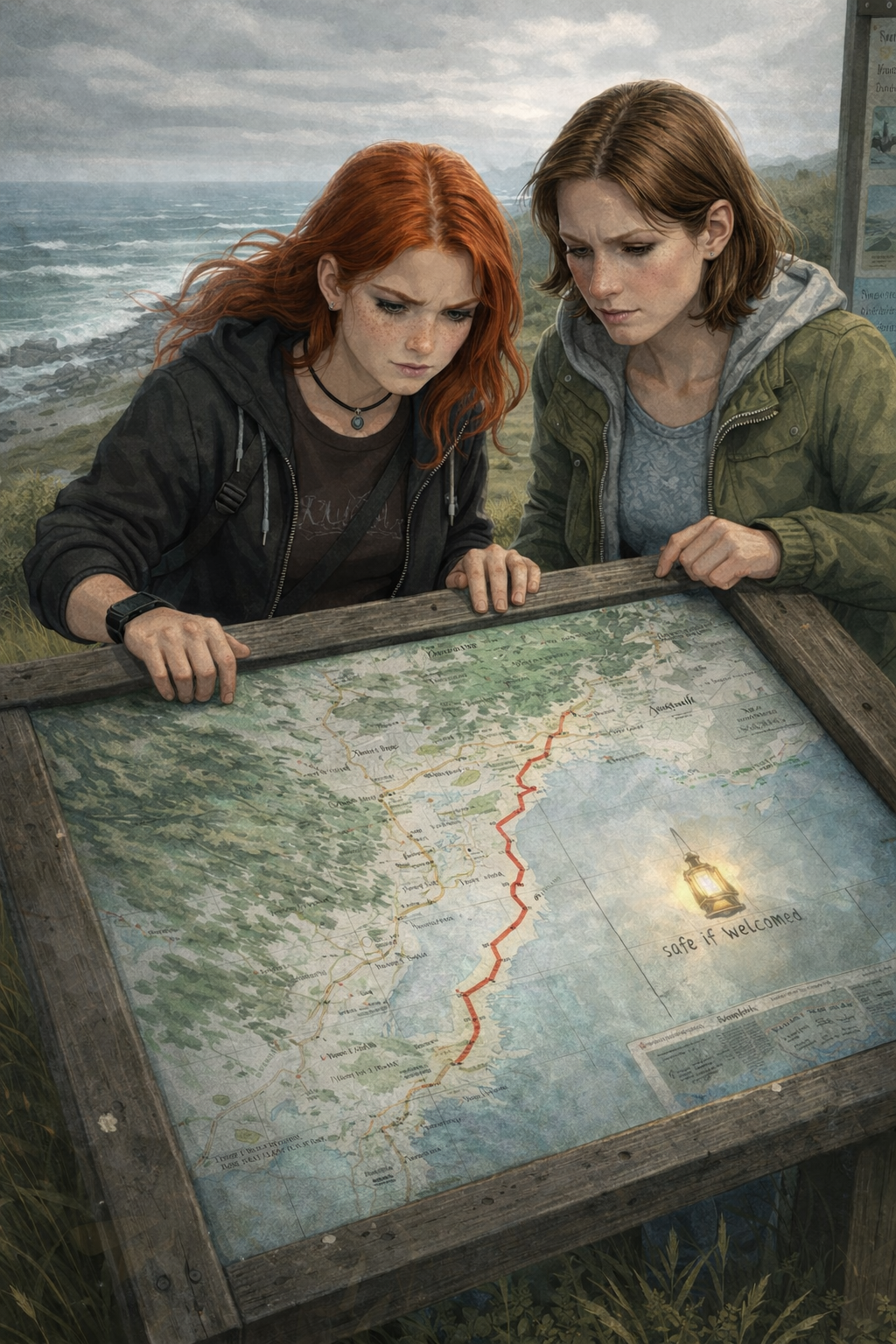
She felt a little prickling rise on the back of her neck.
“That wasn’t there before,” Mum said quietly.
“You remember this exact random roadside map?”
“No. But I’d remember that.”
Dad straightened by the car. “Everything all right?”
Mum looked at the signboard, then at him. For a second Ivy thought she might tell him.
Instead she said, “Fine. Someone’s drawn on the map.”
Dad came over, squinted, and shrugged. “Kids with pens.”
Ivy almost said, Then why does it look older than the sign? But she didn’t. Dad was good at practical things. That also meant he was extremely talented at not seeing weird ones when the weird ones were inconvenient.
Mum touched the edge of the signboard. “Maybe.”
When they got back in the car, Ivy looked at her. Mum had that same tiny crease between her eyebrows again.
She had seen it too. Good. That was either reassuring or worse.
Past Waipara, the weather changed.
Not in a dramatic movie way. No thunder cracking the sky open. No green clouds of doom. It just shifted oddly, as if invisible curtains were being pulled along the road.
One minute the car windscreen was dotted with mist. The next, the road ahead was bright and dry for a stretch maybe fifty metres long, sunlight pouring over it while the paddocks on either side stayed under dull grey cloud. Then the brightness was gone again.
Dad noticed that one. “That’s weird.”
“Hot patch?” Amber offered.
“In winter?” Ivy said.
“It’s autumn,” Mum said automatically.
“It feels like winter.”
Oakley pressed his face to the window. “The road is doing camouflage.”
Nobody answered that, which probably meant everyone was thinking about it.
The radio fizzed.
Dad slapped the dash. “Not now.”
Static whispered in and out. Music returned. Then, beneath the music and too brief to catch properly, a voice murmured something that sounded almost like words.
Mum turned the volume down. “Did anyone hear that?”
“Hear what?” Dad said.
Ivy had. She was almost sure she had.
Not the words. Just the tone. Like someone speaking from another room.
Amber looked up from her drawing. “It said keep left.”
Oakley nodded solemnly. “The car knows the rules.”
Dad gave a short laugh that did not sound very amused. “Let’s all agree not to take directions from haunted electronics.”
They reached the holiday park later than planned, which was also normal. A queue of caravans had built up near the entrance, everybody inching in while gulls wheeled overhead and the wind blew wrappers along the fence. The sign out front read Kōwhai Coast Holiday Park in cheerful painted letters, with a little cartoon sun wearing sunglasses.
Ordinary. Entirely ordinary.
Good.
The office was warm and smelled like photocopy paper and instant coffee. A tired teenager handed Dad a laminated site map and a key to the amenities block even though the toilets clearly did not require keys. Mum paid. Oakley tried to take a free brochure about crayfish tours. Amber found a bowl of complimentary lollies and was told she could have one. She took exactly one and looked as if this was a personal attack.
Back outside, Dad unfolded the site map on the bonnet.
“We’re on sixteen,” he said. “Easy.”
It was not easy.
Backing a caravan into place in front of your own family was apparently a specialised sport designed to test marriages. Mum stood at the side doing hand signals. Dad looked in the mirrors and said, “I can’t see what that means.” Mum said, “It means left.” Dad said, “My left or your left?” Mum said, “The caravan’s left.” Dad said, “That is not a real answer.”
Ivy and Amber stayed out of the way on purpose, which was one of Ivy’s finer talents.
Oakley ran circles around the picnic table making engine noises until Ivy caught him by the hood and parked him on a camp chair with a packet of raisins.
Eventually the van was in. The stabilisers were down. The awning was half-out. The power was connected after Dad tried the wrong socket first. Dinner became pies heated in the caravan oven because everyone was too tired to attempt anything pretending to be healthy.
Rain tapped the roof while they ate.
It should have been cozy. In some ways it was. Amber tucked her feet up beneath her. Oakley fell asleep mid-sentence with pie flakes on his hoodie. Dad looked exhausted in the way only dads at the end of towing days could look. Mum laughed quietly when Amber accidentally got gravy on her own nose.
But Ivy could not stop thinking about the red line on the roadside map. Or the bright patch of road. Or the compass, which Dad had set on the little shelf by the window and forgotten.
Its lid was open again.
She stared at it while Mum brushed Oakley’s hair back from his forehead.
The needle was moving.
Not spinning wildly. Turning slowly, like a hand deciding which door to knock on.
It pointed through the caravan wall.
Toward the empty grass on the far side of their site.
“I’m just going to the bathroom,” Ivy said.
Mum nodded. “Take your torch.”
“I don’t need—”
“Take your torch.”
Ivy took her torch.
Outside, the rain had thinned to mist. The holiday park was all little sounds and glows — distant taps clinking in the amenities block, a TV murmuring in someone else’s van, wet gravel underfoot, the warm yellow squares of caravan windows. The air smelled like damp grass and sea salt and somebody’s sausages from earlier.
She crossed past the picnic table and stood at the edge of their site.
Beyond it was a narrow stretch of grass, then another row of caravans.
No.
Not another row.
Just one.
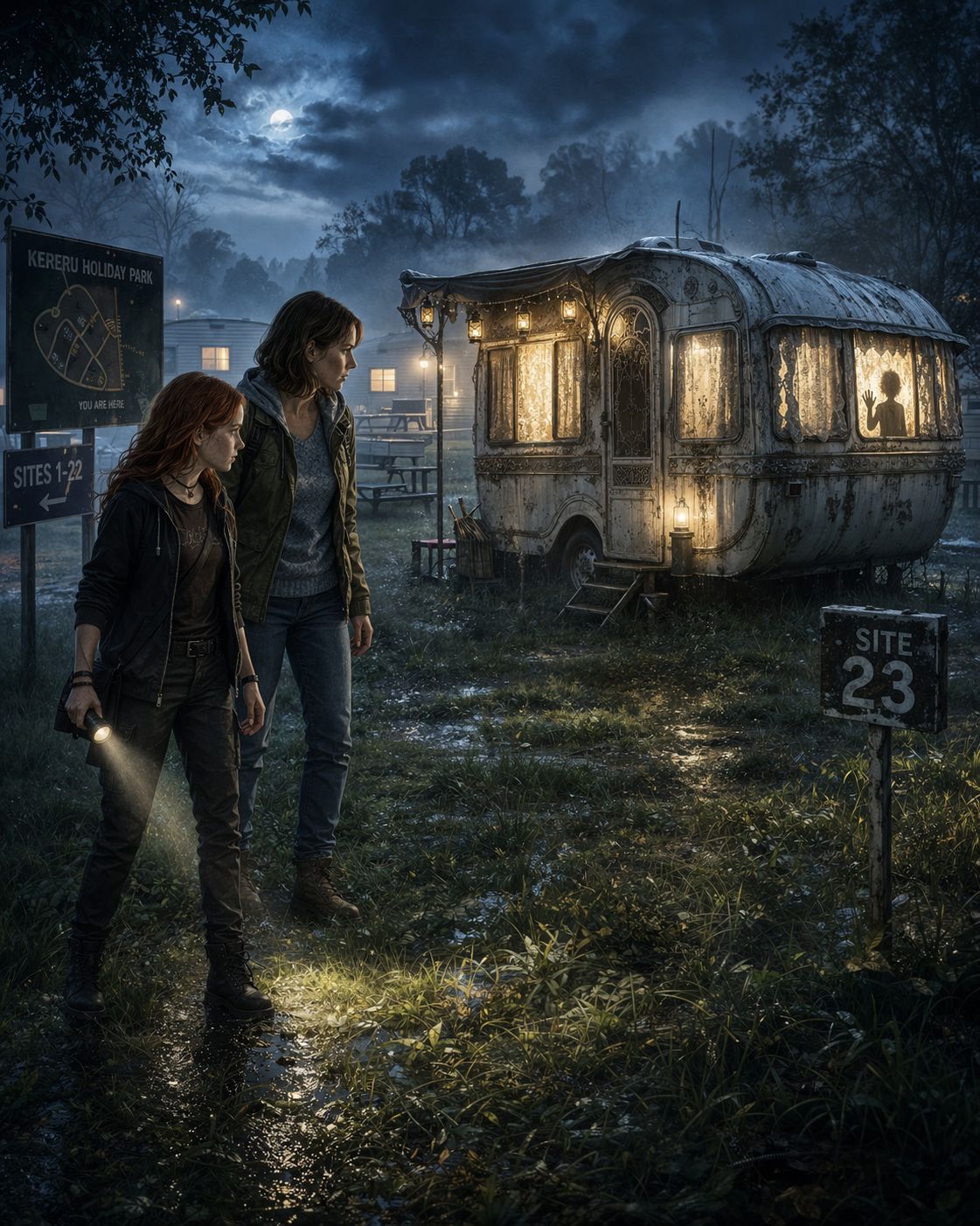
One caravan sat out on the dark grass where there had not been a site when they arrived.
Ivy stopped breathing for a second.
It was old-fashioned, smaller than theirs, with rounded corners and cream paint that looked almost silver under the mist. Soft light glowed behind lace curtains. A string of tiny lantern-shaped bulbs hung along its awning, though there was no power pole anywhere near it.
She turned back sharply and looked at the holiday park map in her hand. Dad had shoved it at her earlier when he was hunting for levelling blocks.
Sixteen. Seventeen. Eighteen.
There should have been a path across the grass.
No site.
She looked up again.
The caravan was still there.
A shape moved behind one of the curtains.
A child-sized shape.
Ivy’s fingers tightened on the torch.
A hand lifted slowly on the other side of the glass.
Waving.
The torch nearly slipped from her hand.
“Ivy?” Mum called softly from behind her. “You okay?”
Ivy did not turn around.
She kept staring at the impossible caravan lit in the mist, at the tiny lantern bulbs, at the small shadow in the window.
Then, very quietly, because suddenly she did not want whatever was in there to hear her unless it had to, she said:
“Mum… our map is missing a site.”