Chapter 6 - The One Who Mends
The stitched strip looked less impressive once it was inside the car.
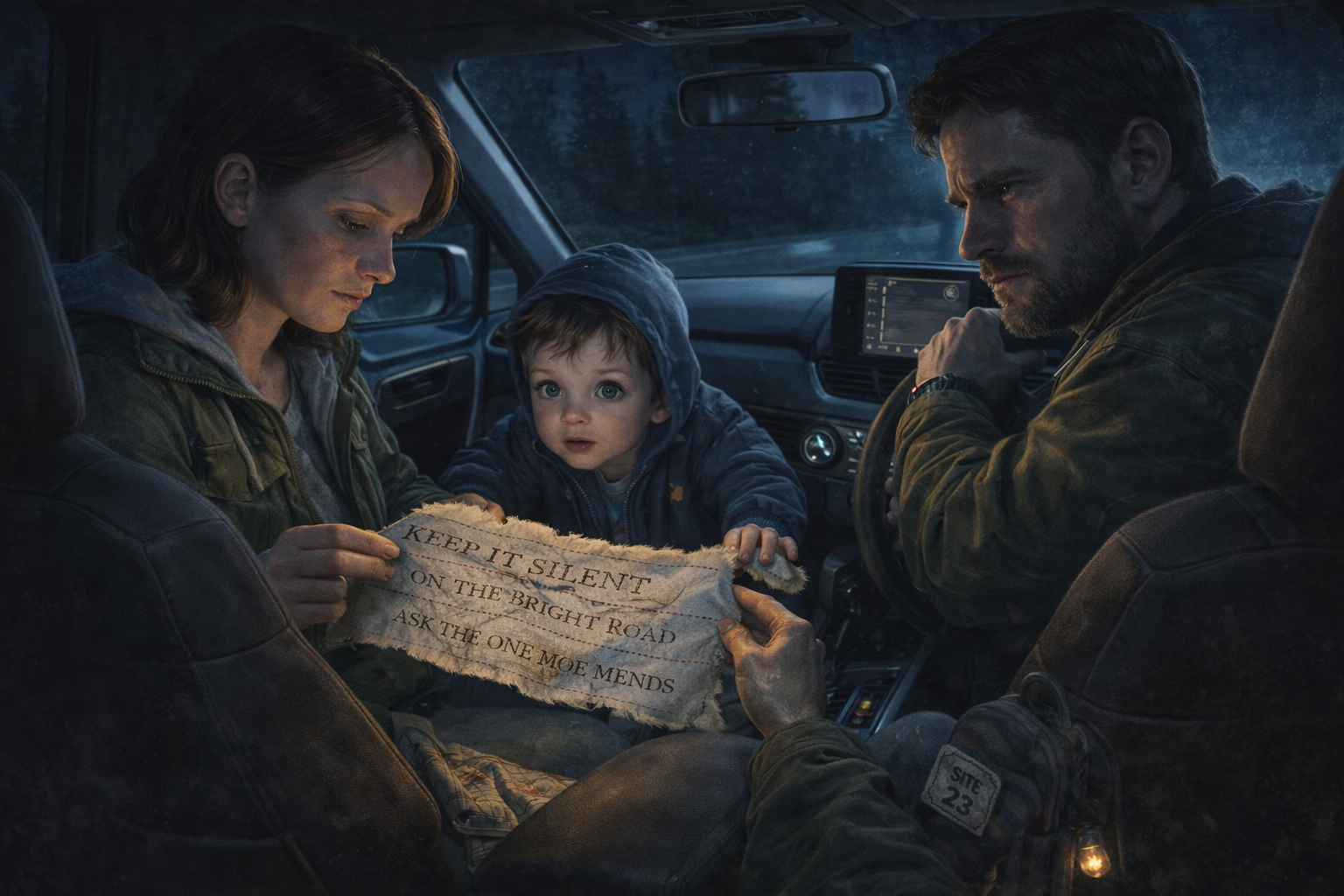
Out in the pine clearing it had felt important enough to change the air. Back at the roadside pull-over it was just a torn piece of old cloth in Mum’s hands, lit by dashboard glow and the occasional sweep of passing headlights. A frayed edge. Faded thread. A smell of damp leaves and old dust.
And yet Dad kept glancing at it as if it might lunge.
“No one,” he said for what was probably the fourth time, “is going back in there tonight.”
He had both hands on the steering wheel even though the RAV4 was parked. That was never a great sign.
Nobody argued straight away. The surf down below kept rolling in and out, but after the silence inside the pines it sounded wrong too—too loud, too ordinary, too determined to pretend everything had not just happened.
Mum smoothed the cloth against her knee. The stitched lantern caught the dashboard light. So did the words.
KEEP IT SILENT.
NOT THE BRIGHT ROAD.
ASK THE ONE WHO MENDS.
Amber leaned between the front seats. “It still feels warm.”
“It’s cloth,” Dad said.
“It’s weird cloth,” Ivy muttered from the back.
“That is not better.”
Oakley was half sideways in his seat, pyjama socks on, hoodie twisted up under one arm, staring hard at the strip with the intense concentration he usually reserved for space documentaries and the possibility of biscuits. “Toast Boy knew.”
Dad closed his eyes for one long second. “We are not calling him Toast Boy.”
“He lives in Toast Caravan.”
“He lived in Site Twenty-Three,” Ivy said automatically.
Oakley shrugged. “Toast.”
Amber would normally have argued for accuracy on behalf of the mysterious missing boy, but she was too busy watching the cloth. “He did know,” she said quietly. “He pointed you away from the lights.”
Ivy didn’t answer. She kept looking out the window toward the black shape of the pines across the road, where the gap had vanished again. Ordinary trees. Ordinary dark. Nothing to prove they had just towed a caravan into a hidden road and back out again except the fact that the strip existed and all of them looked slightly wrecked.
Mum folded the cloth carefully, not hiding the words, just making it smaller. “We need Erin.”
Dad gave a short humorless laugh. “You think?”
“She’ll know what kind of stitch this is.”
“She’ll know what kind of anything this is,” Ivy said.
That made Dad look at her in the rear-view mirror. She was pale under the car’s dim light, and trying hard not to look it. Her red hair had gone wild in the sea wind. There was sand still on one sleeve. She had the Site 23 tag looped tight around her fingers, almost hidden in her fist.
Dad’s voice softened a fraction. “You all right?”
“Yep.”
It was a terrible lie. Not because she was falling apart. Ivy never did anything as helpful as falling apart cleanly. It was because the answer came too fast, like she had thrown it up as a barrier and hoped no one would inspect it closely.
Mum did inspect it closely. Of course she did. But she only said, “Let’s get off this road first.”
That got everyone moving again. Dad started the engine. Gravel crackled under the tyres. Nobody looked left as they pulled out, but the pines sat there anyway, patient and black and uninterested in being caught looking magical.
They drove in silence for nearly ten minutes.
Then the phone buzzed.
Dad hit speaker. “Please tell me you’re still awake.”
“Justin,” said Auntie Erin dryly, “you rang me an hour ago to tell me your holiday had developed secret campgrounds, predatory etiquette, and a morally suspicious dairy. Obviously I am not asleep.”
Some tension leaked out of the car at that.
Even Dad almost smiled. “Fair.”
Her voice changed slightly. Sharper now. “What happened?”
Mum gave the short version first because she was good at short versions when everyone else was full of too much. The beach. The pines. The bell that did not ring properly. The hidden track. The clearing. The bright road they had not taken. The cloth.
When she said the last line—“It says ask the one who mends”—there was a pause so clear that even Oakley noticed it.
“Aha,” he said to no one. “Mission clue.”
“Can you send me a photo?” Erin asked.
“We’re driving.”
“Then don’t. I’m very fond of all of you remaining un-crashed. Stop somewhere with decent light and send me front and back.”
“There is no back,” Ivy said. “Just threads.”
“There’s always a back,” said Erin.
Mum looked at the cloth again. “That sounds ominous.”
“That is because sewing is mostly structured optimism in the face of fraying disaster.”
Amber made a small approving sound. To her, that counted as a terrific sentence.
Dad turned inland at the next junction, following a sign for a holiday park in a town small enough to have one dairy, one fish-and-chip shop, and a playground that probably looked cheerful in daylight. Right now it was all sodium streetlights and closed windows and damp footpaths.
“Erin,” Mum said, “what is it?”
Another pause. Not uncertainty this time. Memory.
“I know that lantern stitch,” Erin said. “Or something very close to it. I haven’t seen it in years, but I know it. Send me the photo the second you stop.”
Dad’s hands tightened again on the wheel. “From where?”
“I’d rather not do this while you’re still driving.”
“That bad?”
“That old.”
No one said much after that.
The holiday park turned out to be exactly the kind Dad wanted after a night like this: ordinary to the point of insult. A fluorescent office. A sleepy manager in a puffer jacket. A row of static caravans. A washing line clacking in the breeze. Two bored teenagers wandering back from the ablutions block with packets of chips. Nothing missing. Nothing hidden. No extra sites appearing in the dark. Dad visibly approved of all of it.
He reversed them into place with grim, professional concentration.
By the time the struts were down and the caravan door was shut, the children had gone rubbery with tiredness. Not sleepy, exactly. More stretched thin.
Mum got the kettle on. Dad checked the lock twice, then pretended he had only ever meant to check it once. Amber took off one shoe and forgot to do the other. Oakley lay face-down on the seat for ten dramatic seconds, then popped back up and demanded a biscuit because near-death was hard work.
Ivy stood at the window over the little table and stared out at the harmless gravel lane between caravans as if daring it to turn weird.
Mum took the photo.
Then she took another.
Then, remembering Erin, she turned the strip over.
The back was all knots, crossed threads, and a ragged run where something had been pulled loose. Messier than the front. Less meaningful at first glance.
And then less meaningless the longer you looked.
“Justin,” Mum said.
Dad came over, tea towel still in one hand.
“What?”
She held up the phone. The back of the cloth wasn’t random. There was a second pattern there, half hidden in the crossings of thread: lines angling away from the stitched lantern. Tiny marks at intervals. One thicker knot where the bell on the front would have been. It was not pretty, but it was deliberate.
“See?” she said.
Dad squinted. “I see sewing’s revenge.”
“That’s a map,” Ivy said at once.
Mum sent both photos.
The reply from Erin came before the phone had properly settled on the table.
Video. Now.
Dad looked at the message. “That is not ideal wording.”
Mum already had the call open.
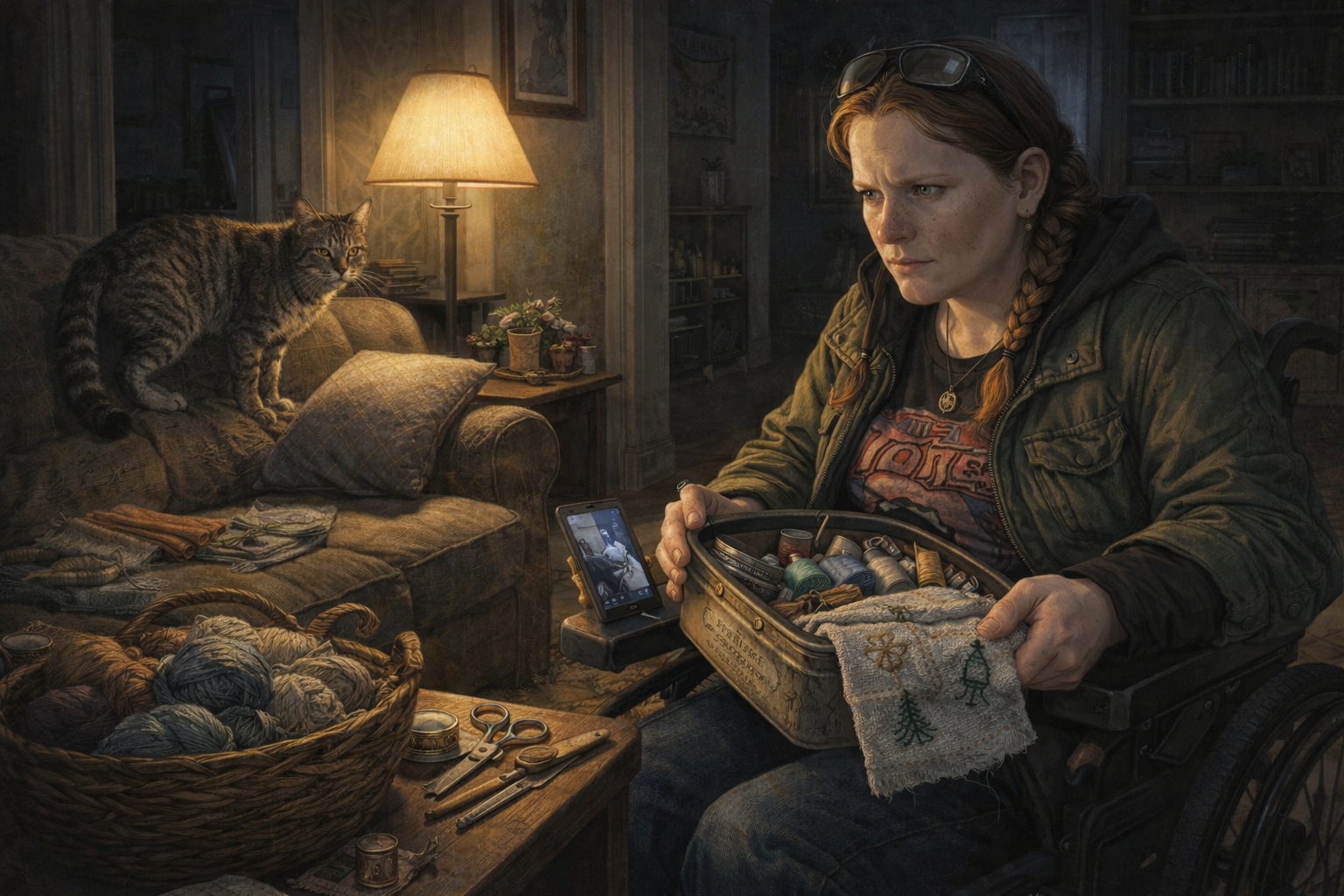
Erin answered from downstairs at home, framed by lamplight, shelves, and approximately a million baskets of craft materials. Meow Meow was on the back of the sofa behind her, turned toward the stairs instead of toward the room. His fur looked wrong. Not puffed in a cartoon way. Tight. Alert.
Erin didn’t waste time.
“Show me the front again.”
Mum held it up. Erin leaned closer to her screen. Her face had gone very still.
“Right,” she said softly. “Well. That is deeply inconvenient.”
Dad folded his arms. “We’re all enjoying the clarity.”
“It’s a route-strip.”
The kids looked at each other.
“A what?” Amber asked.
Erin pointed somewhere offscreen, probably at one of her own thoughts. “Not decorative embroidery. Not a sampler. Not just instructions. A route-strip. The old roads used thread as well as signs, because thread survives in different ways. Metal gets buried. Paint gets scratched off. Bells get cracked. Cloth can be hidden inside hems and quilts and cushion covers and nobody notices until they need to.”
Mum’s eyes flicked up. “You know this like you already knew it.”
“I know it like Granny owned things I was told not to touch.”
That landed.
Even Dad lost some of his impatience. “Granny?”
“Yes, Granny.” Erin reached down beside her chair and hauled up a flat tin so old the painted roses on the lid had almost disappeared. “When I was about Amber’s age I found this under her spare-bed linen. She told me it was mending supplies. It was not mending supplies in the normal sense unless your normal sewing projects include hidden symbols and enough rules to ruin a child’s afternoon.”
She opened the tin. Inside were folded cloths, paper packets, cards wound with thread, and one small brass thimble with a lantern stamped into its side.
Nobody in the caravan spoke.
Oakley climbed up onto the seat for a better look and breathed, “Treasure sewing.”
“Yes,” Erin said. “Sadly.”
She set the tin on her lap and dug until she found a folded square of cream fabric. When she opened it, a stitched lantern appeared in one corner, then a pine bough, then a line of small crossing marks that looked decorative until they didn’t.
It was not identical to the family’s strip.
It was close enough to make Mum go cold.
“Granny had that?” she asked.
Erin nodded once. “And she had stories. Never the full thing at once. Just bits. Warnings, mostly. The sort adults say while pretending they’re only being quaint.”
Dad had gone very still in the way he did when something serious hit before he was ready to react to it. “Why didn’t you tell me?”
Erin gave him a look. “Because for years it sounded insane, Justin. Also because every time I tried to bring up one of Granny’s weird road sayings you acted as if all folklore existed purely to annoy you personally.”
“That is not fair.”
“It is a bit fair.”
It was, unfortunately, a bit fair.
Amber leaned toward the screen. “What did she say?”
Erin ran a thumb over the old square in her lap. “That some roads stay honest because somebody keeps mending them. Markers. cloths. promises. names. That if the mending stops, the roads go hungry.”
No one in the caravan moved.
The silence that followed was not empty. It was full of the pines. Full of Site 23. Full of numbers being scraped away and letters vanishing from signs while the family watched.
Dad was the first to speak. “You could have led with that.”
“I am leading with it now.”
“You recognize the phrase?”
“I recognize the idea.” Erin looked at the strip again. “Ask the one who mends isn’t telling you to fix it yourselves. It means you’ve hit damage beyond ordinary traveler rules. It means the road is fraying.”
Oakley lifted a hand. “Bad road chewing.”
Erin pointed at the screen. “Exactly that, yes. Disturbingly.”
Ivy had barely blinked this whole time. “So who’s the one who mends?”
Erin didn’t answer immediately.
That was answer enough to make everyone in the caravan sit up straighter.
Mum saw it first. “You do know.”
“I know one name,” Erin said. “Or a title. Maybe both.”
Dad’s laugh was short and exhausted. “Marvelous. Naturally there’s a title.”
Erin ignored him. “Granny used to say that when a marker went missing or a cloth came back torn, you didn’t follow the bright road, you didn’t ring what wanted ringing, and you went looking for the Mender.”
Amber whispered the word as if testing it.
“The Mender?” Ivy said.
Erin nodded. “Sometimes just that. Sometimes…” She hesitated. “Sometimes Ben Jammin.”
Oakley sat bolt upright. “That is a real name?”
“Almost certainly not his first one,” Erin said. “But yes.”
Dad stared at the screen. “Ben Jammin.”
“I did not invent it.”
“It sounds invented.”
“It sounds deeply invented,” Erin agreed. “That does not appear to have stopped it being useful.”
There was a beat in which everyone in the caravan tried, and failed, to picture an ancient magical road-mender called Ben Jammin without it sounding ridiculous.
Amber got there first. “Was he a person?”
Erin tipped one hand. “That depends how strict you’re being.”
“Oh, good,” Dad muttered.
Mum was still fixed on the old square in Erin’s lap. “What else did Granny say?”
“That menders don’t usually come when roads are neat. Only when something’s gone wrong enough to ask properly.” Erin reached back into the tin and found a second object: a narrow paper envelope brittle with age. “And that if you ever find thread-maps in pine country, keep away from lights that look too pleased with themselves.”
Ivy let out a breath that was almost a laugh. “Okay. That tracks.”
“Can you read the back of your strip to me?” Erin asked. “Not the words. The crossings.”
Mum moved the phone closer. Ivy came around beside her at once. Amber crowded in on the other side. Dad hovered despite every instinct telling him not to get physically involved in thread analysis. Oakley somehow appeared underneath everyone’s elbows.
For a minute the caravan became very quiet except for kettle ticks and the muffled noise of someone laughing somewhere outside near the camp kitchen.
“Rotate it left,” Erin said.
Mum did.
“No, your other left.”
Dad said, “This is why magic systems fail audits.”
“Shush.”
Mum turned it again.
Erin leaned closer, then reached offscreen for a pencil. “Right. Those aren’t decorative crossings. They’re joins. The front gives the rule. The back gives the approach.”
“Approach to what?” Ivy said.
“The mender, I think.”
Meow Meow moved on the sofa behind her.
Not a normal move. He got to his feet all at once, spine low, ears flat, eyes fixed on the dark of the stairwell door beyond the room.
Erin half-turned. “Oh, don’t start.”
He made a sound then—low, rusty, furious.
Everyone in the caravan froze.
Dad said, “Erin.”
“I know.”
Something clicked softly from the hall.
Not loud. Not dramatic. Just a tiny hard sound, like one object touching another.
Meow Meow launched off the sofa.
The screen jolted as Erin grabbed her chair wheels and shoved backward, turning faster than looked possible in the small room. The phone image swung wild—bookshelf, lamp, wall, then the doorway to the hall.
Nothing stood there.
Nothing anyone could point at and say there.
But hanging on the inside hall peg was a length of old cream cloth the family had not been shown before, and one stitched corner was unravelling by itself.
Thread slid loose in the air.
Amber made a frightened sound.
Erin reached the peg and snatched the cloth down. “No, you don’t.”
The unravelling stopped.
Meow Meow remained fixed on the doorway, tail blown double.
Nobody in the caravan spoke until Erin wheeled back into frame with the cloth in her lap and a face that had lost any remaining interest in pretending this was manageable.
“Well,” Dad said at last. “That’s appalling.”
“Yes,” Erin said. “Thanks.”
“What was that?”
“I don’t know.”
“You absolutely know a category.”
Erin looked at the cloth she had rescued. “I know it likes edges. Names. numbers. joined things. Same as the rest of this mess.”
Mum’s voice stayed very calm, which was never good. “Is home safe?”
Erin met her eyes through the screen. “At the moment? Safe enough. But whatever’s chewing through the roads isn’t staying politely out there anymore.”
That dropped into the caravan harder than anything else.
Home had always sat at the edge of the mystery. A hiss near the stairs. Meow Meow going mad during a phone call. Strange enough to be worrying. Distant enough to be survived.
Not anymore.
Ivy was the first to recover. “What cloth is that?”
Erin looked down. Her expression changed again. Not softer. Older.
“It was Granny’s,” she said. “I forgot I had it.”
It was a longer piece than the square from the tin, yellowed with age and folded so many times the creases had nearly become seams. Erin opened it carefully. The front showed stitched bells in a line, then pines, then a tiny lantern worked in metallic thread so worn it was nearly brown.
Across the bottom, in neat small lettering, were words half hidden by age.
BRIGHT ROADS RING FOR ANYONE.
HONEST ONES WAIT TO BE ASKED.
Dad actually sat down.
“Right,” he said faintly. “Right. Great.”
Ivy’s eyes had gone bright in the way they did when fear and answer-hunger collided. “That’s about the pines.”
“It’s about more than the pines,” Erin said. “But yes. And look here.”
She turned the old cloth over.
On the back, among the crossings and knots, was one extra symbol stitched in green-black thread near the edge.
Not a lantern.
Not a bell.
A little shape with a curved neck and a round body.
Amber frowned. “Is that—”
“A guitar?” Mum said.
Erin nodded.
Oakley slapped both hands onto the table. “Banjo wizard!”
That broke the tension just enough for everyone to breathe.
Dad rubbed both hands over his face. “Please do not let ‘banjo wizard’ become the official term.”
“No promises,” said Ivy.
For the first time in ten minutes, Erin almost smiled. “Granny said if the road ever gives you thread and tells you to ask the one who mends, you look for the green-string mark. It means he’s nearby. Or was.”
“Nearby where?” Mum asked.
“That part,” Erin said, “I think you’re going to hate.”
She reached for the family’s screenshots on her device, enlarged the back of their torn strip, and compared it to the old bell cloth in her lap. Her pencil moved fast over a scrap of paper just out of frame.
“Those join marks on your strip? They’re not only an approach. They’re a warning path. They turn away from the bright road and loop round behind it.” She glanced up. “Justin. Get Tane’s map.”
Dad gave her a look. “You enjoy issuing orders more every hour.”
“Yes. Map.”
He got it.
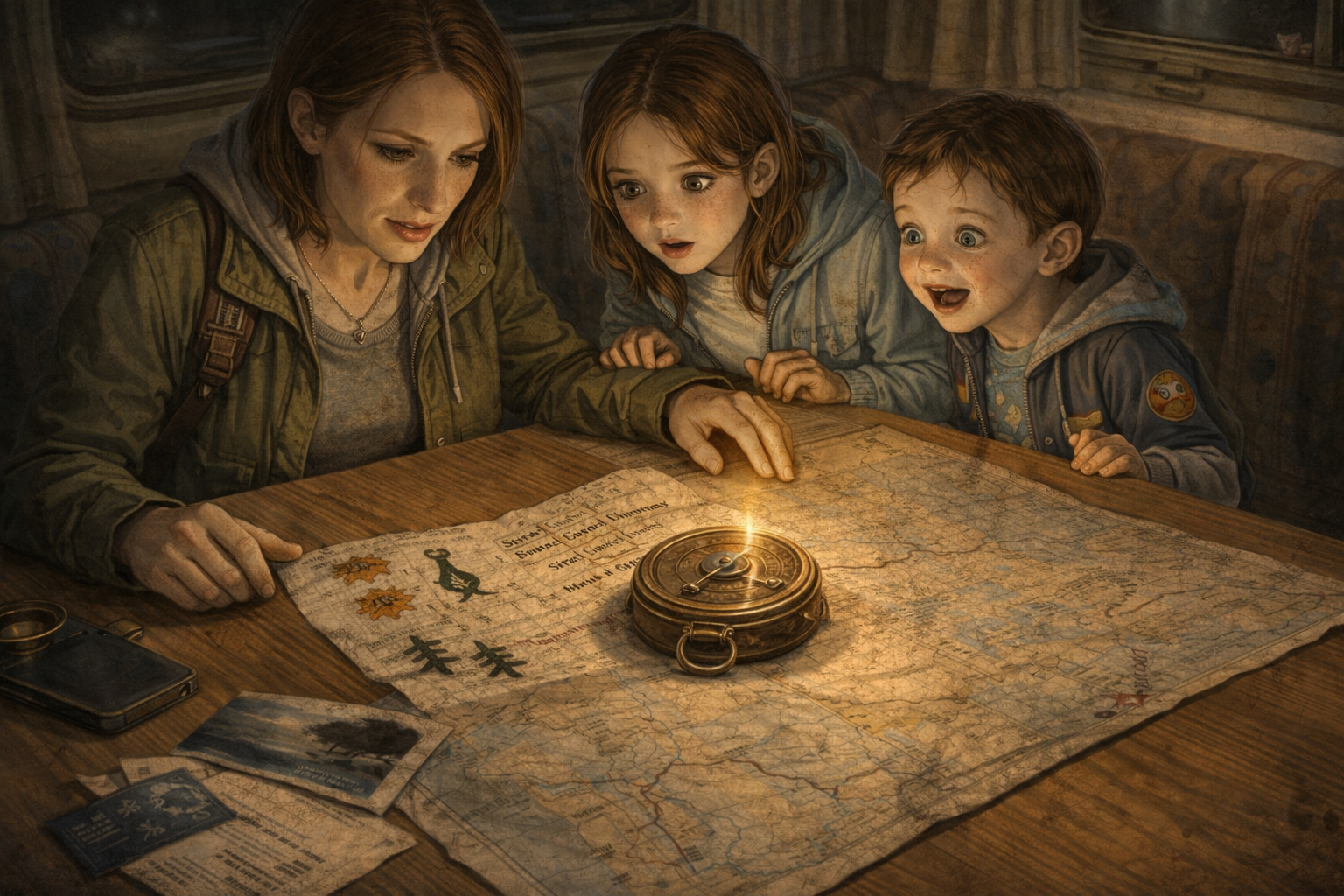
Mum laid it flat on the table. The black-sand postcard. The dairy receipt. The torn strip. The Site 23 tag. The Lantern Compass. All of it ended up there together, a little travelling pile of evidence and bad decisions.
“Put the tag near the top edge,” Erin said.
Ivy did.
“Now the strip. Back side up. Rotate until the thick knot sits over the red bend in the line.”
Mum and Ivy did that together, their heads nearly touching.
For half a second nothing happened.
Then the Compass needle twitched.
Amber sucked in a breath.
A fine line, no thicker than thread, appeared on the map beneath the torn strip. It did not glow. It darkened, like damp coming through paper. It curved away from the route they already knew and bent around an unmarked patch of green.
New words came up slowly enough to read.
NO BELLS.
NO BARGAINS.
MENDER OFF THE FAIR ROAD.
“Fair road,” Ivy said.
“The carnival,” Amber whispered.
Even Dad did not argue that this time.
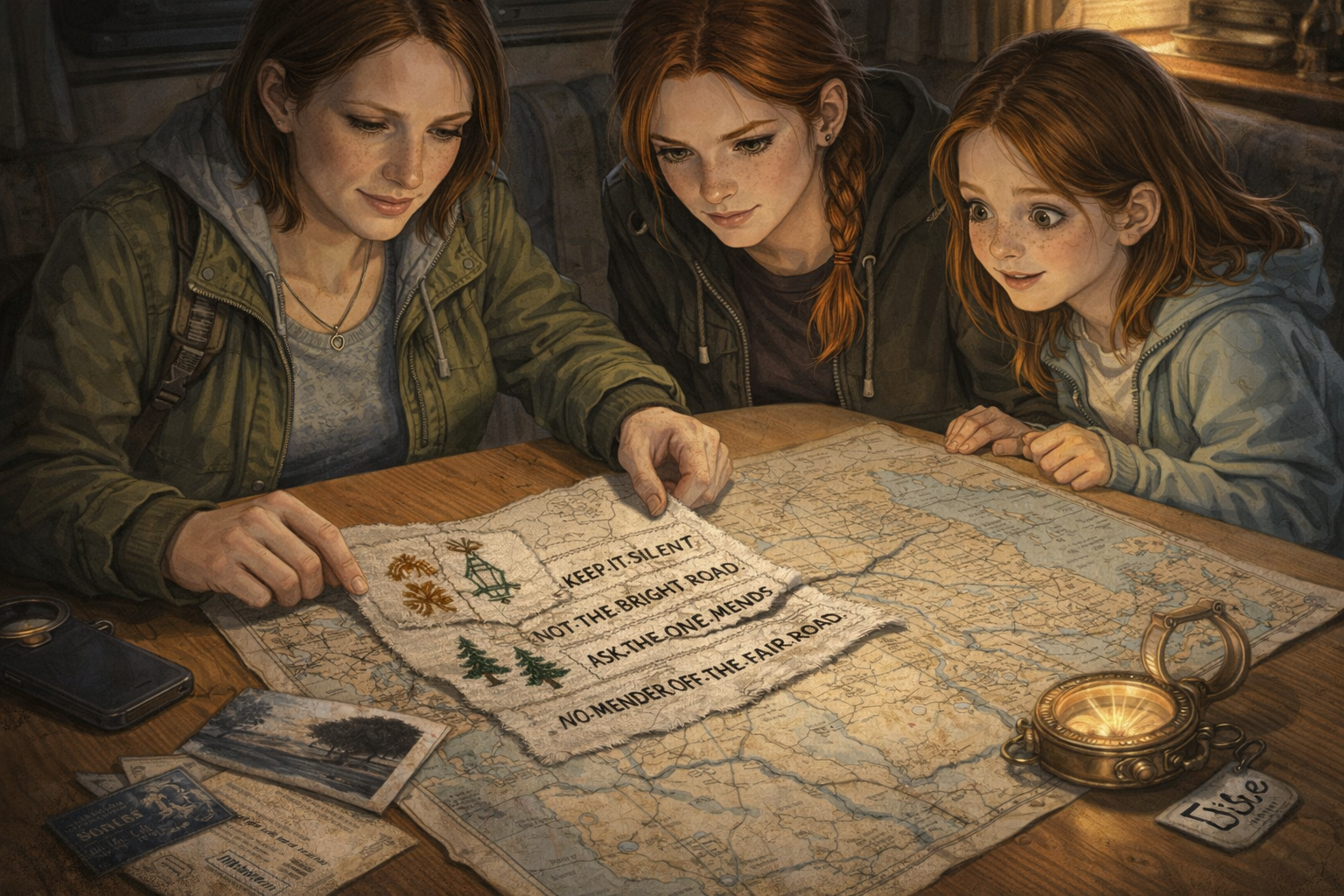
The line on the map ran past the place they had entered the pines and skirted whatever bright route waited deeper in, but did not touch it. At the end of the line, near no printed road at all, a tiny green-black symbol appeared.
The same little guitar.
Oakley made a noise of triumph so loud Mum had to shush him on instinct.
Ivy looked from the map to Erin. “So there is a way around it.”
“Yes,” Erin said. “Assuming the map is telling the truth, which I feel weird saying aloud.”
Dad pointed at the words. “Fair road?”
“Bright road. False welcome. Spectacle. Bargains.” Erin’s mouth tightened. “Whatever is in those pines wants to be chosen. That cloth is telling you not to choose it.”
Mum traced the little dark line without touching the paper. “And the mender’s path goes around the back.”
“Looks like it.”
“Do we go tonight?” Ivy said.
Dad answered before anyone else could. “Absolutely not.”
Ivy’s head snapped round. “Dad—”
“No. You are not going into a hidden road system in the middle of the night looking for a magical guitarist whose name sounds like a tax dodge.”
“Ben Jammin,” Oakley corrected helpfully.
“Thank you, Oakley. Somehow worse.”
Mum did not tell him he was wrong. She just kept looking at the map, thinking.
“Tomorrow,” she said at last.
Dad looked at her. “Belinda—”
“Tomorrow,” she repeated. “In daylight. With sleep. With actual food in everybody. With Erin on call. We don’t blunder back in tired.”
Amber nodded hard. Ivy looked furious for nearly three seconds, then not furious at all. Just exhausted.
“That’s still not normal,” Dad said.
“No,” Mum said. “But it’s right.”
The fight went out of him. He sat back.
“All right.”
On the screen, Erin let out a breath she had probably been holding since the words appeared. “Good. Because I’d quite like to spend the next few hours checking whether Granny left anything else useful hidden in the soft furnishings.”
“Comforting sentence,” Dad said.
“Thank you.”
Mum looked at the old bell cloth in Erin’s lap. “You said Granny told stories. Did she ever say why our family would have any of this?”
That changed the room again.
Erin’s fingers stilled on the fabric.
Meow Meow had returned to the back of the sofa, but he was still facing the hall. Watching.
“Not properly,” Erin said. “Not in one clean answer. Just... bits. That some families used to carry markers without knowing. That some got noticed easier than others. That roads remember who repaired them and who abandoned them.”
Dad’s face had gone unreadable.
“Did she mean us?” Ivy asked.
Erin looked at her for a long second, then at Dad, then back at the strip on the caravan table.
“I think,” she said carefully, “the roads know this family better than we do.”
No one had a good reply to that.
Outside, someone somewhere shut a car door. A dog barked twice. The ordinary holiday park kept being offensively normal, which helped less than it should have.
Eventually Erin said, “Get some sleep.”
Dad laughed without humour. “Marvelous plan.”
“I mean it.”
Mum nodded. “We will.”
“Lock everything,” Erin added.
Dad stared at her. “Already done.”
“Do it in your heart too.”
“That is not a sentence I can work with.”
“It’s the best you’re getting.”
Oakley yawned so hard it nearly folded him in half.
Amber rested her chin on Mum’s shoulder, still staring at the tiny guitar mark on the map. Ivy kept one hand over the Site 23 tag as if she had forgotten it was there.
“Erin?” Mum said.
“Yes?”
“Don’t sit up alone all night.”
Erin gave a tiny shrug. “I have a cat with anger issues and several sharp crochet hooks. I’ll cope.”
Meow Meow blinked once, slow and murderous, toward the hall.
The call ended.
For a while the family stayed around the table in the caravan’s warm little pool of light. Nobody rushed bedtime. Nobody said they were frightened. That would have been too tidy.
Dad made tea he did not really want. Mum tucked the route-strip back inside the map with hands that were steady by effort. Amber finally took off her second shoe. Oakley fell asleep sitting up for almost a full minute before waking himself and asking whether banjo wizards liked rockets.
“Probably,” Mum said, because it was late and that was close enough.
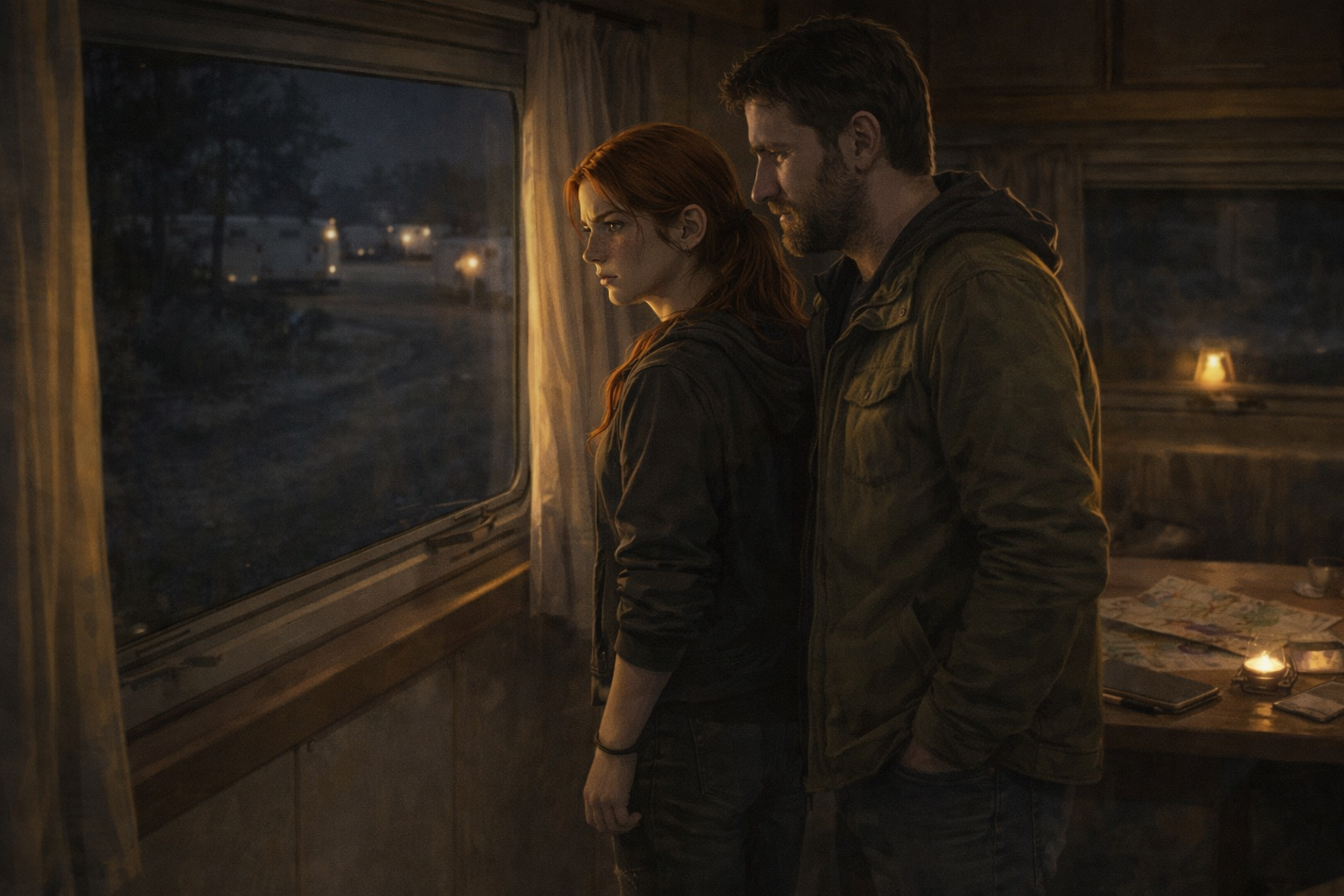
Ivy stood by the curtained window again.
Dad came over and stopped beside her, not crowding, not making a big speech out of it.
“You did good tonight,” he said.
She kept looking out. “I nearly went.”
“I know.”
“He said not the bright road.”
Dad glanced at her. “The boy?”
She nodded.
He was quiet a moment. “Then we’re going to do this properly.”
That made her look at him at last.
He did not look convinced. He looked terrified in a practical, irritated, Dad-shaped way. But he also looked committed, which was better.
Across the little table, the Lantern Compass gave one small click inside its casing.
Everyone turned.
The needle, which had been still since the call ended, swung a fraction across the map and settled not on the bright-road line, not on the mender’s mark, but just beyond them both toward the dark patch of green where the fair road curled through the pines.
Then, faint as breath, from somewhere no road map had any business reaching, came the sound of a single plucked string.
Not through the window.
Not from outside the caravan.
Through the table.
Oakley’s eyes went huge.
Amber grabbed Mum’s sleeve.
Dad said one clear, astonished word under his breath.
And Ivy, staring at the little green-black guitar symbol darkening on the map, thought with a rush of fear and relief that felt almost the same:
He had heard them.
Then the string note faded, and the caravan was only a caravan again, parked in a harmless holiday park under a flat ordinary sky.
For now.