
Chapter 12 - The Road That Wasn’t on Any Map
Nobody moved for nearly a full minute after the house went still.
The silence had weight to it. Not empty silence. After-something silence. The kind that arrived only once a thing had finished trying to get inside you.
The downstairs hall smelled of thread, damp shoes, dust, cold air from the side entry, and the bitter edge of Auntie Erin’s tea going forgotten on a little table beside her chair. The front of the house looked ordinary again. That should have been a comfort. It was, a bit. But it was the sort of comfort that stood on one leg and kept glancing over its shoulder.
Meow Meow sat in the doorway with his tail wrapped around his paws and the expression of a cat who had personally saved civilisation and resented how little fuss was being made about it.
Oakley was the first one to break.
“Can I have a biscuit,” he said, in the croaky, deeply offended voice of a child who had survived several forms of impossible danger and felt the adults were now neglecting the obvious next step.
Dad laughed once. It came out tired and rough, but it was a laugh. “That,” he said, rubbing a hand over his face, “is the most reasonable thing anybody has said in the last three hours.”
Mum let out a breath that almost became a giggle and almost became crying and did neither. “Kitchen,” she said. “Tea. Water. Biscuits. Nobody wander off.”
“That is not a sentence you should have to say in your own house,” said Ivy.
“And yet,” said Erin.
The family drifted, not neatly, but in the slow battered clump of people who had earned the right to be a mess. Mum gathered Oakley before he could head for the stairs. Dad checked the front hall one more time, because he was Dad and because ordinary was something he now inspected like faulty wiring. Ivy stayed nearest the wall-slot where Site 23 sat lantern-side in the seam, as if moving too far away might make the house forget. Amber followed Mum into the kitchen, then slowed when something caught her eye above the doorway.
Only for a moment.
A tiny shape crouched on the top trim, no taller than Mum’s hand. It had a squat body, a round head, and something shiny strapped over its eyes. It seemed to be staring into the room with terrible seriousness. Then it ducked backwards so fast Amber almost convinced herself it had been a shadow from the light fitting.
She stopped dead.
“Amber?” Mum glanced back, already opening a cupboard. “You all right?”
Amber looked up again. Nothing there. Just the familiar bit of paint Dad always said he would touch up and never did.
“Yeah,” she said. “I thought I saw—”
Oakley, half over Mum’s shoulder, pointed at the biscuit tin. “Chocolate ones.”
Which was not remotely the same topic, but it was enough to break the moment apart.
By the time tea was poured and Oakley was installed with two chocolate biscuits and strict warnings about crumbs near magical architecture, the Lantern Compass had still not settled.
It lay on the kitchen table among Tane’s map, the torn route-strip, Erin’s thread card, and a scatter of mugs. Its needle held east with stubborn, unfriendly certainty.
Mum looked at it. Then at Erin. “How long do we have?”
Erin did not pretend not to understand.
“Not forever,” she said.
“That is also not a useful unit of time,” said Ivy.
“It’s the one we’ve got.”
Dad came back in from the front hall. “Still a normal hallway,” he said. “Which I hate having to report out loud.”
“That means the fold held,” Erin said. “For now.”
Dad leaned both hands on the back of a chair. He looked older than he had that morning. “You said closer,” he said to nobody and everybody. “Not finished. Fine. What does finished actually mean?”
No one answered at once.
Then, from somewhere low in the house, not from a room and not from the wall exactly, came the child-voice again.
“Home,” it said quietly.
Nobody flinched this time.
It was still strange. Still impossible. Still the sort of thing that would once have snapped the whole evening in half. But now the voice carried something none of the others did.
Need.
Not hunger. Not trickery. Not politeness sharpened into a knife.
Need.
Mum set her cup down carefully. “We hear you.”
A warmth moved through the seam-wall where Site 23 sat. The enamel tag gave one small click, as if answering with its own metal tongue.
Erin looked at the wall, then at the map.
Tane’s old paper had redrawn again. The warning words were still there.
RETURN NOT FINISHED
NAME NOT SAFE
But beneath them, faint and new, another line had appeared, like something worked out by a hand that did not fully trust itself to be seen.
ANSWER AT PLINTH
BEFORE FIRST BELL
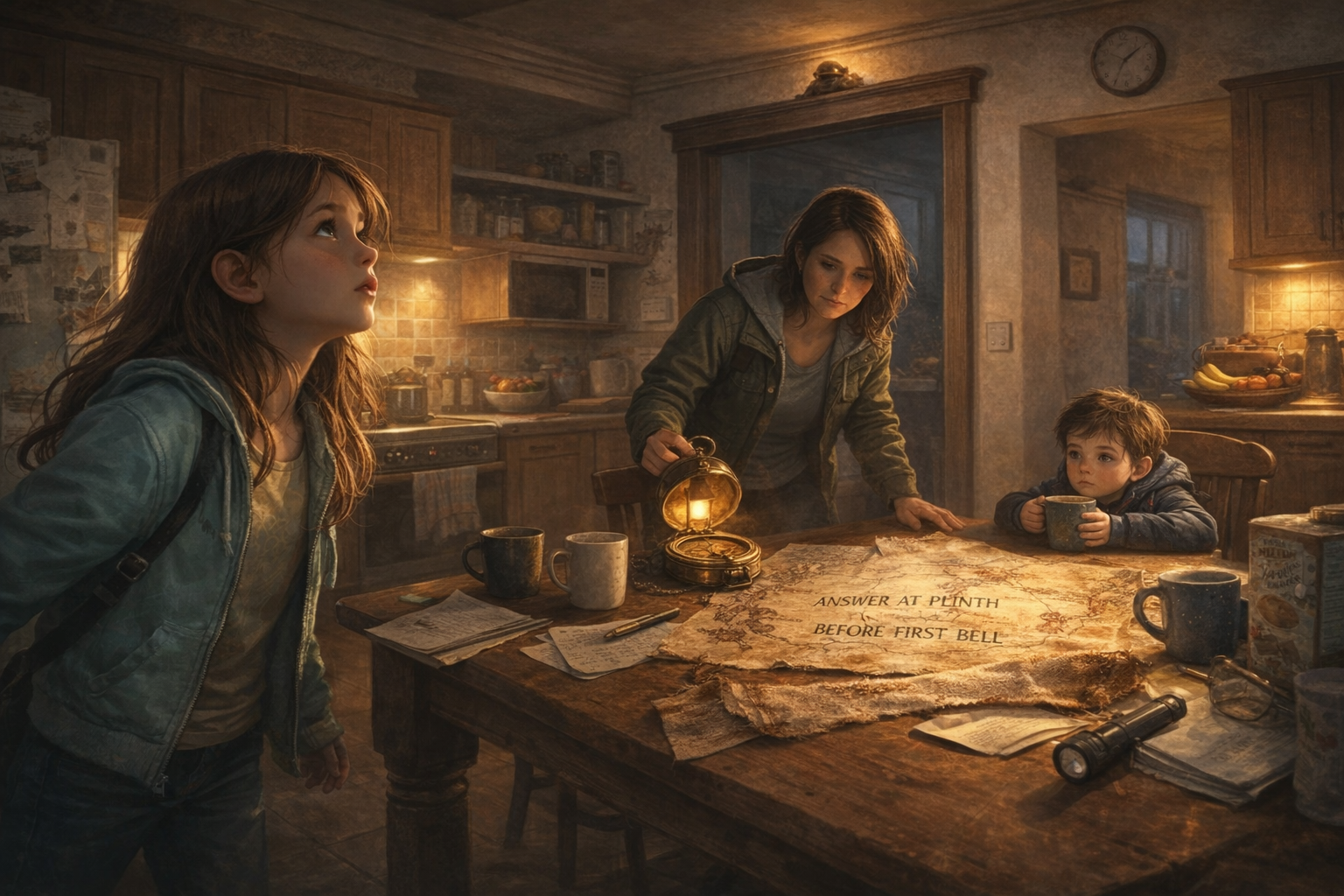
Kitchen warning / unfinished business at Home
Dad stared at it. “Right,” he said. “No. Excellent. Terrible. Great. We’re doing a final haunted infrastructure errand before sunrise.”
“Put that on the family crest,” said Ivy.
“We do not yet have a family crest,” said Erin.
“Good,” Dad said. “Because that would be weird.”
Mum was already reading faster than the others could speak. “The plinth,” she said. “The east-line one.”
Erin nodded. “Twelve stays here. It has to. Home is still the nearer berth. But the road end needs its answer finished properly.” She tapped the route-strip with one finger. “We advanced the count in the house. We didn’t close the line.”
Amber looked from the map to the seam-wall. “So he’s still stuck in the middle.”
“Closer,” said Erin, softer now. “But yes.”
Dad let out a long breath through his nose. “Can we finish it without his name?”
“We’d better,” said Erin. “Because the map is being uncharacteristically plain about how bad an idea the other option would be.”
Ivy looked at the Compass. “Ben said the house needed to see Twenty-Three. He didn’t say the house needed to keep it.”
Erin’s eyes sharpened. “No.”
“I’m not saying take it out now,” Ivy said quickly. “I’m saying maybe the plinth doesn’t need the tag. Maybe it just needs the road to know Home has seen it.”
That landed.
Not because it was dramatic. Because it sounded right.
Mum looked at Ivy for a second too long, the way she had begun to when the roads did something back at her eldest daughter. Not fear. Not quite. Something more careful than that.
“Relation,” Mum said. “Like before.”
“The nearer berth answers,” Amber said slowly. “And the outer berth returns.”
Dad frowned. “That still sounds like half a sentence.”
“It’s road-logic,” said Erin. “Half the problem with it is that it thinks being emotionally devastating counts as clarity.”
The child-voice came again, weaker this time.
“Please.”
That did it.
Dad straightened at once. “Fine,” he said. “We go now.”
Oakley looked up from his biscuit. “Night mission?”
Mum gave him a look. “Unfortunately, yes.”
“Can I bring my torch?”
Dad looked at the tiny plastic rocket torch on the bench, then at everything else on the table, then at the universe in general. “At this point,” he said, “I’d be surprised if not.”
By the time they were in the car, Woodend had that deep, brittle pre-dawn darkness that made even familiar streets look held in a different shape.
Dad drove.
Mum sat beside him with the map and the Compass.
Ivy and Amber were in the back with Oakley between them in a puffer jacket zipped wrong in his hurry. Erin stayed at Home, because Home still needed Twelve threaded into the hold-line and because not every brave thing involved charging into the trees. Meow Meow remained downstairs with her like a furry deputy.
Erin stayed on speaker through the first stretch of the drive. Her voice came in and out under the tyres on the road and the whisper of the heater.
“Do not answer any bell before the road is closed,” she said.
“We’ve done bells,” Dad muttered.
“We have survived bells,” Erin corrected. “That is not the same as having done them.”
Mum kept one hand on the map. “Home’s all right?”
“For a very flexible version of all right, yes.”
“Comforting.”
“You married a systems man,” said Erin. “That is as close as you were ever getting.”
In the back, Amber watched the dark slide past the windows and thought she saw movement twice where there should have been none. Not big movement. Not road movement. Small. Quick. Above things. Perched where nothing should perch.
At one point, when they turned near a line of hedges silvered by cold, she could have sworn there was a tiny figure sitting on a letterbox, visor gleaming faintly, little feet braced as if waiting for a signal.
She blinked and it was gone.
She did not say anything.
Not because she was sure she had imagined it.
Because she was beginning to think she hadn’t.
The pine turnoff appeared before dawn fully admitted it was coming. No false brightness. No fair lights. Just the old posts, the chain, the cracked bell with its bound clapper, and beyond it the dark throat of the hidden track.
And Ben Jammin, waiting on his stump as if he had always been part of the place and the place knew better than to start without him.
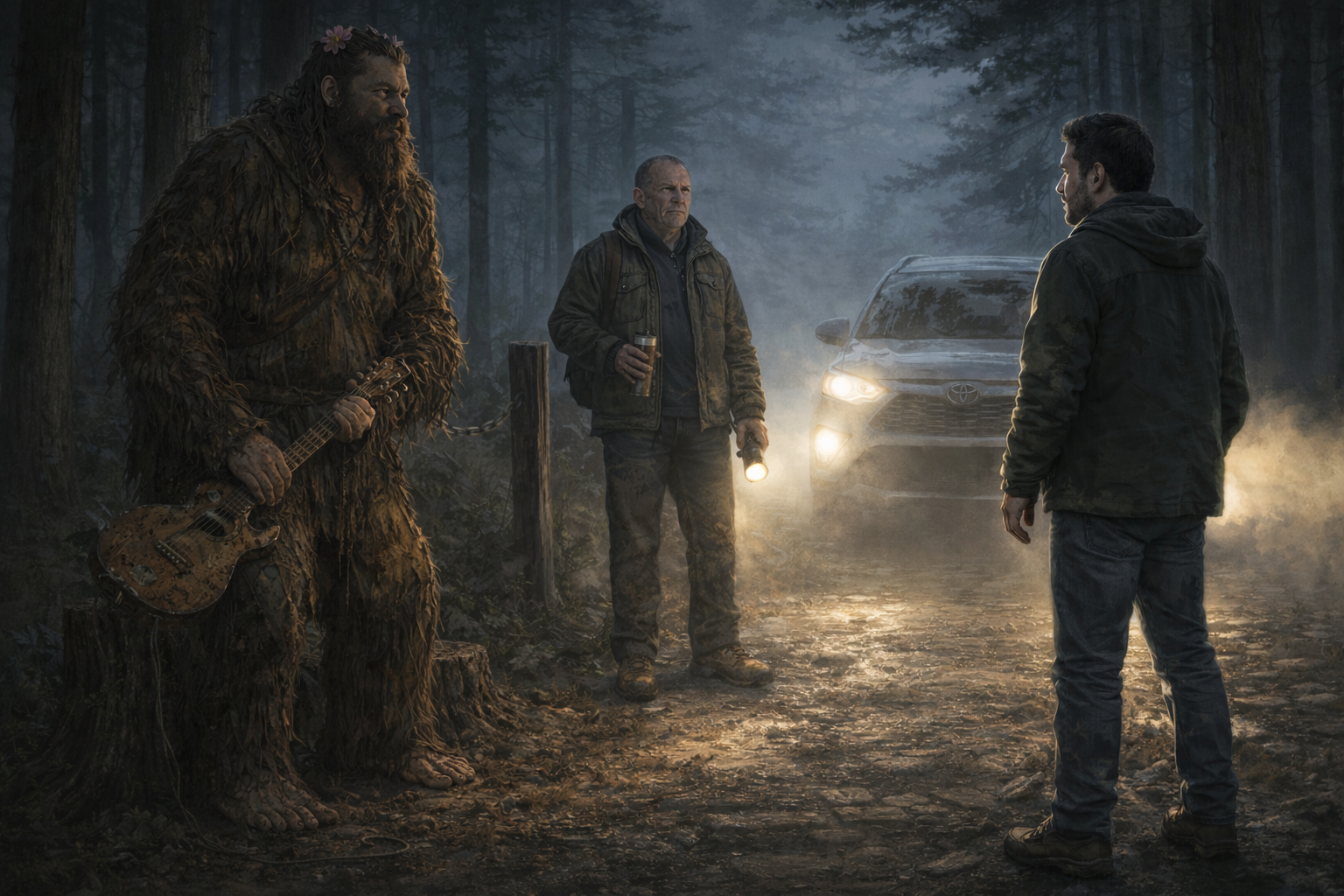
Ben Jammin and Gampa Kev at the pine entrance
He lifted one huge hand in a sheepish wave when the car lights found him.
“Morning,” he said.
“It is absolutely not,” said Ivy, climbing out.
Ben gave a faint hum that might have been agreement.
Beside him stood Gampa Kev, thick jacket zipped up, thermos in one hand, old torch in the other. He looked exactly like a man who had spent half his life on cold roadside verges and had discovered, too late, that some of them remembered him.
Dad got out and shut the car door a bit harder than necessary.
Kev nodded once. “Justin.”
“Kev.”
Not warm. Not shouting either. Just the kind of flat that came before either forgiveness or much worse.
Ben looked between them and decided, wisely, to speak first.
“Road’s thin,” he said. “Still honest. That helps.”
“Does he?” said Dad.
Kev took that without flinching. “Fair enough.”
Mum was already around the side of the car with Oakley’s torch and the clue bundle. “We can do family feelings after we stop the haunted return system from breaking the house again,” she said. “Move.”
That, more than anything, got them going.
The east line felt different now.
Still damaged. Still old. Still carrying the memory of bells it had not wanted. But the worst of the false brightness had gone. The pines stood tall and black against the paling dark. Cold damp gathered in the mossy edges of the stones. Somewhere far off, a real bird tried one note and stopped, as if waiting to be told whether dawn had permission yet.
Ben walked ahead, guitar in his hands.
It looked rougher than before. One string fully gone. Another slightly out of true. Yet when his fingers brushed the remaining strings, the path settled under their feet, not opening exactly, but agreeing not to argue.
Ivy kept close enough to the front to see what he saw. Amber stayed a little farther back, where the road felt more emotional and less practical. Oakley held Dad’s hand and his rocket torch with equal seriousness.
Halfway in, the boy appeared.
Not in a jump-scare blur. Not as a vanishing glimpse between trunks. He was simply there, a little ahead on the left side of the path, child-shaped and damp-edged and thin in the strange way unfinished things sometimes were. He looked less broken than before. Less dragged apart by wrong places. More like a real boy being badly held by bad rules.
He looked first at Mum.
Then at Amber.
Then at the path ahead.
“Nearly,” he said.
Amber’s throat tightened.
Mum stopped, but not so fully the road cooled beneath them. “We’re going to finish it.”
The boy looked at her, and for a second there was such fierce hope in his face that Amber wanted to cry on the spot.
Then he turned and kept moving, never quite touching the ground.
Kev made a sound in the back of his throat. Regret, probably. Older than words.
Dad heard it. So did Ivy. But neither said anything yet.
The plinth stood where it had before, deeper on the east line where the pines thinned around a stone clearing. Moss furred its base. The half-erased carving still read RET—. The slot in the centre waited dark and narrow.
The moment the family entered the clearing, the air changed.
Amber felt it first.
Not sound. Not exactly.
Expectation.
Then, from somewhere just beyond the trees, came a bell.
One bright, tidy note.
Ben swore under his breath so mildly it almost became politeness.
“Of course,” said Dad.
The second bell sounded from the other side.
A path tried to appear to their right.
It looked easier than the real clearing. Dryer. Cleaner. Lit by soft golden bulbs that had no business being there at dawn. For half a second it showed a gate, a painted sign, a smiling lantern, and a road smooth enough to trust.
Mum did not even look at it properly.
“No.”
The bright path shivered.
The grin came next.
Not a whole body. Not fully. The sort of thing that liked to be seen in parts first. A smile in the wrong light. A shoulder leaning where there was no wall. Fingers resting on the suggestion of a gate that did not belong.
“Oh, don’t be dull now,” said the Grin from the false path. His voice was warm enough to make warmth suspicious. “You’ve done the hard part. I can make the rest easy.”
“No bargains,” Mum said.
“No bells,” said Ben, and struck a chord so rough and stubborn the bright path buckled at its edges.
The Grin’s smile widened.
“You still haven’t chosen a safe way to be called,” he said. “You know that matters now.”
Ivy went still.
Amber saw it. So did Mum.
The smile turned a fraction toward the eldest girl. “Names are fragile things on these roads. Families ought to travel better protected. I could help with that. One word each. One true road-name. One clean answer when the dark comes asking.”
Dad stepped in front of Ivy so fast it would have been funny in any less magical circumstance. “Absolutely not.”
Kev spoke then, sudden and harsh. “That’s how it starts.”
The clearing stilled.
Even the false light seemed to listen.
Kev did not look at the Grin. He looked at the plinth instead. At the stone. At the slot. At the place where years ago he had failed to finish what should have been finished.
“That’s how it starts,” he said again, quieter now. “You take the neat answer because the real one’s harder. You tell yourself you’ll sort the rest once everyone’s safe. Then the rest sits there for years with a child caught in it.”
Dad stared at him.
Kev swallowed. “I thought shutting the line would hold. I thought moving the answer would be enough. It wasn’t.”
The boy stood at the edge of the clearing, listening.
Ben’s fingers stayed on the strings, keeping the bright path thin and unhappy.
Mum looked at Kev once, not forgiving, not yet, but not turning away either. “Then help now.”
He nodded once.
That was all.
Then the road began.
The plinth lit from within, faint lantern-gold threading through the carved cracks. Back at Home, on speaker in Erin’s kitchen, something answered with a low chiming click.
Erin’s voice came through the phone. “Home is holding.”
Mum stepped to the stone. “Tell us what to say.”
“Not names,” Erin said. “Relation. Direction. Return.”
Ivy was already staring at the slot.
Not the slot itself.
The stone around it. The way the moss had been pushed back once and then grown wrong. The faint grooves at the base. The place the route-strip ought to lie.
She moved before anyone could tell her to.
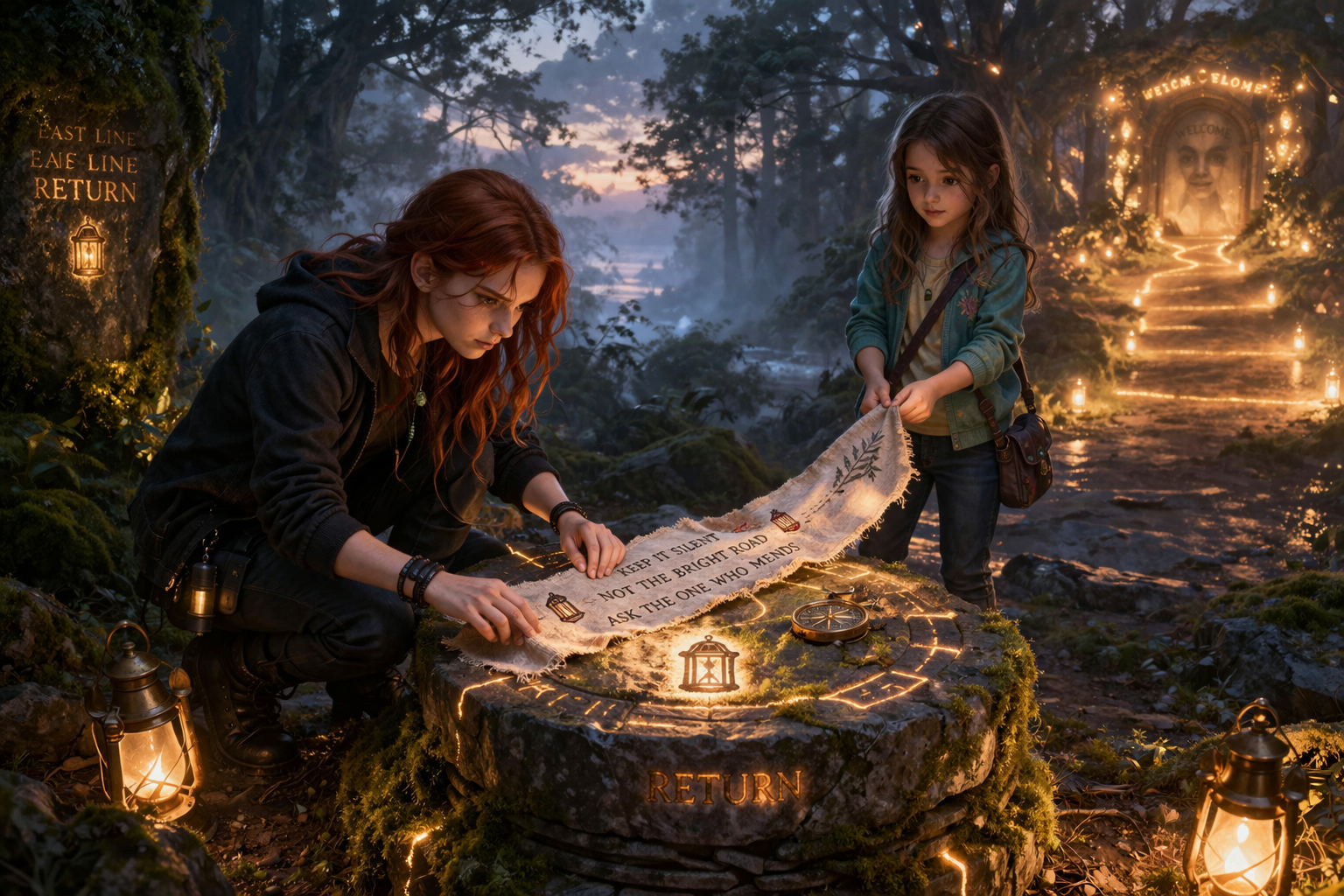
Ivy and Amber at the plinth while the fair presses in
She dropped to one knee and smoothed the torn route-strip from the plinth’s lower edge toward the east-facing seam in the stones, laying it not by guesswork but by something quicker and stranger. The cloth settled. The gold threads in it woke.
Dad saw it happen.
So did Mum.
Neither interrupted.
Amber stepped in at once, understanding before she could have explained. She took the free end of the strip and held it steady with both hands, making a bridge of it.
Ben struck another chord. The false path hissed brighter, then thinner.
The Grin spoke again, softer now. More dangerous.
“You do not even know who you’re bringing home.”
Amber looked up at the boy.
That was the trick, she realised.
Not only the unsafe name.
The loneliness.
The idea that if you could not say exactly who someone was, maybe you could pretend they did not properly belong anywhere.
That was the nasty bit. The bit under all the polished welcome and tidy offers and clever road-names. The bit that wanted people unclaimed.
She stood straighter.
“We know enough,” she said.
For once, nobody treated that as a child’s brave line.
Because it was correct.
Erin’s voice came through the phone again, clear and sharp. “Nearer berth holds.”
Mum answered at once. “Outer berth presents return.”
The plinth brightened.
Kev stepped forward, old shame plain on his face. “Return was owed,” he said.
Dad took Oakley’s shoulder and drew him close. “Return is still owed.”
The boy looked at them as if he could hardly bear it.
The Grin’s smile sharpened. “And what will you call him, then?”
Nobody answered that.
Oakley did.
“You don’t gotta,” he said scornfully, as if explaining something obvious to a slow adult. “He’s the kid coming home.”
The clearing changed.
It was tiny, the shift. Yet it ran through the whole place.
Ben looked down with startled respect.
Erin made a sound over the phone that might have been a laugh.
Mum’s eyes filled and stayed steady anyway. “Yes,” she said. “He is.”
Then she raised her voice, not loud, but with the clean authority she used when frightened children needed the truth before anything else.
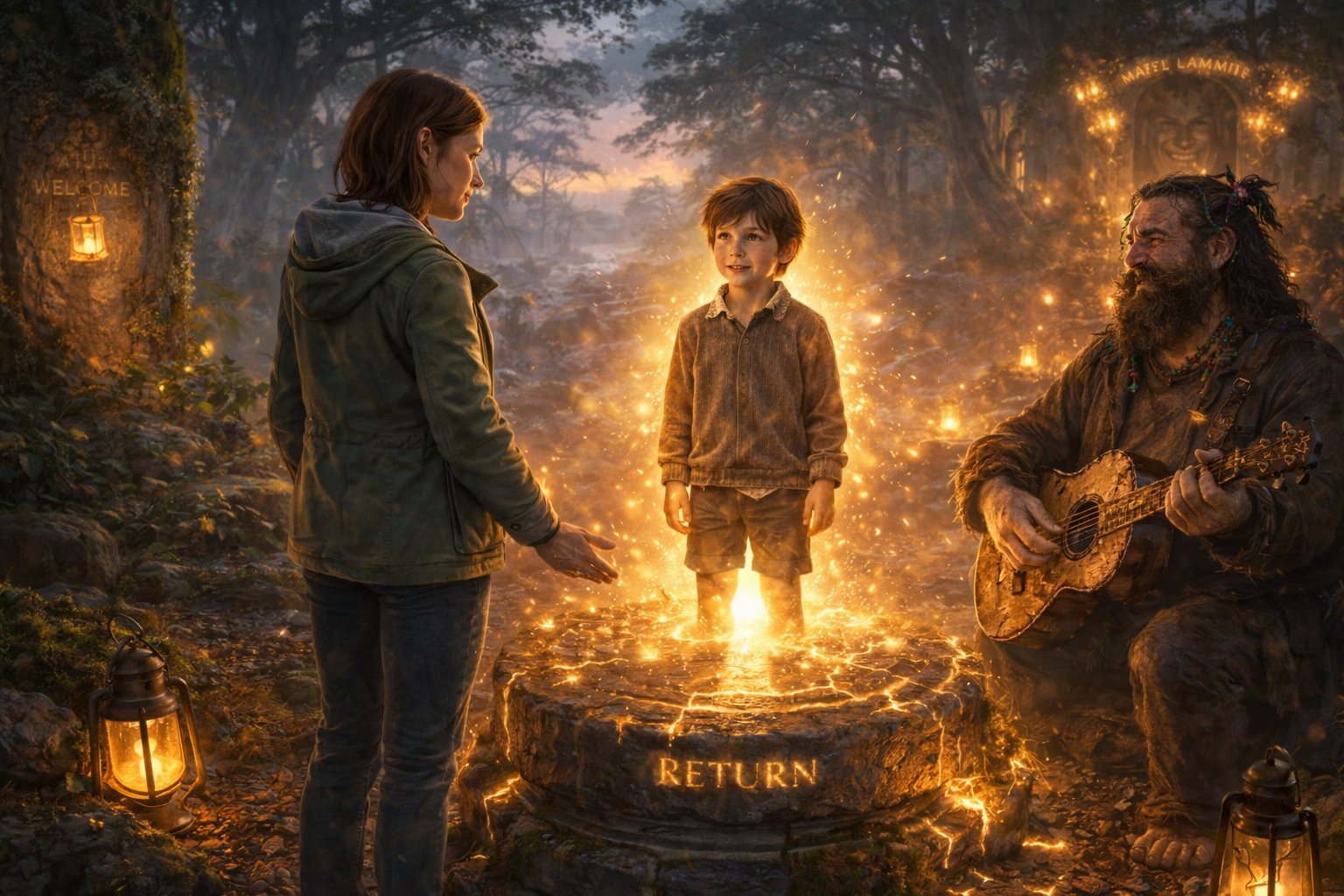
The child finally counted home
“Home knows the nearer berth,” she said.
Dad answered, strong as stone. “Home sees the outer berth.”
Ivy, one hand on the plinth, felt the line through the route-strip and said the next part with no hesitation at all.
“The unfinished return is counted.”
Amber held the cloth and looked at the boy.
“Return counted,” she said.
From the phone in Dad’s pocket, Erin spoke the last answer from Home.
“Come in honestly.”
The world took a breath.
The false path cracked like painted glass.
The Grin’s smile held one impossible second longer than the rest of him, then folded back into the dark between the trees.
Ben hit the final chord.
Not pretty. Not magical in the flashy way. More like a thing being nailed back where it belonged.
The plinth flared gold.
Back at Home, through the phone, there came the bright answering click of Twelve in the hold-line and the softer metal note of Twenty-Three in the wall.
The boy stepped forward.
For one heartbeat he looked wrong and water-edged and unfinished.
For the next he looked only like a child.
Not named. Not explained. Not reduced to a tidy bit of lore.
Just a boy who had been waiting far too long to hear that he was allowed in.
He looked at Mum.
At Dad.
At Ivy.
At Amber.
At Oakley.
At Kev last of all.
Kev’s face broke open.
“I’m sorry,” he said.
The boy’s expression shifted. Not forgiveness exactly. Not blame either. Something sadder and gentler and far older than either of those things.
Then he looked past them all, toward Home, though Home was nowhere visible from the clearing.
And smiled.
Not a grin.
A real smile.
He stepped into the gold.
The light folded.
The clearing went still.
No bells.
No bright path.
No pressure behind the eyes.
Only cold dawn air, damp pine, and somewhere above them the first proper morning tui beginning to sing as if nothing in the world had ever been wrong.
For a long moment nobody moved.
Then the stone plinth gave one low settling sound and the carving finished itself under the moss.
RETURN
The Lantern Compass, in Mum’s hand, shuddered once and then went calm.
Tane’s map redrew on the spot. The old warning lines faded.
In their place came new words, spare and certain.
RETURN COUNTED
LINE ANSWERED
Then, lower on the page, in thinner red:
OTHERS WAIT
Dad read that and closed his eyes briefly. “That,” he said, “had better not be tonight’s problem.”
Ben peered at the map. “No,” he said. “That’s tomorrow’s, or next month’s, or some other badly timed day entirely.”
“That is the nicest thing anyone has ever said to me,” said Dad.
Kev sat down very suddenly on a low stone as if his knees had decided enough was enough. He took his cap off and scrubbed at his face. Nobody hurried him.
Mum crouched beside Oakley. “You did well.”
Oakley looked pleased with himself in the grave, holy way of small boys who have accidentally said something structurally important. “I know.”
Ivy was still staring at the finished carving.
Mum touched her shoulder. “You all right?”
Ivy let out a breath. “No, but in a better way.”
Amber looked once toward the pines beyond the clearing.
Nothing moved there now except dawn.
Still, just before she turned away, she thought she saw something tiny and hunched on a branch above the path out, visor glinting, both little hands clasped around what looked suspiciously like one of Oakley’s spare torch batteries.
It gave a solemn nod.
Then dropped backwards out of sight.
Amber blinked.
“Amber?” said Dad.
She looked at him. At the map. At everyone else standing in the real morning.
“Nothing,” she said.
This time, she knew she was lying.
Only a bit.
The drive back to Home felt completely different.
Not safe in the silly story way where everything was fine forever and no one had to think again. Safe in the human way. In the tired, real, deeply earned way.
The road back was just a road.
The sky over Canterbury was paling from charcoal to silver-blue. Paddocks held low white mist. Real fences stayed fences. Real signposts did not smile. Someone somewhere had already lit a kitchen and started a day that had absolutely nothing to do with broken berths or false welcomes, which Dad seemed to find personally offensive and comforting at the same time.
Kev followed behind them in his own vehicle after all, because there were things still to do and because leaving again now would have felt cowardly.
Ben did not come out to the road.
He stood back at the pine entrance with his one-string-short guitar and raised a hand as the car pulled away.
“Road’ll know you now,” he called.
Dad rolled down the window. “That,” he said, “continues to sound threatening.”
Ben smiled. “Only partly.”
Then the pines took him back.
Home looked like Home.
That was enough to make Amber’s chest hurt.
The front garden was untidy again in a normal way. The side entrance was just the side entrance. The downstairs hall smelled of tea, wool, and the sort of overnight worry that had not fully left yet but had at least changed its shoes.
Erin was waiting in the kitchen with fresh toast and the expression of someone who had spent the last several hours holding a house together by intellect and spite and would now like everyone to appreciate that properly.
The moment Mum stepped inside, the Lantern Compass needle settled.
Not east. Not front. Not wrong.
Still.
Erin saw that and nodded once.
“That,” she said, “will do.”
Only then did the family finally begin to land.
Dad made more tea because making tea was what Dad did when the universe had been unreasonable and he needed something, anything, to obey known laws. Mum found blankets. Oakley fell asleep sideways on the couch with one sock missing and the rocket torch still clutched in his hand. Ivy sat on the floor by the wall-slot for a while, not guarding it exactly, just being near it until she no longer had to. Kev stood awkwardly by the bench and apologised to Erin first, which was perhaps wise.
She accepted the apology in the tone of someone noting a weather report.
Later, when Oakley was snoring faintly and the windows had turned properly gold with morning, Dad and Kev went to collect the caravan from the holiday park. The trip was long, boring, and gloriously ordinary, which made it one of the best drives Dad had ever had. By the time the Coachman Pastiche was back in the driveway and the family had begun the terrible holy ritual of unpacking, the book had finally remembered how to breathe.
Wet towels appeared.
Half-dead road snacks emerged from bags.
A charger nobody could find turned out to be in a perfectly stupid place.
Mum found three separate pine needles in the washing pile and did not ask how.
Erin reclaimed her downstairs spaces from active magical siege and returned them to their more usual state of creative chaos.
Meow Meow inspected every room as if checking repair work.
By late afternoon the house looked lived in again rather than held.
That mattered.
It mattered almost as much as the answers.
Because they did have answers now.
Site 23 had been a broken berth, not just a haunting.
The east line had been built to bring people home.
Twelve and Twenty-Three had belonged to the same damaged return.
Kev and Granny had moved the answering seam to Home to save what they could.
The fair had tried to define return through false welcome.
The Grin wanted names because names let him hold things.
And the child from the broken berth — unnamed still, safely unnamed — had finally been counted home.
Not every mystery was solved.
But this one was.
That evening, after actual dinner at an actual table in an actual house that was not currently lying about its doors, the family gathered in the kitchen while the last of the light faded outside.
Tane’s map lay open on the bench.
The warning about the unfinished return was gone.
The route they had travelled was still there in fading red, from campground to dairy to beach to pines to Home. But now it no longer looked like a random chain of accidents. It looked like one branch of something bigger.
Much bigger.
Fine red lantern marks glimmered faintly across the whole map of New Zealand. One near a coastline they had never visited. One inland. One high in the central North Island. One so far south it made Amber shiver just to imagine it.
And beside the line they had already lived through sat a new symbol:
a tiny caravan shape in red-gold ink.
It was them.
The network knew them now.
Dad looked at it for a long time. “I hate that,” he said.
Mum smiled into her tea. “You hate it less than you did yesterday.”
“That is not the same as liking it.”
“No,” said Erin. “That would be medically concerning.”
Ivy leaned closer. “So we did one road.”
“One return,” Erin corrected.
“Which means,” said Amber quietly, “there are more.”
Nobody said otherwise.
Oakley, who had recovered enough energy to exist dangerously again, pointed at the little caravan mark. “That’s us.”
“Yes,” said Mum.
“We need a cool road name.”
Dad groaned. “We are not doing this at the dinner table.”
“We are absolutely doing this eventually,” said Erin.
“Not tonight.”
“Agreed,” said Mum. “Not tonight.”
That settled it, for now. Which was all anyone sensible had been hoping for.
Amber looked back at the map.
There, near the top corner, one of the new lantern marks flickered.
Not with route-light.
With movement.
Her eyes narrowed.
On the shelf above the bench, balanced beside an old cereal box and a stack of paper napkins, crouched the tiny visor-wearing creature again.
A gnome. Or something very like one.
Its headset covered most of its face. Its boots were ridiculous. A belt of overbuilt little gadgets crossed its middle. It was holding one AA battery in both hands with the grave concentration of a soldier guarding sacred technology.
It was not looking at the family.
It was looking at the map.
Another tiny shape appeared half a second later from behind the fruit bowl, equally serious, equally ridiculous. One pointed at the glowing caravan symbol. The first nodded sharply.
Then, as if feeling Amber’s stare, the visor-wearer turned its whole head toward her.
It froze.
Amber froze back.
Very slowly, the gnome raised one hand and tapped two fingers against the side of its headset in what looked horribly like a salute.
Then both creatures vanished into the wall behind the pantry with almost no sound at all.
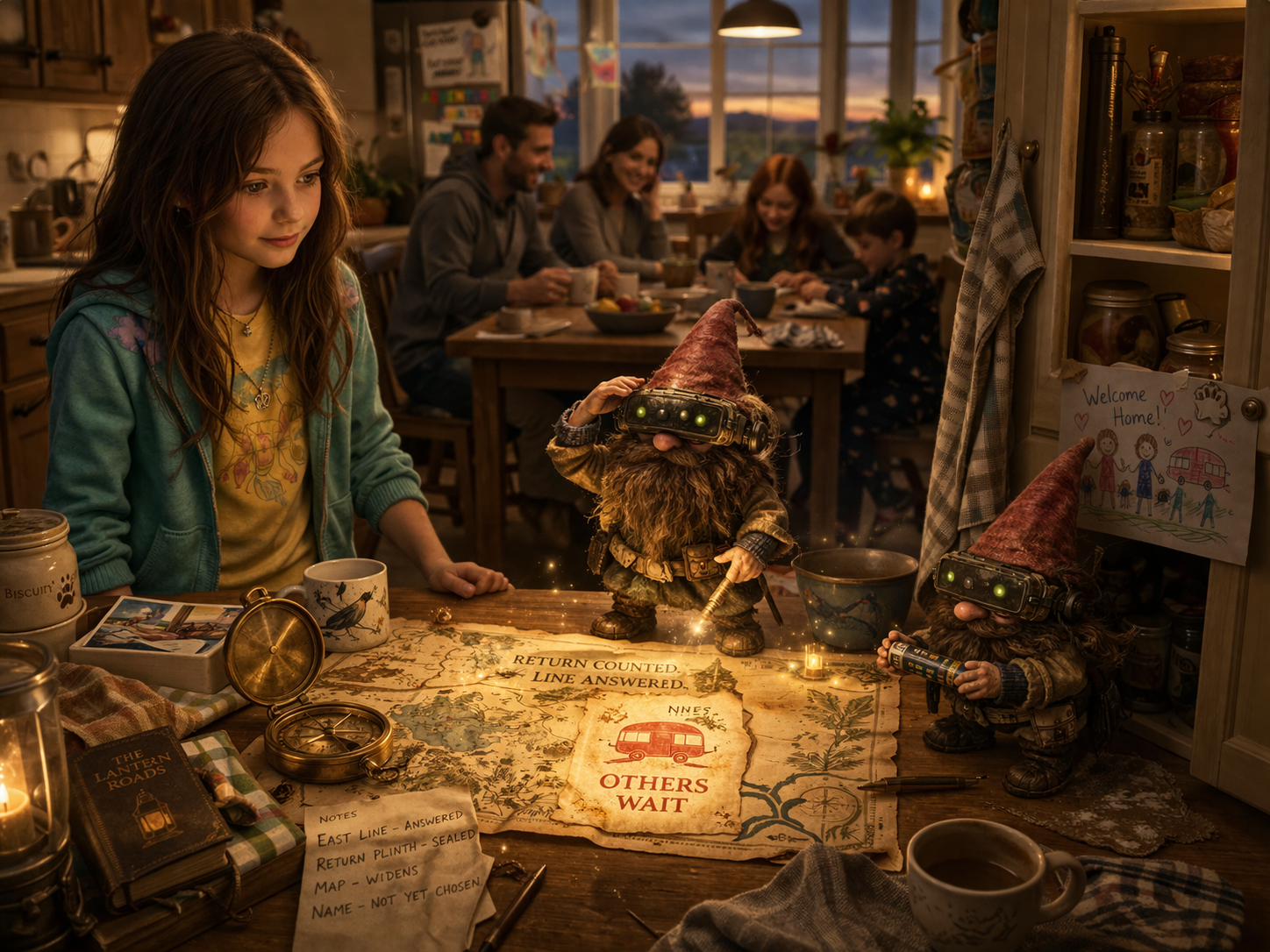
Amber see's gnomes
Amber sat very still.
“Amber?” said Mum.
She blinked and looked down at her plate.
“Nothing,” she said again.
This time she was not sure whether that was true, false, or the sort of answer the Lantern Roads enjoyed most.
Outside, evening settled over Woodend in the ordinary way.
Inside, Home held.
On the bench, the Lantern Compass stayed quiet.
On the map, the one finished line remained calm.
And around it, far beyond campgrounds and beaches and hidden pine roads, the rest of the Lantern Roads waited.
The road that wasn’t on any map, Amber thought, had turned out not to be one road at all.
It was the beginning of all of them.