
Chapter 2 - Site 23
“Mum… our map is missing a site.”
For one strange second, Ivy thought Mum might do the normal adult thing and say she was tired, or imagining it, or that the holiday park had probably just printed the map wrong.
Instead Mum stepped up beside her, looked from the paper in Ivy’s hand to the strip of damp grass beyond their caravan, and said, very quietly, “Yes. It is.”
That was worse.
Because if Mum said it like that, with her voice gone flat and careful, then it meant the thing out there was not just late-night torchlight messing with shadows. It meant Mum could see it too.
The caravan sat beyond the edge of their site where the map showed empty space and a narrow path to the camp kitchen. It was old-fashioned in a way that made Ivy’s skin prickle. Not old like a rusty wreck in someone’s paddock. Old like it had rolled out of a different year and parked itself politely in the dark.
Its rounded roof shone dimly under a yellow porch lamp. The paint looked cream once, maybe, with green stripes gone dull and patchy. One lace curtain had been pulled aside.
The child-shaped figure behind it lifted a hand and waved.
Ivy’s grip tightened on the torch. In her other hand, the Lantern Compass gave a small metallic twitch.
Mum noticed.
“Did you bring that with you?” she whispered.
“It kind of brought me,” Ivy whispered back.
That earned the tiniest, most worried almost-laugh from Mum. “Of course it did.”
The beach was somewhere beyond the dunes, breathing in and out. The holiday park had gone muffled around them. A few sites away somebody’s radio still played, but the sound seemed thin, far off, as if it had been pushed behind glass.
The child in the caravan was still waiting.
“Should we go over there?” Ivy asked.
Mum did not answer right away. She tucked the holiday park map under one arm and stared toward the extra caravan like she was trying to decide whether it belonged in the world at all.
“No,” she said at last. Then, before Ivy could protest: “Not by ourselves.”
Ivy exhaled through her teeth. “Mum—”
“I know.” Mum’s voice stayed quiet, but firmer now. “I know what you’re about to say, and the answer is still no. We wake Dad. Then we decide whether tonight’s gone completely weird or just mostly weird.”
“That feels like splitting hairs.”
“It is. But I’d still like him awake for it.”
The figure at the curtain lowered its hand. For a second Ivy had the horrible feeling it might vanish if they looked away.
Mum seemed to think the same thing, because she said, “Keep your eyes on it,” and began backing toward their caravan.
Ivy did.
The lamp outside the strange caravan flickered once. The curtain moved, just a little, as if somebody inside had shifted their weight.
The compass needle spun, stopped, and pointed dead at the missing site.
“Cool,” Ivy muttered. “That’s normal. Super normal. Love that.”
“Language,” said Mum automatically from the steps.
Ivy glanced back at her. “That wasn’t language.”
“It was tone.”
Even in the dark, with an impossible caravan sitting on grass that should have been empty, Mum could still be Mum. Somehow that helped.
A lot less helped was the fact that when they climbed into the Coachman, Dad was asleep hard enough to qualify as a geological feature.
Mum crossed the caravan in two quick steps and put a hand on his shoulder. “Dad. Wake up.”
He made a noise into the pillow.
“Justin.”
That did it. Dad opened one eye, took in Mum’s face, then Ivy hovering in the aisle in socks and a hoodie with the torch still clutched like a weapon.
“What’s on fire?”
“Nothing,” said Mum.
Dad shut his eye again. “Then it can wait till morning.”
“There’s an extra caravan outside,” Ivy said.
Dad opened both eyes.
From the bunk opposite, Amber pushed herself up on her elbows so fast her hair stuck out in every direction. “There’s a what?”
“No,” Mum said.
“Yes,” said Ivy.
Amber’s face lit up in instant, dangerous delight. “Can I see it?”
“No,” said Mum again.
Oakley sat bolt upright in his little bed as if some hidden launch siren had gone off. “Is it a space caravan?”
Dad dragged a hand over his face. “I need more information and probably tea.”
“You can have both later,” said Mum. “Up. Shoes on.”
It turned out there was no such thing as quietly getting a whole family out of a caravan at night.
Amber could not find one gumboot. Oakley insisted he needed his rocket torch, which was somehow under Dad’s pillow. Dad tried to put on Mum’s hoodie by mistake. Ivy stood by the door vibrating with impatience while the compass clicked softly against her palm like a trapped beetle.
By the time they spilled outside, the campground air had gone colder.
Ivy’s stomach dropped.
For one frightened instant she thought the caravan had disappeared.
Then Dad stepped down beside her, stopped dead, and said, “Oh.”
There it was.
Still sitting on the impossible patch of grass.
Still lit.
Still wrong.
Amber let out the kind of breathy little sound she made in museums and aquariums and anywhere the world turned unexpectedly beautiful or creepy or both. “That,” she whispered, “is absolutely not supposed to be there.”
“Correct,” said Ivy, with more satisfaction than was probably healthy.
Dad folded his arms. That was his practical-thinking posture. “Maybe someone came in late and parked off-map.”
Mum held up the brochure. “On the path?”
Dad looked at the map, then at the caravan again. “Maybe the path’s in the wrong place.”
“It is not the path that is wrong,” said Mum.
Oakley squinted into the dark. “That caravan looks like old toast.”
Nobody had anything useful to do with that.
The curtain twitched again.
Amber grabbed Ivy’s sleeve. “Someone’s in it.”
“I know,” Ivy said.
“Do they know we’re in us?”
“That is not how sentences work,” Ivy said.
“It is at night.”
Dad took one slow step forward. “Stay here.”
Ivy and Amber both made noises of protest at exactly the same time.
Dad looked back at them. “Fine. Rephrase. Stay behind me.”
Mum did not argue. That was how Ivy knew she was actually worried.
They crossed the damp grass together. Ivy felt each blade soak through her socks. The compass pulled harder the closer they got, almost warm now, which felt rude from an object that was definitely made of brass and bad decisions.
The strange caravan was smaller than theirs but somehow looked bigger inside the dark around it, as if night bent a little to fit it. Its windows were narrow and curved. A cracked enamel kettle sat on the step beside a pair of child-sized gumboots. A brass number plate had been screwed beside the door.
Ivy stopped so suddenly Amber bumped into her.
“There,” Ivy said sharply. “There is a number.”
Dad leaned in with his torch. The beam shook just enough for Ivy to notice. “Site Twenty-Three,” he read.
Amber looked from the plate to the brochure map in Mum’s hand. “But there isn’t a Twenty-Three.”
Mum’s fingers tightened on the paper.
The door of the caravan opened inward with a small, careful creak.
The child who had waved at them stood just inside.
He looked about Ivy’s age, maybe a bit younger. Eleven. Twelve. Hard to tell. He had dark hair that flopped over his forehead and a jersey with a frayed collar, the sort of thing somebody’s grandad might wear in an old photo. His face was pale in the lantern light, not ghost-pale, just as if he had not spent enough time in ordinary daylight lately.
He looked at all of them, but his eyes stopped on the compass in Ivy’s hand.
“You brought it,” he said.
Nobody answered.
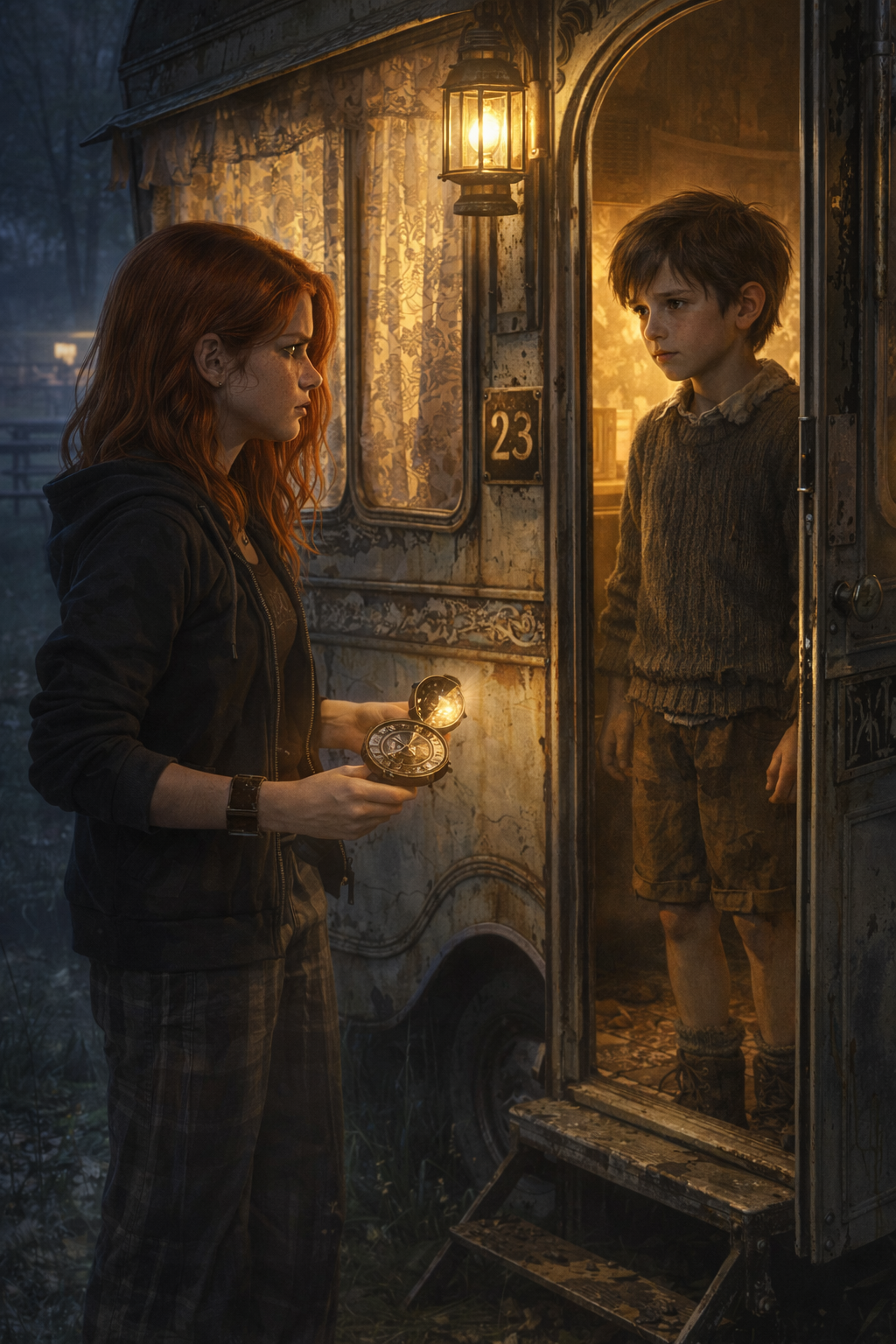
His voice was normal. That was almost the worst part.
Dad cleared his throat. “Are you here with your parents?”
The boy blinked, as if the question had come from a very long way away.
“Not exactly,” he said.
Amber took half a step forward before Mum gently caught her shoulder.
“What’s your name?” Amber asked.
The boy’s mouth moved like he was trying one on. Then he looked at the number plate beside the door.
“I’m in Twenty-Three,” he said.
“That’s not a name,” said Ivy.
“It is if people keep forgetting the rest.”
A little wind moved through the campground.
It did not feel like beach wind. Beach wind rushed and shoved and smelled of salt. This was a thin, cold slip of air, carrying a dusty smell like old cupboards and damp paper. The lamp above the caravan door fluttered.
The boy turned his head sharply toward the far end of the park.
“Did you hear that?” he asked.
“Hear what?” Dad said.
Ivy had heard nothing. That did not stop the hair on her arms standing up anyway.
Oakley peered around Dad’s legs. “The bad road,” he announced.
Everyone looked at him.
Oakley pointed toward the dark beyond the amenities block. “It’s chewing.”
Dad glanced at Mum. Mum glanced at Ivy. Amber went very still.
Then the compass jerked so hard it nearly jumped out of Ivy’s hand.
Something moved at the edge of the holiday park.
At first Ivy thought it was just shadow, a long patch of shadow sliding where shadow should not slide, because the moonlight was coming from the wrong direction for that. Then it passed over the white post of a nearby site marker, and the number on the post vanished.
Not got covered.
Vanished.
The post was still there. The reflective sticker was still there.
But the number was gone.
Ivy’s stomach dropped into her socks.
The thing kept moving. Low. Long. Too smooth. Like darkness had learned to crawl.
The boy in Twenty-Three flinched backwards. “You need to go.”
Dad stepped in front of the kids. “Excuse me?”
“Go back to your caravan,” said the boy, louder now, scared now. “Shut the windows. Lock the door. If it knocks, don’t answer.”
Amber stared at him. “What is it?”
The boy’s gaze flicked to the creeping patch of wrongness and away again. “Hungry.”
The lamp above the door flashed brighter. For half a second Ivy saw more of the inside of the caravan behind him.
A narrow table.
A shelf of old tins.
A map pinned to the wall with red lines running across it like cracks.
Then the light dipped.
The moving shadow reached the edge of Site 22 and the little solar fairy lights someone had strung along their awning blinked out, one by one, like invisible fingers pinching them dead.
Dad swore under his breath.
Mum did not waste another second. “Back. Now.”
Ivy did not want to move. She wanted answers, and a better look, and maybe to shake the entire universe by the shoulders until it explained itself properly. But Mum’s voice had gone into the tone that meant argument was a hobby for later.
They began retreating.
The boy stepped down onto his little metal stair and held something out toward Ivy.
She hesitated.
“Take it,” he said.
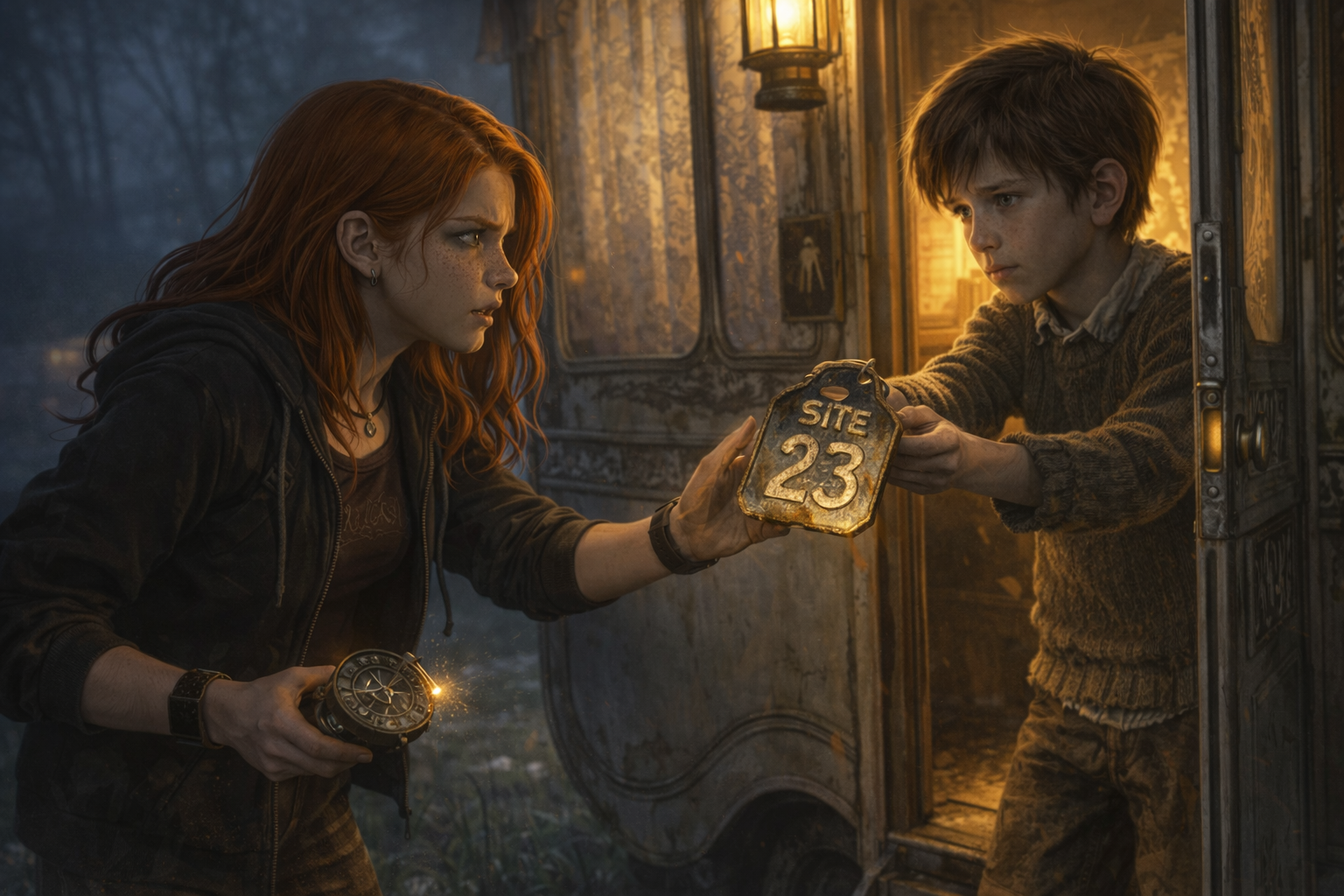
The shadow thing slid closer. The grass beneath it looked colourless.
“Ivy,” Mum snapped.
Ivy lunged, snatched the object from his hand, and jumped back.
It was cold and square and heavier than it looked.
The boy met her eyes. “Keep it where the map can see it.”
That made almost no sense.
Then Oakley, who had absolutely no respect for tension, waved cheerfully at the boy and called, “Bye, Toast Caravan!”
To Ivy’s astonishment, the boy smiled.
“Bye,” he said.
The lamp went out.
Darkness folded over Site 23.
Not all at once. More like a curtain dropping in slow motion. One blink there was an old caravan, a boy on the step, and a brass number plate shining faintly. The next there was only a shape. Then less than a shape.
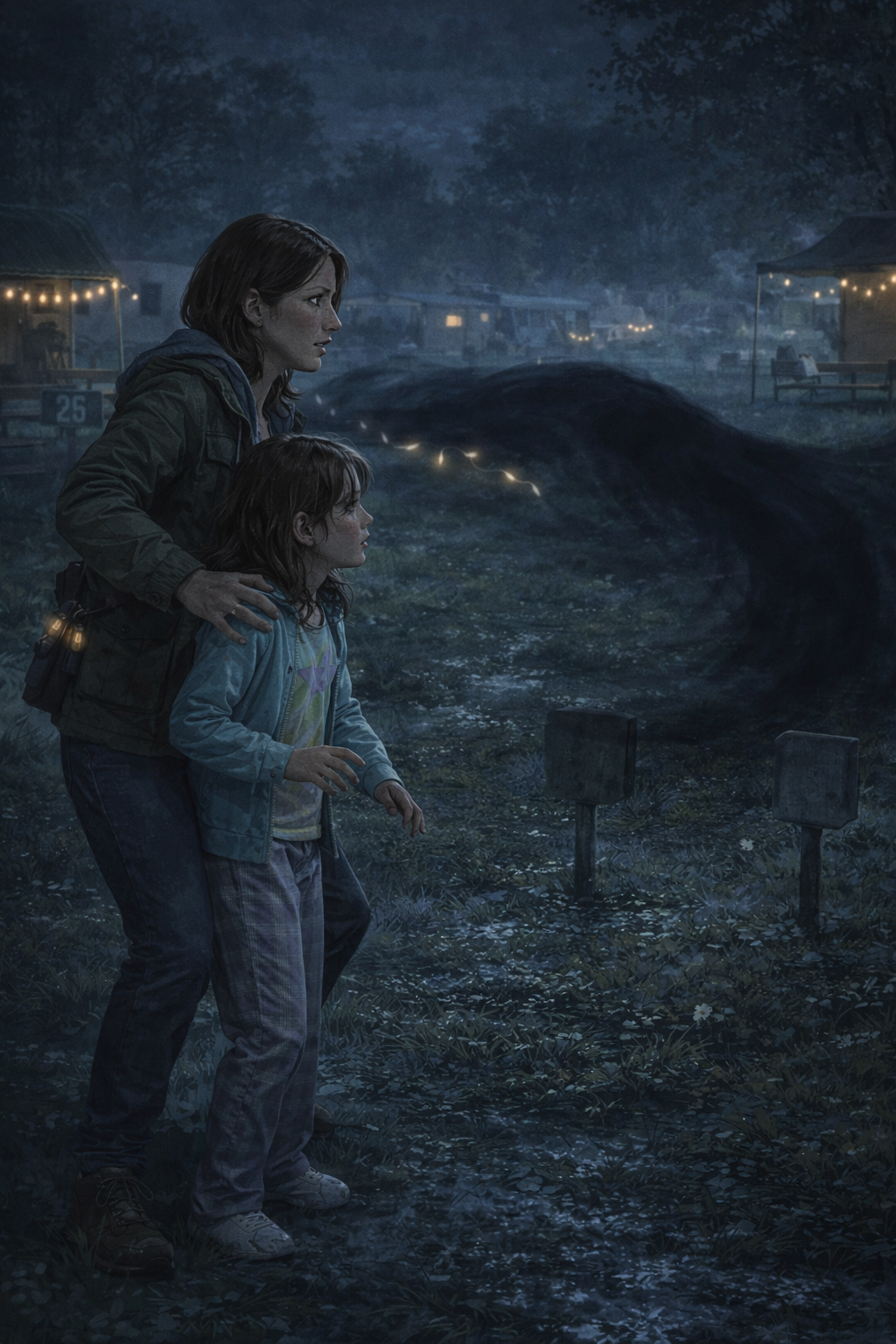
Then nothing but wet grass and night.
Dad’s torch beam hit the place where it had been and found empty ground.
Amber made a sound halfway between a gasp and a yelp.
Dad strode forward across the last few metres of grass and swept the torch everywhere. No caravan. No boy. No stair. No number plate. Nothing except a flattened rectangle in the damp, as if something heavy had been parked there not long ago.
And beyond it, sliding away between the sites, the long black wrongness withdrew into the dark.
The numbers on Site 22 and Site 24 stayed blank.
Ivy realised she was breathing too fast.
Mum’s hand landed on the back of her neck, warm and steady. “Inside,” Mum said.
This time nobody argued.
The inside of their caravan felt too bright after that, even though Dad had only turned on the little lights above the dinette.
Nobody sat where they were supposed to. Dad stood by the curtained window looking out through the narrow gap. Mum had Oakley on her lap because he had suddenly gone clingy in the way he only did when something genuinely strange had punched through his usual chaos. Amber curled sideways on one bench with her knees tucked up, staring at the square object in Ivy’s hands.
It turned out to be an old site tag.
Not plastic. Enamelled metal, chipped at the corners, with a hole through the top where it must once have hung on a hook or a key ring. On one side, in faded black letters:
23
On the other side, barely visible under grime, was a tiny lantern engraved inside a circle.
The same lantern as the compass.
Nobody said that for a few seconds.
Then Dad said, “Right.”
He said it the way he did when reality had become personally offensive.
“Right,” he repeated. “So. Let’s review. There was definitely a caravan.”
“Yes,” said Ivy.
“Yes,” said Amber.
“Yes,” said Mum.
Oakley nodded solemnly. “Toast one.”
Dad looked at him. “Correct. Thank you.”
He turned back to Mum. “And we all saw a kid.”
“Yes.”
“And then the whole thing vanished.”
“Yes.”
Dad put both hands on the table and leaned on them. “I hate this holiday already.”
That would have been funny if Ivy’s heart was not still trying to leave through her throat.
Amber lifted her head. “He was scared.”
Dad glanced at her. “He might also be dangerous.”
Amber frowned. “He told us to go inside.”
“That doesn’t make him safe.”
“It makes him not the worst one out there.”
Nobody had a decent reply to that.
Mum looked at Ivy. “What did he hand you exactly?”
Ivy slid the site tag across the table. The compass lying beside it clicked once and pointed at it like an overeager snitch.
Dad saw that and went still. “That thing’s doing it again.”
“It has been doing it again,” said Ivy.
Dad rubbed at his forehead. “I know.”
Mum picked up the site tag and turned it under the light. “Lantern symbol,” she said softly.
Amber looked between the tag and the compass. “So the same people made them?”
“Or the same something,” said Ivy.
Dad gave her a look.
“What? We are past normal object rules.”
Mum set the tag down carefully. “He said keep it where the map can see it.”
“That is an absolutely unhelpful sentence,” Dad said.
“It is if you hate mystery,” said Amber.
“I do hate mystery,” Dad said. “Mystery is just a problem wearing a dramatic hat.”
Even Ivy, wound tight as she was, snorted at that.
Mum took the holiday park brochure from the counter and unfolded it on the table. The paper showed the neat printed map of the grounds: rows of sites, amenities block, camp kitchen, playground, path to the dunes.
No Site 23.
Ivy set the old tag on the blank space where the impossible caravan had stood.
Nothing happened.
“Maybe it needs darkness,” Amber said.
“Or honesty,” said Ivy, before she could stop herself.
Everyone looked at her.
She shrugged, suddenly hot-faced. “The compass said ‘For the Honest Road.’ The map in the car said ‘safe if welcomed.’ Maybe this stuff has weird rules.”
Dad did not laugh or tell her not to be ridiculous.
That frightened her more than if he had.
Mum let out a slow breath. “I think Ivy’s right.”
Dad stared at her. “Belinda.”
“I’m not saying I like it,” said Mum. “I’m saying it fits too many things already.”
Oakley, half-dozing against her, murmured, “Don’t let it lick the windows.”
Dad closed his eyes for a second. “Fantastic.”
Amber looked at the curtains. “Do you think it will knock?”
Nobody answered.
Because yes was the obvious answer, and no would have been a lie.
Dad pushed himself upright. “Right. New plan. Nobody opens anything tonight. Nobody goes outside. If anyone needs the toilet, congratulations, they can suddenly wait till morning.”
Oakley sat up. “I need the toilet.”
“No, you do not,” Dad said.
Oakley considered this. “Okay.”
Mum stood and checked the latch, then the windows, then the door again, as if practical actions could build a wall against whatever moved in the dark outside. Maybe they could. Maybe that was the point of practical actions. Maybe doing ordinary things in the face of impossible ones was how you kept from coming unstuck.
Ivy liked that thought. She did not entirely believe it.
The rest of the night went badly.
Not loudly badly. Quietly badly.
Every sound mattered too much.
Wind in the pōhutukawa branches sounded like whispering. Somebody zipping a tent three sites over sounded like a warning. The little fridge kicking back on nearly made Amber squeak.
Ivy stayed awake in her bunk with the curtain open a crack and the compass under her pillow, because apparently she had decided sleep was for people whose campgrounds obeyed maths.
At 12:17, something tapped the caravan window.
Just once.
Not a branch. Not rain. Not a bug.
Tap.
Ivy stopped breathing.
From the bunk below, Amber whispered, “I heard that.”
Dad’s voice came from the front of the caravan, low and awake. “Nobody move.”
Silence.
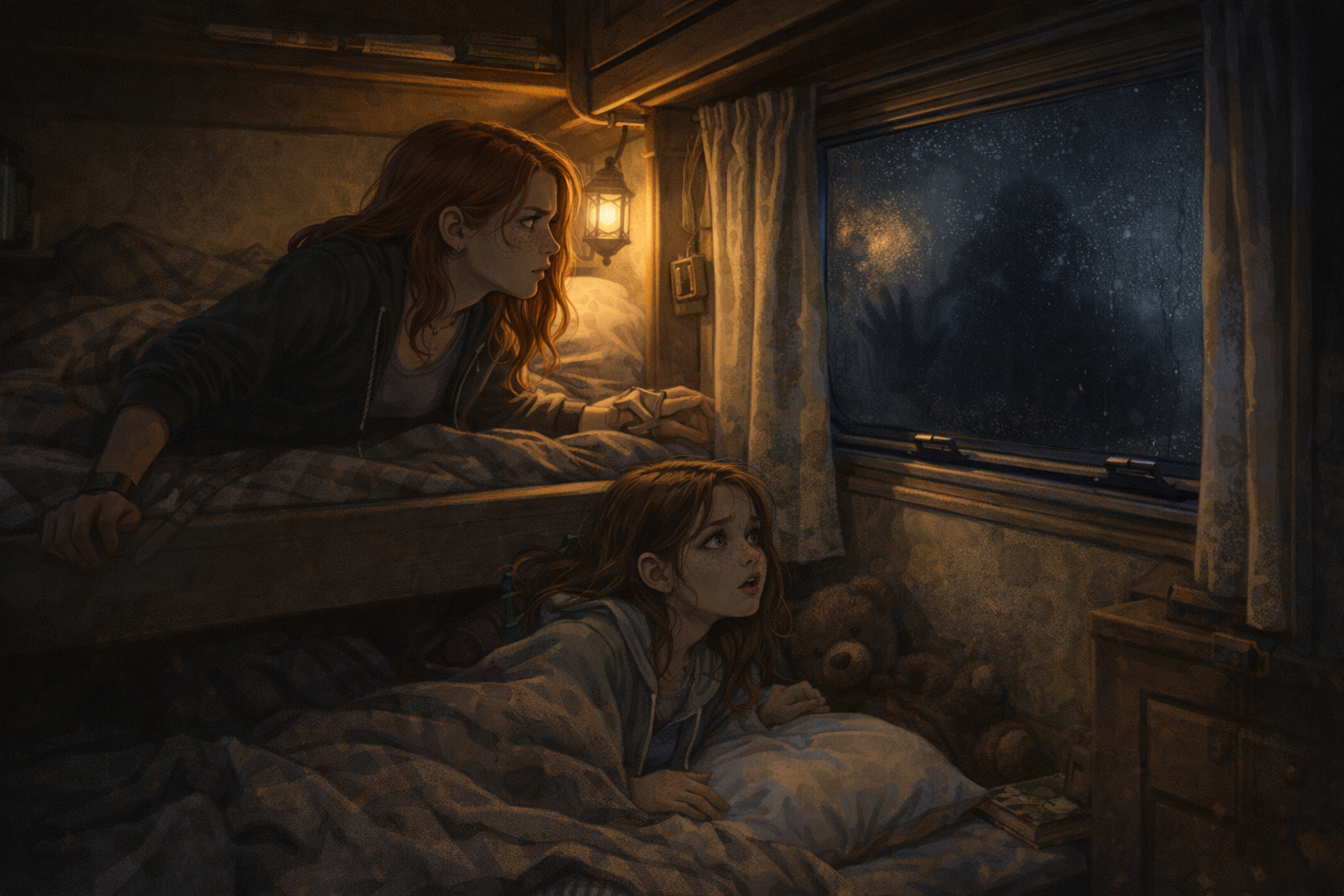
Then, very softly, from outside near the door:
Ivy.
It was Mum’s voice.
Exactly Mum’s voice.
Amber made a tiny broken sound.
Mum, who was very much inside the caravan by the dinette, said in a voice that was definitely hers, “Do not answer that.”
The outside voice waited.
Then it said, in Dad’s voice, “Ivy, open up, mate.”
Dad swore so quietly it was almost respectful.
Oakley, from somewhere under a blanket fortress, announced, “That’s not our Dad.”
The handle did not turn.
Nothing scratched.
Nothing banged.
It only stood there for what felt like a whole damp century, and then the air changed, like pressure easing before a storm passes, and the campground noises came back all at once: surf, distant laughter, a toilet block door slamming, somebody coughing.
No one slept much after that.
Morning arrived anyway.
It was a bright, ordinary sort of morning, which felt personally insulting.
Sunlight turned the caravan windows golden. Gull cries came from the beach. Somewhere a kid yelled because somebody had stolen their cereal bowl. Dad went outside first in track pants and a face like he had been sanded overnight.
The others followed in a clump.
The place where Site 23 had stood was empty.
Completely.
No old caravan. No porch lamp. No boy.
Just a patch of damp grass more flattened than the rest, with faint wheel ruts pressing into the earth and stopping where the path ought to have been.
Site 22 had its number back.
So did Site 24.
As if the night had tidied itself up and decided to lie.
Dad crouched by the wheel marks. “Okay,” he said. “That is still not nothing.”
Amber hugged herself. “Do you think he’s gone?”
Ivy looked at the flattened patch and felt a weird little ache in her chest she did not want. “I think he was never here properly.”
Oakley pointed at the ground near the edge of the site. “He forgot his toast smell.”
Mum looked at him, then at the faint square of flattened grass, and for some reason that nearly undid Ivy more than the knocking had. Because Mum looked sad.
Not terrified.
Not confused.
Sad, like this mystery had a human cost already and they had only just arrived.
Dad straightened up. “I’m going to the office.”
“With that?” Mum asked, nodding to the site tag in Ivy’s hand.
Dad hesitated.
Ivy held it tighter.
Mum looked at her. “You found it. You bring it.”
That was how, ten minutes later, Ivy ended up marching across Kōwhai Coast Holiday Park beside Dad and Mum, carrying a chipped metal tag for a site that officially did not exist, while Amber and Oakley trailed behind eating emergency breakfast biscuits straight from the packet because nobody had the emotional range for proper cereal.
The office smelled of sunscreen, old brochures, and burnt coffee.
Behind the counter stood a man in a faded campground polo, a rain jacket tied around his waist even though the sky was blue. He had the kind of face that seemed permanently arranged for disappointment.
“Tane Rook,” his name badge said.
He looked up as they came in. “Morning.”
Dad gave him the sort of nod adult men used when they were trying not to sound like they’d been awake all night being psychologically attacked by a caravan.
“Morning,” Dad said. “We’ve got a question about the site map.”
Tane already looked tired of it. “If you want to move closer to the playground, you should’ve booked earlier.”
“It’s not that,” said Mum.
Ivy put the old tag on the counter.
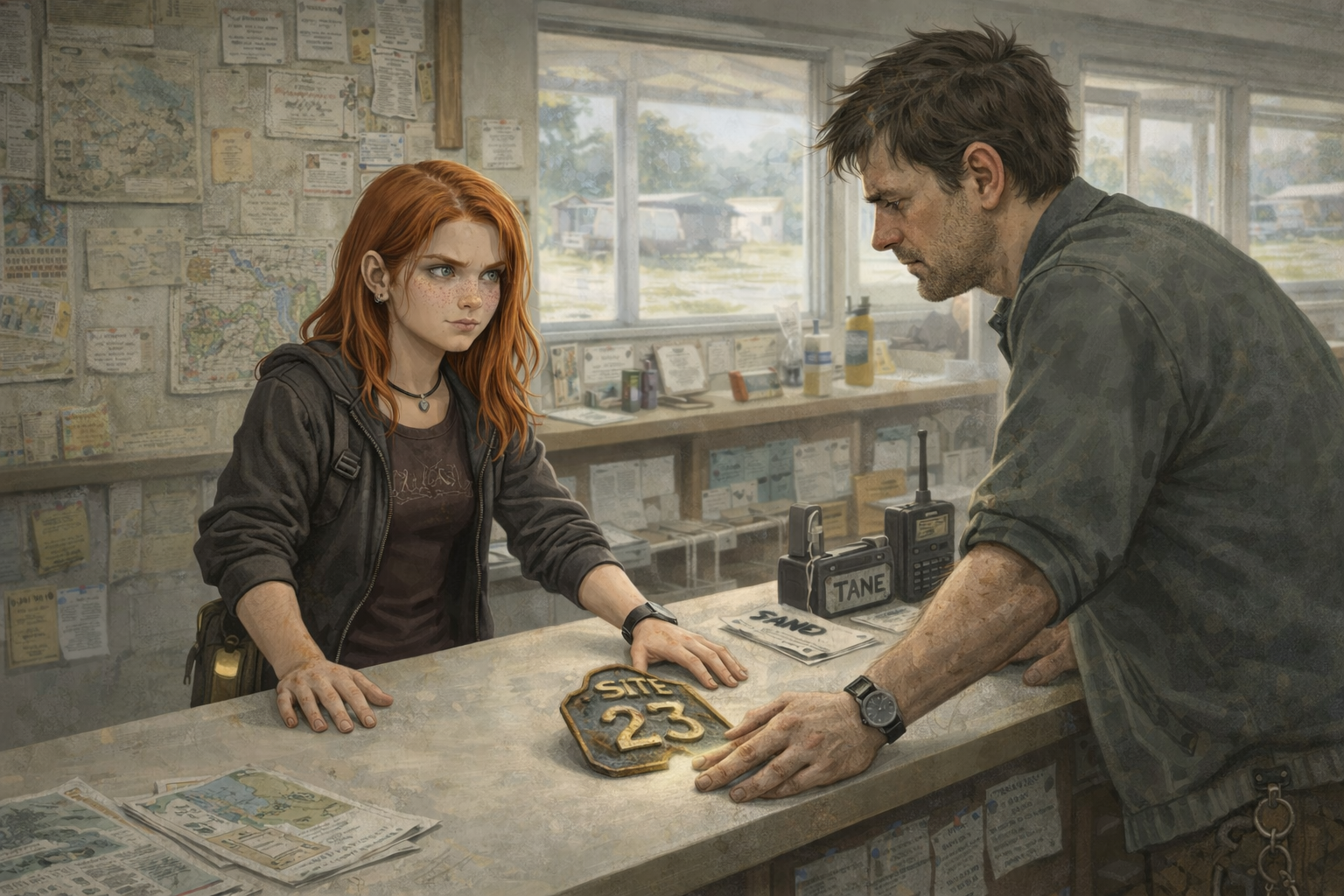
Tane looked down.
And all the boredom fell off his face.
He did not gasp. He did not stumble back. That would have been too dramatic for him. He just went still in a way that felt worse.
“Where,” he said carefully, “did you get that?”
Ivy heard Dad breathe in beside her.
“From Site 23,” Ivy said.
Tane’s eyes lifted to hers.
For a second, he looked exactly like someone who had hoped never to hear those words again.
“There is no Site 23,” he said.
Dad’s jaw tightened. “Funny story. There was last night.”
Tane looked past them through the office window toward the campground. The bright morning showed families hanging towels, kids on scooters, a man in jandals carrying half a bag of ice. Normal, normal, normal.
Then Tane looked back at the tag.
His thumb hovered over it but did not touch.
“When did it appear?” he asked.
Mum answered before Dad could. “After dark.”
“Was there a caravan?”
“Yes.”
Tane swallowed.
“Was there a boy?” Amber asked quietly.
Tane’s expression changed again. Not much. Just enough.
He knew.
Ivy felt it like a click in her bones.
Dad saw it too. “You need to tell us what’s going on.”
Tane laughed once, without humour. “If I knew that, I’d be sleeping better.”
Mum leaned one hand on the counter. “Try us.”
Tane studied their faces one by one. Dad angry and tired. Mum steady. Ivy probably looking like she would bite through drywall for an answer. Amber wide-eyed. Oakley licking biscuit crumbs off his thumb like this was all perfectly standard campground admin.
Finally Tane said, “Pack up early today.”
Dad stared at him. “That’s your helpful advice?”
“It’s the helpful bit you’re getting first.”
He slid open a drawer, took out an old folded local road map, and tapped one point on it with a blunt finger.
A little building icon by the highway.
No name.
Just a square.
“If your map starts drawing lines again,” he said, not looking at Dad now but at Ivy, “and if one of those lines leads here, do not ignore it.”
Amber leaned in. “What is it?”
Tane folded the map once and pushed it across the counter.
“A dairy,” he said.
He looked at the site tag one more time, face grey around the edges now.
“Also,” he added, “if Twenty-Three appears again—”
He stopped.
The office seemed to hold its breath.
Ivy said, “What?”
Tane met her eyes.
“Don’t let it leave with your name.”