
Chapter 4 - The Wrong Footprints
By the time they reached the coast, the day had thinned into that strange late-afternoon light that made everything look both sharper and more tired.
The sea appeared first in flashes between scrub and dune grass. Then the road curved, the view opened, and there it was in full: a long black-sand beach under a pale sky, the Tasman rolling in with big white edges and a steady, breathy roar. A faded DOC sign leaned beside the gravel pull-over. Someone had once painted over the rust. The rust had won.
Dad parked the RAV4 facing out.
“That,” he said, gripping the steering wheel for one beat longer than necessary, “is because I enjoy efficient exits and definitely not because a nameless dairy woman told us not to do anything stupid near demon footprints.”
“She didn’t say demon,” Amber said.
“She didn’t need to.”
Oakley was already half out of his car seat straps. “Is this the walking sea?”
“No,” said Ivy, reaching over to stop him launching himself into the footwell, “this is the staying-in-the-car-until-an-adult-opens-your-door sea.”
“That’s not a sea.”
“It is now.”
Mum had Tane’s map open on her lap. The old paper had gone soft from being folded and unfolded too often in one day. The black-sand beach postcard sat tucked inside it, and the strange receipt was folded around the Site 23 tag so the enamel square stayed pressed against the page where the red route line had last shown itself.
The Lantern Compass lay open beside Mum’s hand.
Its needle was not pointing inland.
It was not pointing north either.
It kept twitching toward the beach, then slightly left along the tide line, then back again, as if the shore ahead was not one place but several trying to sit on top of each other.
Mum looked up through the windscreen.
“Firm sand,” she said quietly. “That was one of Mo’s rules.”
Dad exhaled through his nose. “Right. Firm sand. No following the first footprints. No names. No matching anything. If somebody starts inviting us into a cursed side quest, we decline politely and leave.”
“We’re already in the side quest,” Ivy muttered.
Dad looked in the rear-view mirror. “I’m aware.”
Amber leaned forward between the seats, eyes wide on the sea. “Do you think the boy paid for the postcard?”
Nobody answered straight away.
That had become a problem lately. Half the things they said now landed too hard.
Mum closed one hand over the map and looked back at them all in turn.
“Shoes on. Stay together. Nobody runs. Oakley, that includes your soul.”
“My soul is speedy.”
“I know.”
That got a laugh out of Dad despite himself, and for a second the car felt ordinary again. Wind. Chips in the door pocket. Damp towels piled in the back. Holiday mess. Family noise.
Then the Compass needle jumped so sharply it clicked against the glass.
Nobody laughed after that.
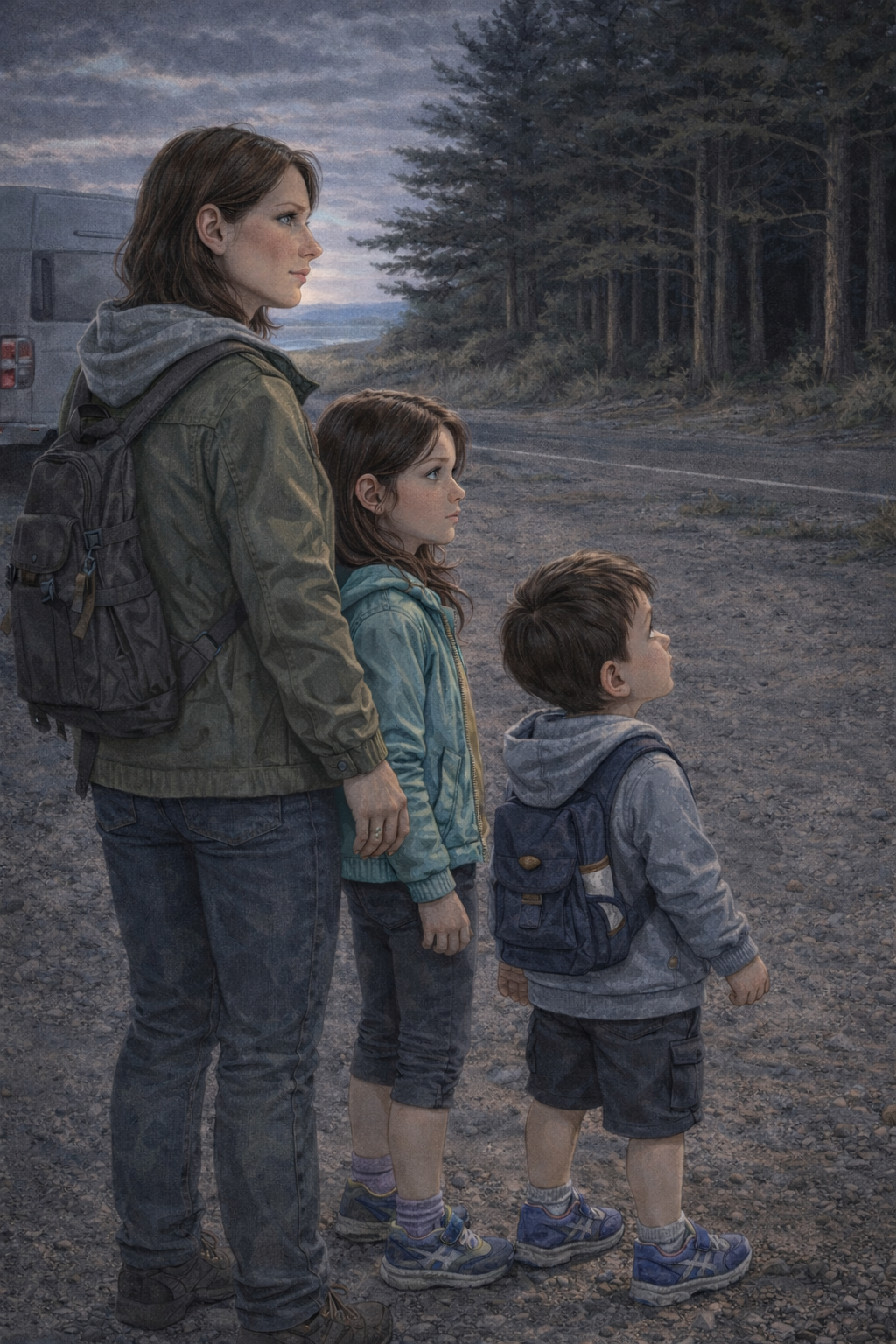
The carpark was mostly empty.
One campervan sat at the far end with its curtains drawn. A surf lifesaving tower stood silent and boarded up for the season. The wind pushed salt over everything. Black sand hissed across the concrete in dry little streams.
Ivy climbed out first and pulled her hoodie tighter. The air was colder than she’d expected. Not South Island mountain cold. Coast cold. Wet, blunt, full of movement.
Oakley pointed at the sea with both hands. “It’s huge.”
“Yes,” said Dad. “Thank you, NASA.”
Amber spun once in the wind and caught herself. “It feels wrong.”
It did.
That was the irritating thing. The beach was beautiful. Huge and clean and dramatic in exactly the way beaches on postcards always wanted to be. The surf rolled in hard. Gulls rode the air. Far off, black rocks stuck out of the water like broken teeth.
But the place felt watched.
Not by a person standing somewhere.
By the beach itself.
Mum locked the car and kept the map tucked under one arm. The receipt was still folded around the Site 23 tag. Ivy noticed she was holding the whole bundle very carefully, as though it might decide to make a run for it.
Dad crouched in front of Oakley and zipped his little jacket all the way up.
“Rule check,” he said.
Oakley put up one finger. “No exploding.”
“Good starting point.”
“Stay wif the big people.”
“Yes.”
“No stealing a sea.”
Dad nodded. “That one was not on my list, but I support the energy.”
Amber smiled faintly. Ivy didn’t. Her eyes had gone back to the shoreline.
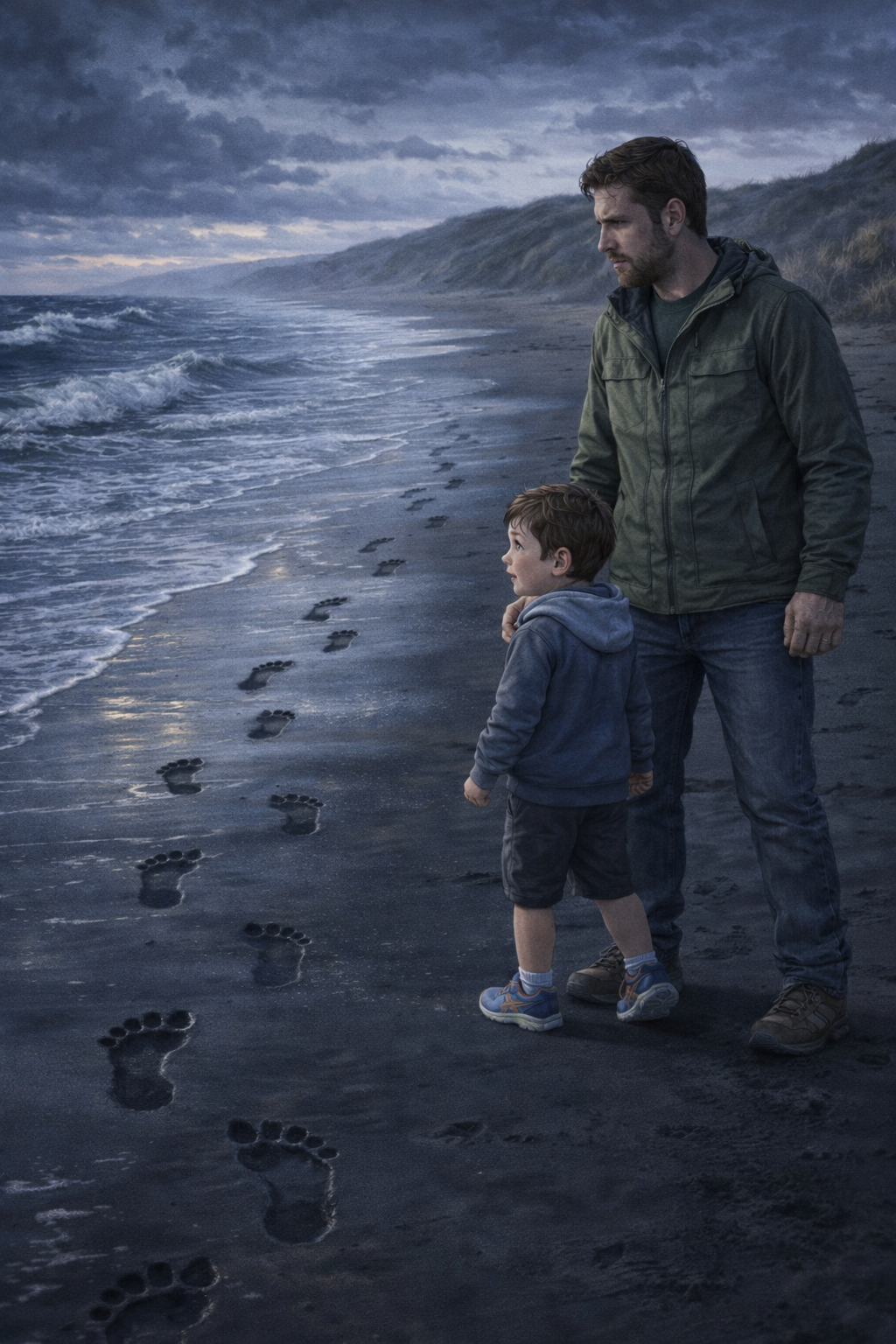
There was something there.
Not a person. Not exactly movement.
Just a patch near the edge of the tide where the wet sand seemed darker than the rest. Too dark. Too neat. As if the beach had rubbed one bit of itself hard with a thumb.
Mum followed her gaze.
“Stay behind me until we know what we’re looking at.”
“That’s going to be difficult,” Ivy said. “Since what we’re looking at appears to be the whole beach.”
“Behind me anyway.”
They walked down the path through low scrub and onto the sand.
The first step onto it felt wrong at once.
Not because the beach was soft. It wasn’t. The upper dry sand shifted, but below that lay a firmer, damp strip packed flat by the tide. Mo had said stay there. Firm sand. The strip ran along the beach in a dark shining curve.
The wrongness came from the sound.
Footsteps should have made footstep sounds.
Instead the sand took each one with a soft, swallowed hush, as though it were listening before it let them go.
Dad heard it too. “Nope,” he said under his breath. “Absolutely not a fan of that.”
Oakley grinned up at him. “Beach is eating noise.”
“Lovely. Hate it.”
The wind shoved at them from the sea. Ivy pushed hair out of her mouth and looked left, then right. Their footprints trailed behind them in a neat family line. Mum’s. Dad’s. Amber’s. Ivy’s. Oakley’s smaller ones stamping in bursts whenever he forgot to walk properly.
Ordinary.
Then Amber caught Ivy’s sleeve.
“There.”
Just ahead of them, close to the edge of the foam, a fresh footprint appeared.
Not because someone stepped there.
Because the sand dipped on its own.
A bare human footprint. Clear heel. Five toes. Smallish. Pointing inland.
Nobody moved.
A second footprint appeared ahead of it.
Then a third.
Then a fourth.
A line of prints formed out of nothing, one after another, coming away from the sea and heading diagonally up the beach toward the dunes.
Oakley made a very small, impressed noise. “The sea is doing walking.”
Dad’s hand landed instantly on his shoulder. “Nobody follows that.”
“I know,” Oakley said, equally offended and delighted.
The footprints kept coming.
Each one arrived with a tiny, awful softness, as though an invisible foot were pressing down and lifting away. The line climbed the beach. Straight toward the marram grass.
Ivy pulled the receipt from Mum’s folded map and opened it with cold fingers.
The black text was still there.
THANK YOU FOR PAYING IN FULL.
DO NOT FOLLOW THE FIRST FOOTPRINTS.
“Those are the first ones,” Amber whispered.
“That’s the trap, then,” said Dad.
“Or the invitation,” Mum said.
That was worse somehow.
The footprints stopped just short of the dunes.
There were maybe twelve of them. Maybe thirteen. Ivy didn’t trust herself enough to count. They looked too neat. Too deliberate. They did not look like prints someone had made by walking. They looked like the idea of footprints. The beach showing its working.
Nothing stood at the top of them.
No person. No creature. No damp child staring out of the wind.
Just dune grass moving in hard gusts.
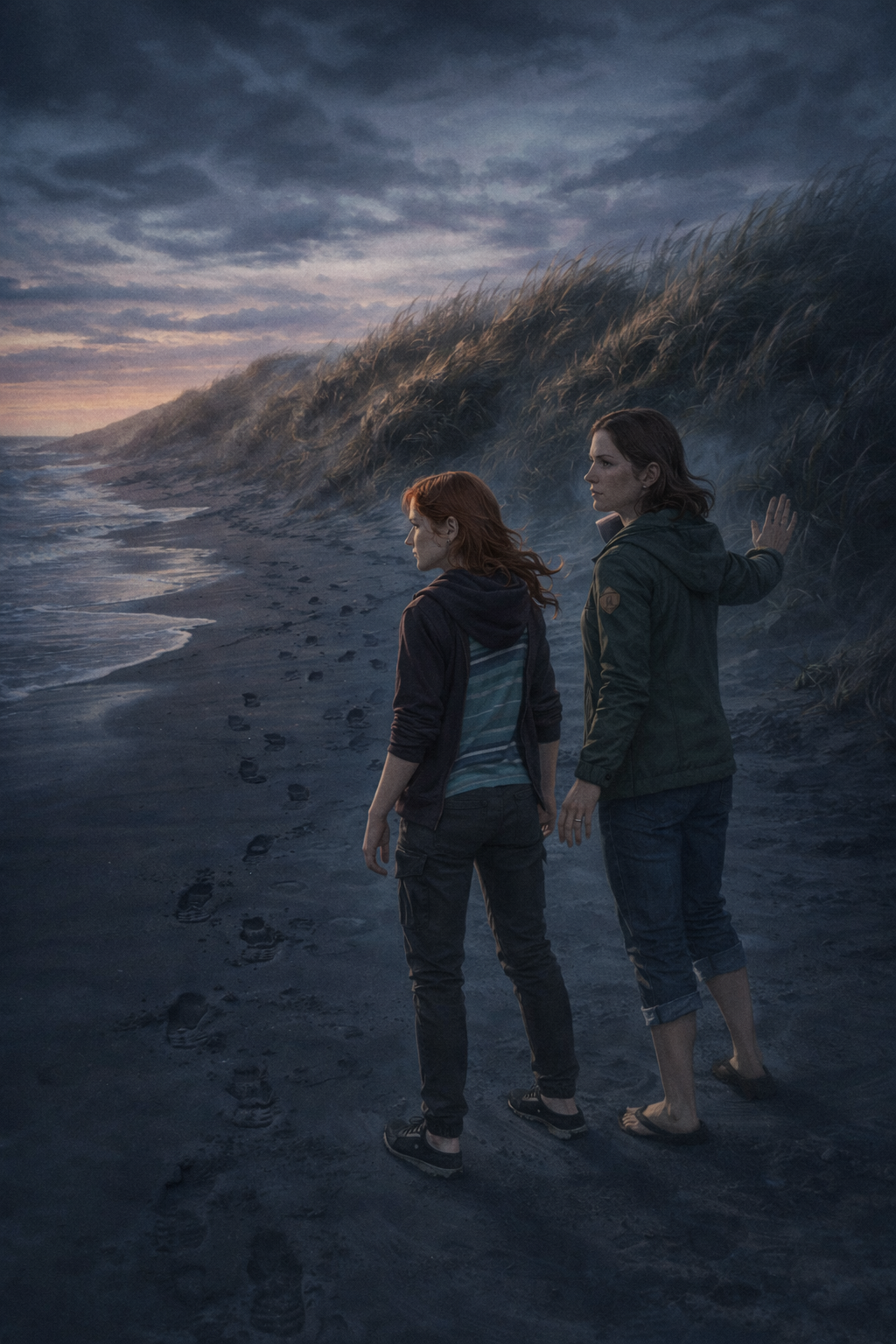
Then, from somewhere behind the dunes, a voice called, “I-vie?”
Every hair on Ivy’s arms lifted.
Dad’s head snapped round. Amber grabbed Mum’s sleeve. Oakley went very still.
It had not been loud.
It had not sounded monstrous.
That was the problem.
It had sounded close. Familiar enough to make Ivy’s chest jump before the rest of her caught up.
Wrong enough that she knew, one beat later, it wasn’t right.
I-vie.
Almost.
Almost.
Mum stepped forward before Dad could.
“No,” she said, calm and clear into the wind.
The dune grass shivered.
The voice did not answer.
Dad stared at her. “That was it?”
“It wasn’t asking a question,” Mum said.
The Compass clicked in her hand.
Ivy had not even seen her take it from the map.
The needle was pulling left now, along the shoreline.
“Bel—” Dad stopped himself, jaw tightening. “Mum.”
Another footprint appeared.
Not on the inland line.
On the wet firm strip near the water.
Then another.
These pointed the other way.
Out to sea.
Amber sucked in a breath. “Return.”
Everyone looked down at the postcard in her hand.
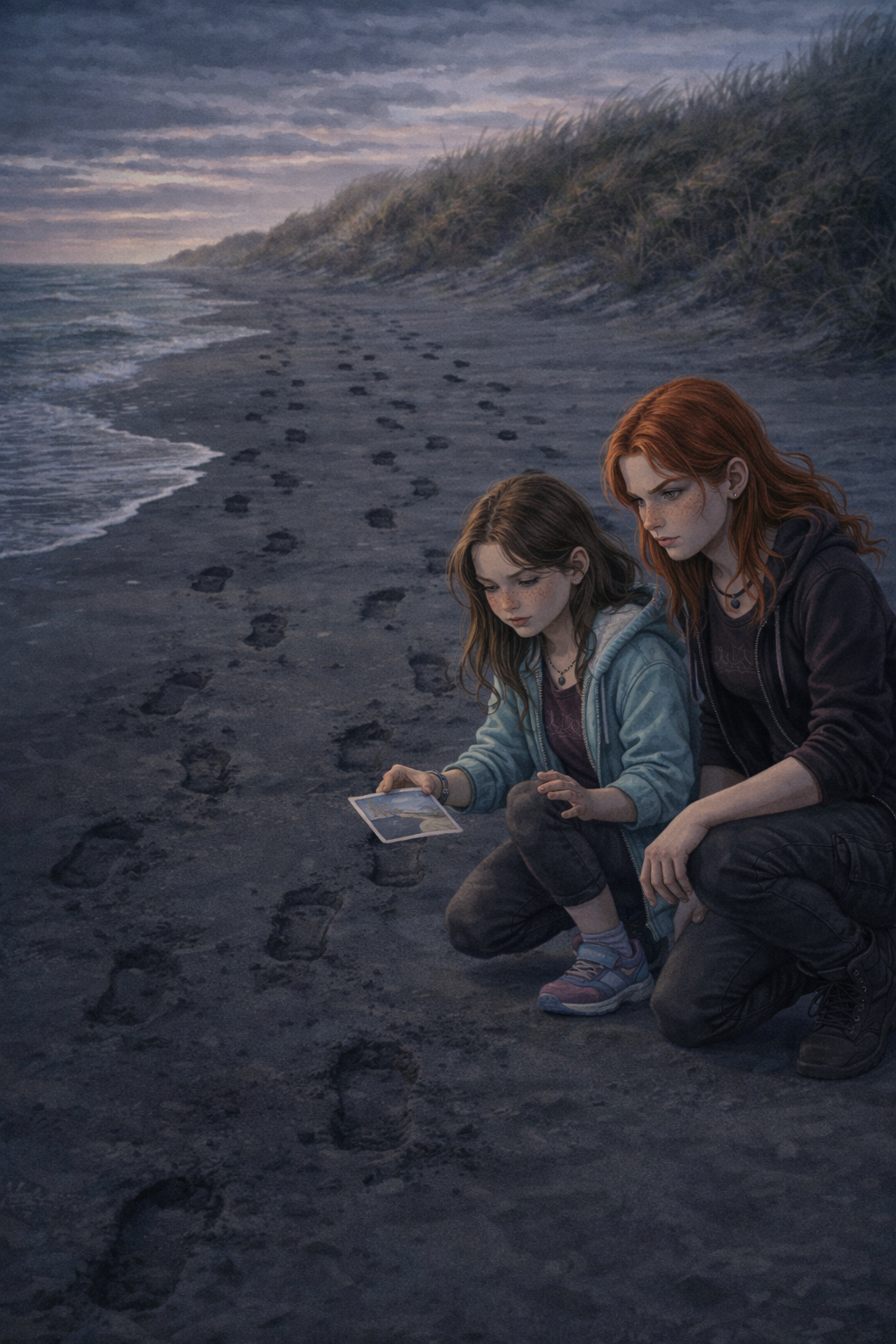
At some point she had taken it from the map without anyone noticing. Her thumb covered the lantern stamp in the corner. The image on the front—black sand, low surf, too many footprints—looked less like a picture now and more like a warning label.
“Count only the ones that return,” Amber said. “Not each footprint. The tracks. Count the tracks.”
A second line appeared from the dunes, heading back down toward the water.
Then a third.
Then a fourth.
Each one was separate. Whole little paths of bare footprints, as if invisible people were coming back across the beach one after another.
Dad stared. “That is not okay.”
“No,” Mum said. “But it is useful.”
They began counting.
Not the first line. Not the eager one coming inland. The returning lines.
One.
Two.
Three.
The tide hissed up and withdrew. The wind flattened the dune grass in waves.
Four.
Five.
Six.
Oakley whispered the numbers after them with grave rocket-launch concentration.
Seven.
Eight.
Nine.
More tracks appeared. Some small. Some adult-sized. Some narrow, some broad. All of them came back from the dune line to the water and ended where the foam reached in and touched them away.
Amber counted with her finger pressed to the postcard.
Dad counted under his breath.
Ivy counted because not counting felt impossible.
Ten.
Eleven.
Twelve.
The voice came again.
“Emmber?”
Not quite Amber.
Not quite any normal way anybody ever said Amber.
The second syllable dragged too long, sweet in a way that felt sticky.
Mum did not even turn.
“We hear you,” she said. “We are staying on the firm sand.”
The wind hit them hard enough to sting Ivy’s face.
For a second the air smelled wrong. Not sea salt. Not wet kelp. Something stale and shut in. Dust. Old curtains. Caravan air that had not moved in years.
Site 23.
Ivy knew it before she had a proper thought.
Thirteen.
Fourteen.
Fifteen.
The returning tracks kept forming.
Dad had moved closer now, one arm half out as if he could physically stop the whole family from making a bad decision with sheer parental authority. Knowing Dad, he probably believed he could.
Sixteen.
Seventeen.
The inward line near the dunes deepened.
The very first footprints.
The wrong ones.
They had not faded. They had sunk darker instead, waiting.
“Why are they still there?” Ivy asked.
Nobody answered.
Because everyone knew.
They were waiting for somebody to complete them.
Eighteen.
Nineteen.
Twenty.
The sea boomed against the shore. Gulls had stopped calling. Even the wind seemed to pull its punches.
Twenty-one.
Twenty-two.
Then nothing.
No twenty-third returning track.
The beach held itself.
Ivy looked from the water to the dunes to the wrong footprints leading inland. They were smaller than she’d first realized. Child-sized. Not tiny. Not Oakley. Closer to—
“No,” she said out loud.
Mum turned to her at once. “What?”
Ivy pointed with a shaking finger. “Those are his.”
Nobody asked whose.
They all knew.
The boy from Site 23.
The line from the sea to the dunes waited in dark little steps. Child-sized. Stopping exactly where the marram grass began.
Only twenty-two had returned.
Something had come in.
Something had not gone back.
The Site 23 tag, still wrapped in the receipt inside the fold of the map, grew suddenly hot through the paper.
Ivy jerked. Mum saw it, opened the fold, and the chipped enamel square nearly fell out.
The lantern symbol on the back had gone bright.
Not glowing. Not silly magic-movie shining. Just sharper. Wet-looking. Alive in a way metal should never be.
Dad saw Ivy’s face and went pale around the edges.
“No,” he said at once, following the direction of her thoughts with horrifying accuracy. “Absolutely not. You are not stepping into anything.”
“I wasn’t—”
“You were.”
“I was thinking.”
“With your feet.”
“That is incredibly rude.”
“It is also correct.”
Another voice called from behind the dunes.
This time it said, “Ivy.”
Perfectly.
Exactly.
For half a second it was the most dangerous thing she had ever heard.
Not because it sounded scary.
Because it sounded right.
The sort of right that reached inside your ribs and tugged.
Mum’s voice cut across it like a snapped rope.
“No.”
Not loud.
Final.
The beach seemed to flinch.
Mum stepped onto the firmest strip of wet sand and lifted her chin toward the dunes.
“She is not answering you,” she said. “We came as travellers. We were welcomed. We paid in full. You do not get her name.”
The wind dropped.
Just for a breath.
Just enough for Ivy to hear the sea sucking back over stones farther down the beach. Just enough for Oakley to whisper, “Mum told the beach off.”
Nobody corrected him.
The wrong footprints shuddered.
Not moved. Shuddered.
A tremor ran through the whole line, heel to toe, toe to heel, as if something beneath the sand had clenched.
The Compass needle snapped seaward.
Amber stared at the tag in Mum’s hand. “It needs its marker.”
Dad looked at her. “What?”
“The tag,” Amber said, faster now, words tripping over each other. “Mo said it was an anchor. And the boy said to keep it where the map can see it, and the map keeps showing us broken places, and if Site 23 is loose, maybe this is another bit of it washing through and it can’t go back because—”
“Because it doesn’t have what belongs to it,” Ivy finished.
Oakley pointed at the dark inland line. “Toast Boy lost his number.”
The silence after that was so complete it felt staged.
Dad closed his eyes for one second.
“I hate,” he said to the air, “how often the four-year-old is contributing useful operational data.”
“Same,” said Ivy.
Mum looked from the tag to the last wrong footprint nearest the dunes. Then at Ivy.
The question in her face was careful.
Not permission exactly.
Trust.
Ivy swallowed.
She wanted to say she was fine.
She was not fine.
Her hands were shaking. Her knees felt hollow. The call of her own name still rang in her head, too perfect, too clean. She could still feel the pull of that empty next step waiting for her foot.
But the boy in Site 23 had warned them.
He had given her the tag.
He had looked scared.
And somebody had paid for the postcard.
“I can do it,” she said.
Dad made a sound that had no words in it at all.
Mum stepped closer to Ivy, close enough that their shoulders almost touched.
“On my count,” Mum said quietly. “You do not step beyond the firm sand. You do not put your foot in the print. You place the tag and come straight back. If anything says your name, you ignore it. If anything says anything else, you ignore that too. Understood?”
Ivy nodded.
Dad looked like a man discovering several new and terrible things about parenthood at once.
“I hate this chapter of our holiday,” he said.
“Noted,” said Mum.
Amber thrust the postcard at Ivy. “Take this too.”
“Why?”
“I don’t know,” Amber said honestly. “It just feels rude not to.”
That made no sense at all.
It also felt right.
Ivy took the postcard in one hand and the Site 23 tag in the other.
The enamel was hot.
The beach had gone quieter than beaches were meant to be.
No gulls.
No nonsense chatter from the carpark.
No children somewhere farther down yelling in the surf.
Just the sea. Just the wind. Just the family breathing.
She walked.
One step.
Two.
Firm sand under her shoes.
She stopped at the edge of the wrong line.
The footprint nearest her was small. Deep. Waiting.
Not for anyone.
For her.
The truth of that hit so hard she nearly dropped the tag.
From behind the dunes came the faintest whisper.
Not her name.
A child’s voice.
Thin. Frayed. Almost swallowed by the wind.
Please.
Ivy looked up.
For the quickest, strangest second she saw him.
Not standing there in full. Not properly. A pale slice of face between grass stems. Dark hair. The shape of somebody trying very hard to stay real.
Then the dune grass snapped back and there was nothing.
She crouched and pressed the enamel tag into the last wrong footprint.
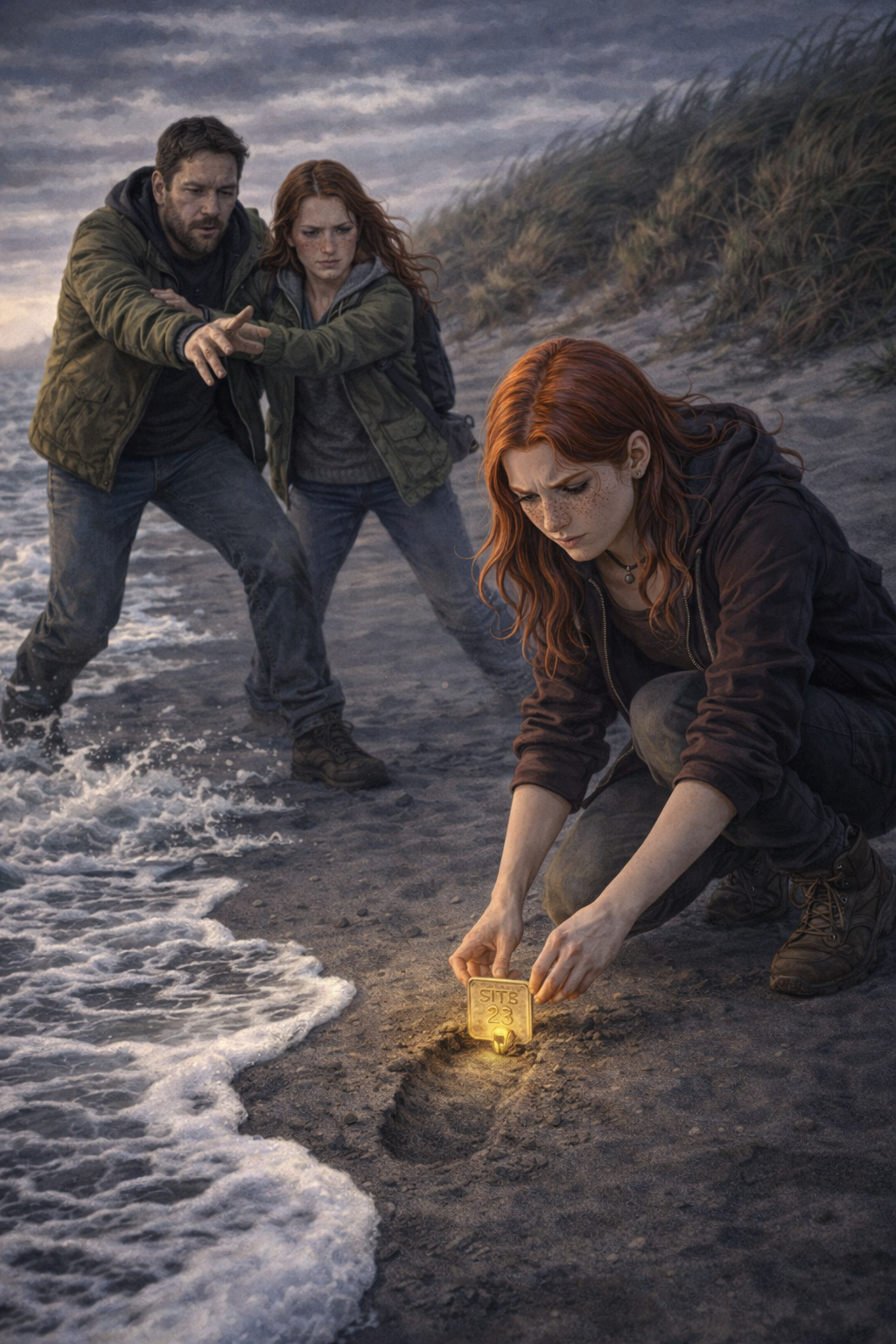
The lantern symbol touched black sand.
The Compass screamed.
Not with sound.
With movement.
The needle spun so fast the brass case vibrated in Mum’s grip.
The postcard in Ivy’s other hand went icy.
The sea rushed forward in a single hard white-edged wave.
Dad lunged.
Mum threw one arm across his chest so fast it almost looked rehearsed.
“Wait.”
The wave stopped inches from Ivy’s shoes.
Stopped.
Hung there, water trembling, foam hissing in place.
Then it slid backward.
And as it went, a new line of footprints appeared.
Not coming inland.
Returning.
Small. Bare. Child-sized.
One after another, they pressed into the wet black sand beside Ivy and walked down toward the sea.
Ivy did not move.
Could not.
The prints were not eager. Not hungry. Not inviting.
They were tired.
That was the worst and saddest thing about them.
They looked relieved.
Amber made a sound halfway between a gasp and a sob.
Oakley whispered, “He found his way back.”
The line reached the water.
A final footprint formed at the edge of the foam.
Then the sea took it.
All at once, sound came back.
The wind hit full force. Gulls cried farther down the coast. The surf crashed properly again. Dad was suddenly moving, hauling Ivy backward by the shoulders with exactly enough force to be safe and exactly enough panic to say everything else.
“You do not,” he said, voice unsteady, “ever do that again without first letting me have several complaints.”
“I didn’t even go in the print,” Ivy said, breathless.
“I know.”
“That was the good version.”
“I am aware.”
Mum was staring at the dunes.
The marram grass had stopped moving.
Not because the wind had dropped.
Because whatever had been behind it was gone.
The first inward line of footprints had changed.
They no longer looked dark and eager.
They looked ordinary.
Almost.
Only there were too many of them now, and the spacing was wrong at the top, where the last few prints blurred and dragged, as if something had been pulled sideways out of one path and into another.
Track damage, Ivy thought.
The road washing through.
Not just a ghost thing. Not just a haunted beach.
A broken route.
Mum knelt and picked something out of the sand where the wave had paused.
Not the tag. Ivy still had that clenched in one fist.
This was a thin, dark strip of something that looked at first like driftwood. Then Mum turned it over.
It was not wood.
It was old painted metal, worn almost black by salt and sand.
A narrow marker plate, curved at one end.
On it, beneath scratches and rust, was a tiny lantern.
And below the lantern, stamped so faintly Ivy almost missed it, were three shallow lines:
PINES
Dad looked over her shoulder. “Please tell me that says something helpful and not, for example, YOU ARE ALL DOOMED.”
“It says Pines,” Mum said.
“Which is not helpful.”
“It is more helpful than doomed.”
“Low bar.”
Amber took the postcard back from Ivy.
“There’s more on it.”
The back, beneath COUNT ONLY THE ONES THAT RETURN, now held another line in cramped grey writing that looked water-soaked and old even though it had not been there thirty seconds ago.
WHEN THE BELL DOES NOT RING, TAKE THE HIDDEN TRACK.
Nobody spoke.
Dad turned slowly toward the carpark and the scrub beyond it.
Past the gravel pull-over, on the far side of the road, a line of dark pines stood against the paling sky.
Ivy had not really looked at them before.
Now she saw the gap.
A narrow space between two trunks where there should not have been any path at all.
The Compass needle pointed straight at it.
Oakley broke the silence first.
“Beach gave us directions.”
Dad put both hands on his hips and looked at the sea, then the pines, then the heavens in general.
“Fantastic,” he said. “A beach with admin.”
Mum laughed once, tired and real.
That helped more than it should have.
Ivy looked down at the Site 23 tag still in her hand.
The enamel had cooled. Black sand clung around the edges. The number 23 looked darker than before, as though the sea had rubbed it awake.
For one second, in the brassy scratched little face of the tag, she thought she saw a reflection that wasn’t hers.
A boy in a caravan doorway.
One hand lifted.
Not waving this time.
Pointing inland.
She blinked, and it was only chipped enamel again.
Dad was already herding them back toward the path.
“No more solving cursed tide equations in the dark,” he said. “We go back to the caravan, we eat something with actual nutritional ambition, and then we decide whether the hidden track can wait until morning.”
“The postcard literally just told us to take the hidden track,” Ivy said.
“Yes,” said Dad. “And I, in turn, am telling the postcard to calm down.”
Mum folded the marker plate into the map with the receipt and the postcard. Very carefully. The sort of careful that meant she had already decided this was not over tonight.
Amber kept looking back at the water.
“Do you think he got free?”
Mum did not answer too quickly.
“No,” she said at last. “But I think we helped something go back where it belonged.”
That was not the same thing.
It was also, somehow, enough for now.
They climbed the path off the beach with the wind at their backs and the sea still roaring behind them. At the top, Ivy looked once over her shoulder.
The beach lay empty.
No wrong footprints.
No waiting line from the sea.
No figure in the dunes.
Only black sand, white surf, and the last smear of daylight over the water.
Ordinary.
Which would have been much more convincing if the Compass had not kept pulling toward the pines hard enough to make Mum’s wrist ache.
As they crossed the gravel to the car, a sound drifted after them from the road beyond the scrub.
Not loud.
Not close.
A bell.
One single clear note.
Then silence.
Dad stopped dead.
Mum and Ivy looked at each other.
Amber tightened her grip on the postcard.
Oakley, with the delighted dread of a child who suspects bedtime has just lost a fight, whispered:
“Oh good.
“It didn’t ring.”