Chapter 3 - The Dairy with No Brand Name
The office door banged shut behind them.
Morning had done a rude and ordinary thing to the world. The mist had burned off. The sky over the holiday park was a clean pale blue. Someone nearby was frying bacon. A tui made two sharp metallic notes from a pōhutukawa tree near the camp kitchen. Wet grass sparkled in the sun, and if Ivy had not been carrying an old enamel tag in one hand and a warning in the back of her throat, the whole place might have looked normal enough to apologize for itself.
It did not.
Dad stood on the gravel outside the office with the folded road map in one hand and the expression he usually wore when the internet went down and three people insisted it was definitely not the router.
“So,” he said. “That was awful.”
“That is not the main takeaway,” Mum said.
“It is one of them.”
Amber hovered close to Ivy, not saying much, watching the map. Oakley was crouched beside a line of ants with the deep seriousness of a scientist who had discovered tiny idiots on parade.
“They are doing a launch queue,” he announced.
“Great,” Dad said. “Good. Nice for them.”
Ivy barely heard him. The enamel tag felt colder now that they were out in the light. It had warmed in her hand last night. It had felt alive then. Now it felt old, chipped, real. A bit of worn metal. Except real things did not get handed to you by boys who lived in places the campground map had forgotten.
Mum glanced down at Ivy’s hand. “You all right?”
No, Ivy thought.
“Fine,” Ivy said, which was such a stupid lie that even the tag seemed unimpressed.
Mum noticed. Of course she noticed. But she only said, “Let’s get out of the doorway.”
They crossed the gravel lane back toward the family’s caravan. Daylight made everything worse in a different way. The place where Site 23 had stood was only flattened grass and two faint wheel ruts now, shallow enough that someone else might have missed them. Ivy did not miss them. Neither did Amber. Oakley pointed at them without even looking up properly.
“Toast Caravan parked there,” he said.
Dad muttered, “I’m never calling it that, mate.”
“You already are,” said Ivy.
Dad looked at her. “I am not.”
“You literally just did.”
He opened his mouth, shut it again, and gave a small nod that said fine, perhaps reality had humiliated him enough for one morning.
At the caravan, Mum sent Amber to grab the cereal box, Dad to boil the jug, and Ivy to sit down for five minutes “without staring directly into the abyss.”
“That is not what I’m doing,” Ivy said.
“That is exactly what your face is doing.”
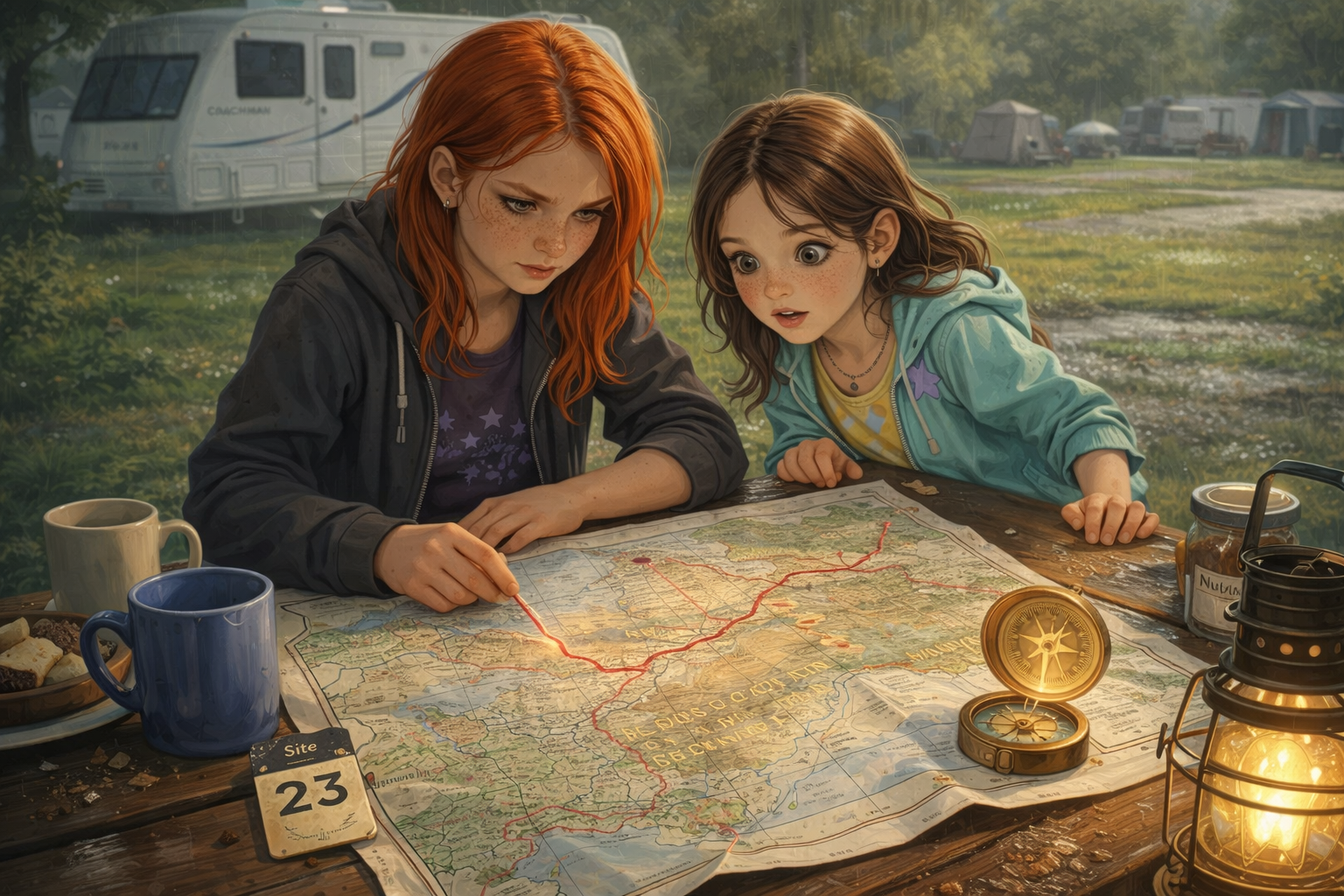
The family picnic table was still damp at one end. Mum wiped it with an old tea towel and laid the road map flat. It was a local map, thin and faded from too many folds, with roads marked in ordinary council colours and a square pencilled in by the highway. No name. No note. Just a box.
A dairy.
Dad set the jug on to boil inside the caravan and leaned out through the open door. “We are not driving straight to a haunted dairy on an empty stomach.”
“It might not be haunted,” Amber said.
Dad looked at her.
Amber reconsidered. “It might be only a little haunted.”
“Brilliant,” Dad said. “That makes me feel much better.”
Oakley climbed onto the picnic bench with his cereal bowl and said, “If it’s a space dairy they will have moon milk.”
Nobody answered him because nobody in the family was brave enough to ask what moon milk might be.
Ivy sat opposite the map, the tag still in her palm. Tane Rook’s words kept replaying with a horrible neatness.
If Twenty-Three appears again, don’t let it leave with your name.
She hated that sentence. It did not explain anything properly. It just sat in her head and made everything worse.
Mum came out of the caravan carrying the Lantern Compass in one hand and four mugs in the other, because apparently she had decided madness would not stop tea. “This was on the shelf,” she said, setting the compass carefully on the table. “Did you put it there?”
“No,” Ivy said.
Amber shook her head.
Dad came down the step with the kettle and stopped when he saw it. “Please tell me the weird old object is not now moving around the caravan by itself.”
“It was on the shelf,” Mum repeated.
“That is not actually better.”
Oakley brightened. “Mission artifact woke up.”
“Of course it did,” Dad said.
The compass lid was open.
Nobody had opened it.
Its needle trembled once, then settled. Not north. Not even close. It pointed across the paper map.
Straight at the blank square.
Nobody moved for a second.
Then Amber whispered, “Put the tag down.”
Ivy looked at her. Amber was staring at the map with the same expression she used when drawing something difficult and beautiful. Focused. Certain.
“Why?” Dad asked.
“Because he said the map had to see it.”
Mum nodded once. “Try it.”
Ivy did not want to.
That was the problem. The wanting and not wanting had got mixed up. Part of her was frightened enough to throw the tag into the nearest rubbish bin and pretend none of this had happened. The other part wanted answers so badly her hands hurt.
She placed the Site 23 tag on the map.
Nothing happened.
Dad let out a breath. “Right. Good. Excellent. We can all enjoy being extremely tense for normal stationery reasons.”
Then the pencil-marked square darkened.
Not with ink. Not exactly. It was more like something underneath the paper had remembered it was meant to show through. A thin red line pushed out from the square and crept along the printed road, then turned where no road existed, sliding across the map in a slow, deliberate stroke.
Amber made a small, shocked noise.
Oakley slapped both hands on the table. “It’s drawing!”
“Hands off,” Dad said automatically, although his voice had gone quiet.
The line stopped three centimetres from the tag.
Then words began to appear beside the square in faint grey letters, as though someone was breathing them onto cold glass.
WELCOME, TRAVELLERS
Everybody went still.
Underneath, another line shimmered into view.
OPEN UNTIL THE BELL
Dad stared. “Nope.”
“That is definitely words,” said Ivy.
“Thank you, Ivy. I had not ruled out a deeply literate fungus.”
Mum touched the edge of the map but not the writing. “It said welcome.”
Ivy looked up. “Safe if welcomed.”
Mum’s eyes flicked to hers. She had remembered too.
Amber leaned closer. “What bell?”
“Bell cow?” Oakley suggested.
“No,” Ivy said.
“School bell?”
“No.”
“Doorbell?”
Dad folded his arms. “My current professional opinion is that magical directions should stop being written by escape rooms.”
Mum almost smiled. Almost. Then her expression shifted. “We should call Erin.”
Dad did not answer straight away.
Which was answer enough.
Mum looked at him. “Justin.”
“I know.”
“You were not going to.”
“I was absolutely going to.”
“You were going to think about it for three hours and then announce it as a new idea.”
Dad looked offended in a very tired sort of way. “That is not fair.”
“It is extremely fair.”
Amber, sensing parental truth in the wild, kept very still.
Dad rubbed a hand over his face. “I don’t want to tell her half of it and make her worry.”
“You also don’t want to tell her all of it,” Mum said.
He gave a tiny shrug. Caught.
Ivy watched them and realized something unpleasant: adults did not look like people who knew what to do when the world went wrong. They looked exactly like people trying not to frighten their children while being frightened themselves.
Mum held out her hand. “Phone.”
Dad passed it over.
They put the call on speaker. Meow Meow answered first, which was impressive since he was a cat, but everyone could hear him howling somewhere near the phone before Erin picked up.
“If that is another accidental video call from Oakley’s forehead,” Erin said, “I’m hanging up. I have standards.”
“It’s us,” Mum said.
“Ah. The away team. How’s paradise?”
Nobody spoke.
On the other end of the line, there was a short silence. Then Erin said, much more sharply, “What happened?”
Dad sat down. “You know that thing where I say I don’t want everyone to panic?”
Erin snorted. “Yes. Your least useful hobby.”
“We found the next level of weird.”
“That narrows it down beautifully.”
So they told her.
Not every detail at once. Nobody seemed able to. It came out in pieces. The missing site. The old caravan. The boy. The warning not to open the door. The thing outside. Tane. The dairy. While they talked, Erin stopped interrupting. Even Meow Meow went quiet.
At last Mum said, “And there’s something else.”
Ivy already knew what that meant.
Mum looked at her. “Show her the tag.”
Dad angled the phone camera down. Ivy set the enamel marker on the table beside the compass.
For one second, Erin did not speak.
Then she said, very softly, “Turn it over.”
A chill ran through Ivy’s shoulders.
She turned it over.
The tiny lantern engraved on the back caught the light.
Erin shut her eyes. Only for a moment. When she opened them again, her face had changed. She still looked like Auntie Erin, still sharp and clever and not remotely built for nonsense, but the joke-light in her expression had gone out.
“Right,” she said. “Don’t lose that.”
Dad gave a hollow laugh. “Fantastic. That’s exactly the kind of sentence I was hoping for.”
“Justin.”
He stopped.
Erin leaned closer to her phone, and her voice went flatter, more careful. “Listen to me. Until I understand more, nobody gives their full name to anyone strange. Not if they ask politely. Not if they look harmless. Not if they seem to already know it.”
Nobody at the table moved.
Oakley spooned cereal into his mouth and said, “Bad manners road.”
“Yes,” Erin said at once. “Exactly that.”
Dad frowned. “Erin. How do you know that?”
She looked away for half a second, toward something off-screen. A wall. A window. The part of the house where the truth was apparently stored in labelled boxes she had not felt like opening.
“I know enough to hate it,” she said.
“That is not an answer,” Ivy said before she could stop herself.
Erin looked straight through the phone and somehow managed to look directly at Ivy anyway. “No. It isn’t.”
Ivy flushed, then hated that she had flushed.
Erin’s voice gentled. “I know. I know. I’m not doing the mysterious grown-up rubbish on purpose. I’m trying to not get ahead of what I can prove.”
That sounded so much like Dad in one of his practical moods that Ivy almost laughed. Almost.
Mum said, “The map changed.”
Erin’s eyes sharpened again. “Show me.”
Dad angled the phone. The red line was still there, thin and certain, joining the blank square to a point somewhere off the normal road grid.
Erin studied it. “And it only did that when the tag touched the paper?”
“Yes,” said Ivy.
“Good.”
Dad blinked. “That does not feel good.”
“It means the map can recognize markers,” Erin said. “That’s better than random.” She frowned. “Do you still have the old road map from yesterday? The one that changed at the servo?”
“No,” Mum said. “This is Tane’s.”
“Pity.”
The word landed oddly. Not because of what it meant. Because of how normal it sounded coming from someone looking at a magical map.
Ivy heard it too.
“You know this stuff,” she said.
Erin exhaled through her nose. “I know around this stuff.”
“Which is annoying,” Dad said.
“Yes.”
“Are you going to elaborate?”
“Eventually.”
“That’s a no, then.”
“It’s a shut up and listen, actually.” Erin pointed at them through the screen. “If that dairy says welcome, you do not walk in acting rude, clever, or in a hurry. You answer when spoken to. You do not pocket anything that isn’t clearly for you. You pay for what you take. In full.”
Dad stared. “Are we going to a dairy or entering a treaty negotiation?”
“Both, by the sound of it.”
Amber spoke for the first time in a while. “What if the boy was trying to help us get there?”
Erin looked at her for a long moment. “Then be kind back,” she said. “But be careful. Places that lose names don’t always lose them all at once.”
Nobody had a good reply to that.
Meow Meow let out one abrupt yowl off-screen.
Erin twisted around. “What is your problem now?”
There was a clatter, then Erin muttered something at the cat that was probably not printable in a children’s novel but was definitely affectionate at its core.
When she turned back, the edge had returned to her mouth. “He’s staring at the stairs.”
Mum went still. “Why?”
Erin looked over her shoulder again. “No idea.”
The whole family listened.
From the phone speaker came the quiet, ordinary house-noises of Woodend. A distant fridge hum. A floorboard. Then Meow Meow hissed so hard it fuzzed the audio.
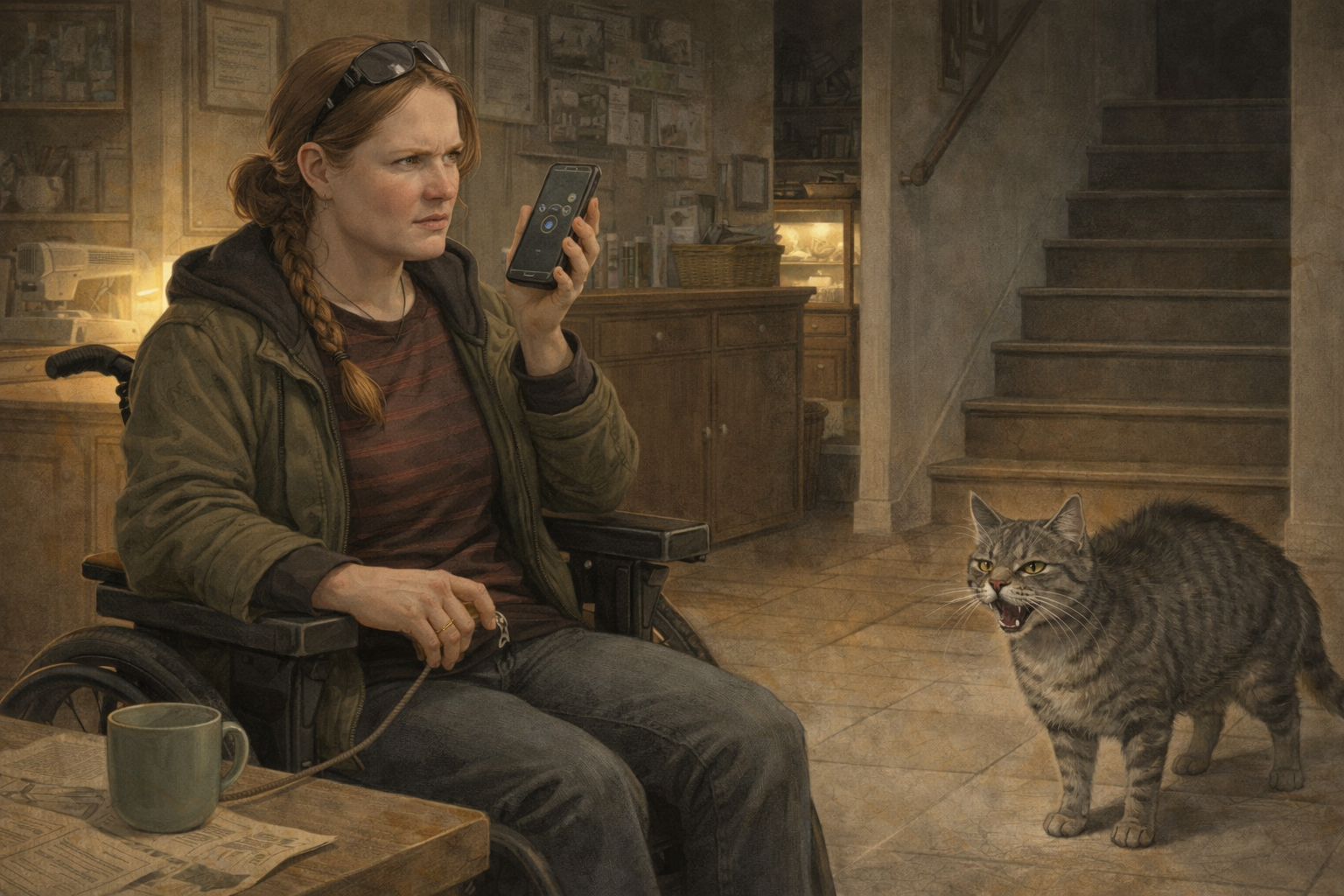
Dad sat up straight. “Erin?”
“I know.” She wheeled back a little. “I’m hanging up because I would rather not broadcast the inside of the house to whatever weird thing has decided today is already underachieving.”
“Should we call—” Mum began.
“No. Not yet.” Erin’s voice became calm in a way that made Ivy more worried, not less. “Go to the dairy. Keep the tag with the map. And Ivy?”
Ivy swallowed. “What?”
“Do not answer to anything that gets your name almost right.”
The line cut.
Nobody said anything for three whole seconds.
Then Oakley asked, “Can cats do karate?”
Dad stood. “Right. We are going to the dairy immediately.”
“That is what you took from that?” Ivy said.
“That and several other deeply concerning things, yes.”
Mum was already folding the map with enormous care. The red line remained. The word WELCOME remained too, though fainter now, as if it disliked being creased.
Ivy picked up the tag.
This time, when her fingers closed around it, it did not feel cold.
It felt expectant.
The road out of Kōwhai Coast Holiday Park looked insultingly normal.
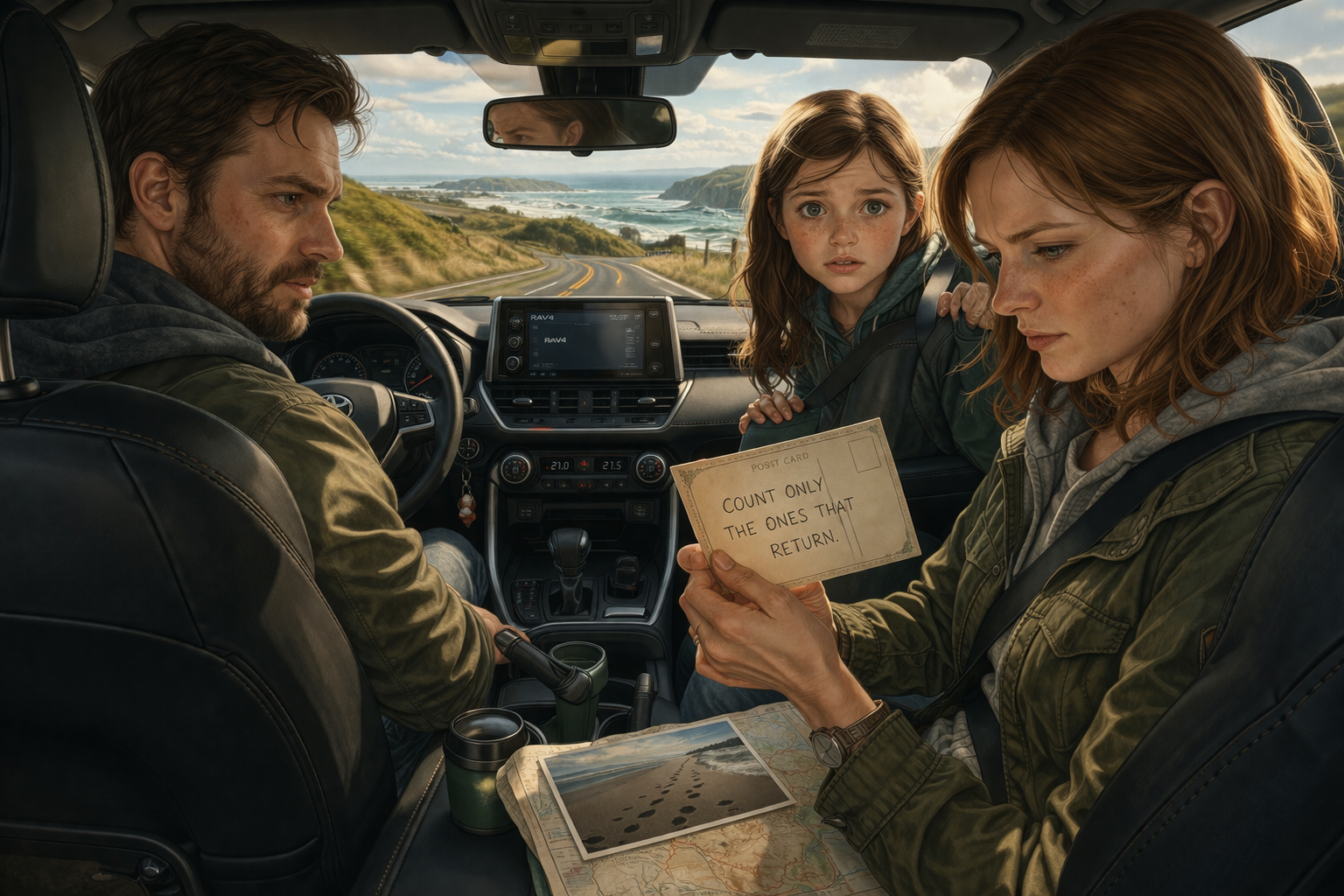
Dad drove. Mum sat in the passenger seat with the folded map on her knees and the compass in the cup holder. Ivy and Amber were in the back, with Oakley in his car seat making spacecraft sounds into a muesli bar.
School holiday traffic moved in lazy clumps along the coast. A white ute passed them in the other direction. Someone had towels flapping on a caravan clothesline at the holiday park exit. The world kept doing its ordinary little chores, and Ivy wanted to shake it.
“How far?” Dad asked.
Mum checked the map. “Not far.”
“That’s not a distance.”
“It’s a mood.”
Dad sighed. “Belinda.”
She tilted the paper. “Fifteen minutes, maybe.”
“Maybe?”
“The line doesn’t fully match the road.”
“No sentence in this car should contain those words.”
Amber pressed her face closer to the window. “What if it disappears when we get there?”
“Then we turn around,” Dad said.
“What if turning around is the trick?” Ivy said.
Dad looked at her in the mirror.
“That,” he said, “was a horrible contribution. Thank you.”
Oakley raised one hand. “If bad road comes, we go whoosh.”
“I admire your strategic clarity,” Mum said.
The highway curved inland. Dry paddocks opened on one side. On the other, a line of dark trees held onto the last of the morning shade. There were mailboxes, fence posts, a faded sign for strawberries, another for firewood, and then—just long enough to make Ivy sit bolt upright—a hand-painted board half hidden in flax.
NO EXIT FOR THE UNINVITED
She twisted to look back.
It was gone.
“I saw that,” she said.
“Saw what?” Amber asked.
Dad glanced in the mirror again. “What?”
“A sign.”
Mum turned. “What did it say?”
Ivy hesitated. Not because she had forgotten. Because saying it out loud made it more real.
“‘No exit for the uninvited.’”
No one spoke.
Then Dad said, with the tone of a man filing a complaint against reality, “That feels unnecessary.”
Mum’s gaze shifted to the map in her hands. “Safe if welcomed,” she said quietly.
Amber hugged her own elbows. “So welcome matters twice now.”
“Three times,” Ivy said. “The map. Erin. The sign.”
Dad tightened his hands on the wheel.
Up ahead, at a bend in the road where a cluster of macrocarpas should have hidden nothing more interesting than a farm gate, a small building came into view.
It looked exactly like a dairy.
That was the first bad thing about it.
The second bad thing was the sign.
Every dairy in New Zealand was called something. Coastside Dairy. Four Square. Bay View Foodmarket. Sunny’s. Something. Even the sad little half-abandoned ones still had a faded name clinging on above the door.
This one had a painted board over the awning.
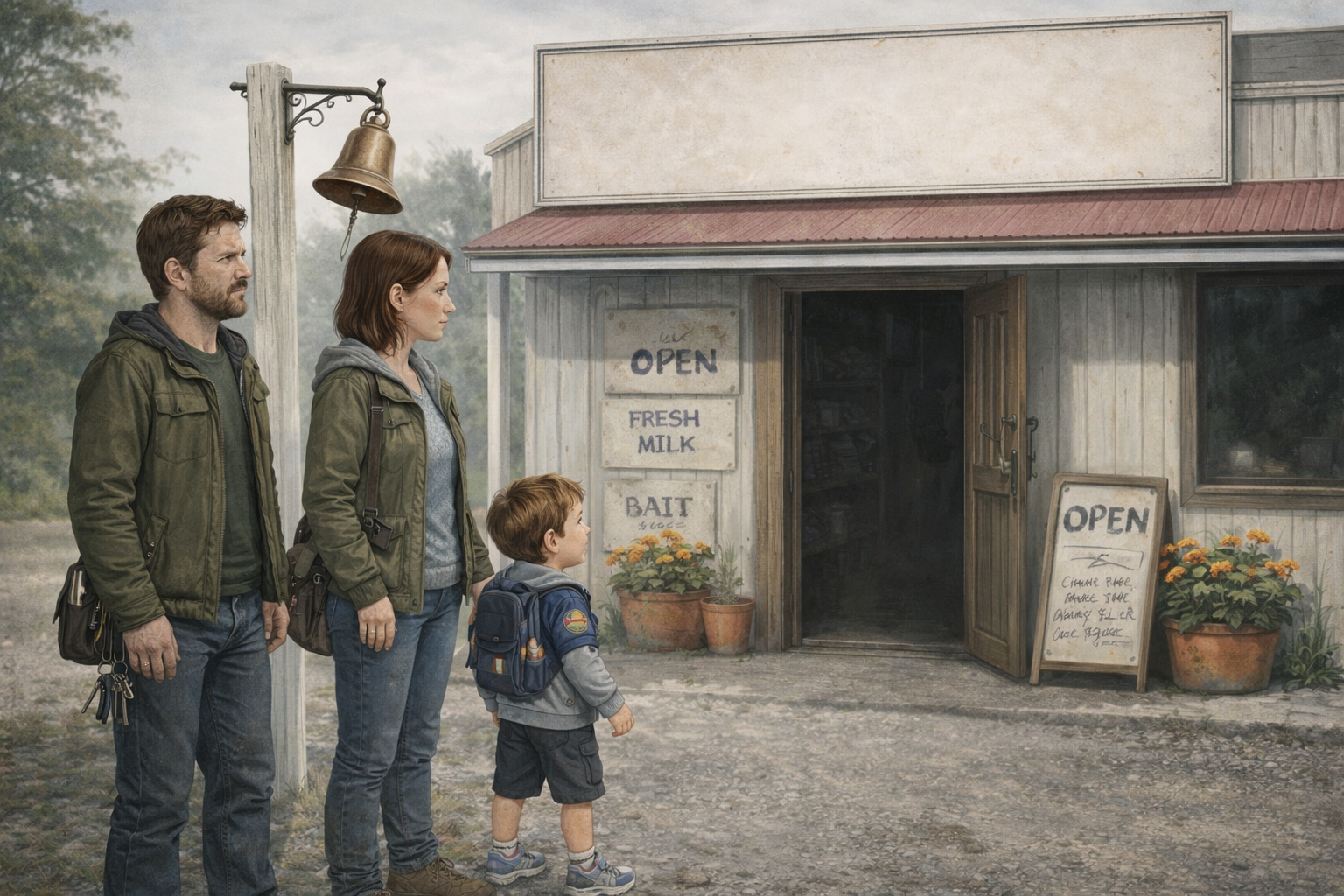
The board was blank.
Not weather-blank. Not peeled. Not broken. It had been painted carefully in cream, framed in green, and left empty on purpose.
Dad slowed the RAV4.
To one side of the building stood an old bell mounted on a wooden post.
It moved once in the wind.
Not enough to ring.
Amber whispered, “Open until the bell.”
Ivy felt the tag press into her palm, warm as a held coin.
Dad pulled into the gravel beside a rusted ice-cream sign that advertised no brand anyone in the family recognised.
Nobody got out.
For a moment they all just sat there, listening to the engine tick down.
The dairy looked ordinary. Small front window. Handwritten signs for milk, bread, bait, and hot chips. A freezer humming by the wall. A rack of cheap buckets outside. Two potted marigolds flanking the step.
And every part of it felt as though it were waiting for them to behave correctly.
Oakley unbuckled one shoe and announced, “I need a pie.”
Dad closed his eyes. “Of course you do.”
Mum kept looking at the bell post. “We answer when spoken to. We pay for what we take. We do not pocket anything.”
“And we don’t give our names,” Ivy said.
Amber looked at the blank sign above the door. “What if it asks?”
Nobody answered that.
At last Dad reached for the door handle.
“All right,” he said. “Let’s go and buy the most stressful snacks in New Zealand.”
The bell by the post rang.
Just once.
And the dairy door, though nobody had touched it, slowly opened inward.
Nobody moved.
Then Dad said, very quietly, “Right. That’s not ideal.”
Oakley grinned. “Magic shop.”
“It is not a magic shop,” Dad said.
The blank sign over the awning caught the light and said absolutely nothing.
Mum opened her door first. “Come on. If we’re doing this, we do it properly.”
Dad got out with the expression of a man who would have preferred to wrestle a printer. Ivy slid from the back seat clutching the warm enamel tag in one hand. Amber came round to stand close enough that their shoulders almost touched. Oakley launched himself out after everyone else and immediately asked if hot chips counted as breakfast if the day was “already spooky.”
The gravel crunched under their shoes. The bell on the post gave a tiny shiver in the wind but did not ring again.
The closer they got, the stranger the dairy felt. It still looked ordinary in all the important ways. Wire stand of cheap buckets. Handwritten notices for bait and milk. Smudged window with taped-up opening hours that somehow only said:
OPEN UNTIL THE BELL
No times. No days. No brand. No owner’s name.
Dad paused at the step. “I hate that sign.”
“It hates you too,” said Ivy.
“Good. Mutual.”
Mum reached the doorway first.
Inside, a woman behind the counter looked up from a newspaper.
“Welcome,” she said, in a voice so calm and flat it sounded older than the building. Then she added, “If invited.”
The sentence went through Ivy like a draught.
Mum answered before anyone else could ruin it. “We think so.”
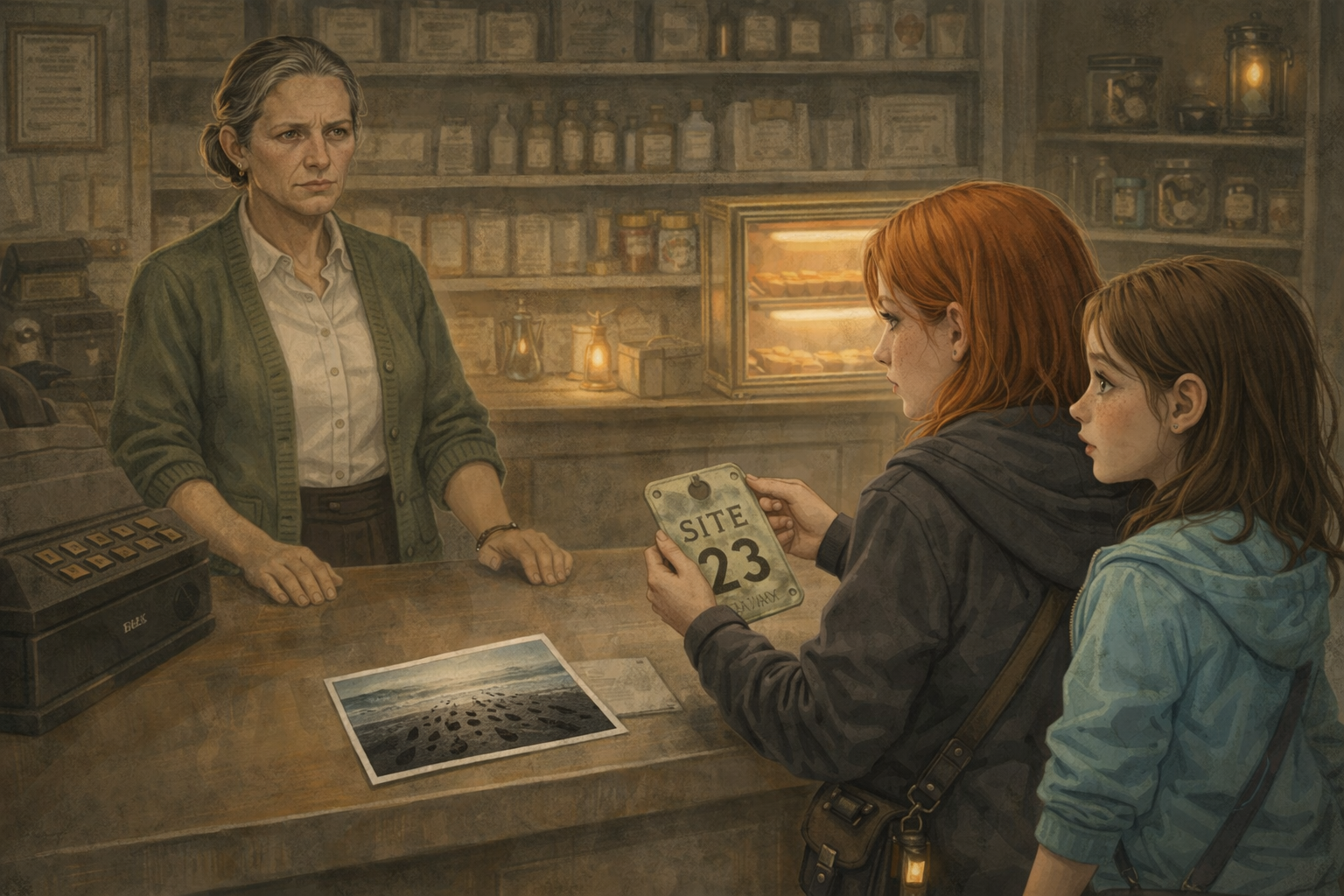
The woman studied them for a second. Her gaze moved over Dad, Mum, the children, the brass compass in Mum’s hand, and finally stopped on Ivy’s fist closed round the Site 23 tag.
“That’ll do,” she said.
They went in.
The air inside smelled of hot pastry, detergent, damp cardboard, and something sharper underneath, like rain on old metal. A pie warmer hummed near the counter. Two fridges clicked softly along one wall. There were shelves of bread, tinned spaghetti, biscuits, batteries, chewing gum, and enough lollies to ruin a small village.
And yet none of it was quite right.
Half the labels on the shelves were blank.
Not missing. Blank.
Crisp packets with red and yellow stripes but no logos. Bottles of fizzy drink with bright colours and no brand names. A freezer full of ice creams with wrappers that showed only pictures: vanilla swirl, chocolate shell, strawberry bar. One rack held postcards of places Ivy was almost sure she had never seen and somehow recognised anyway.
Dad noticed it too. “That,” he said, very softly, “is unsettling.”
The woman folded her newspaper with enormous neatness and set it beside the till. She was small and wiry, maybe in her sixties, with brown skin, silver-streaked hair twisted into a knot, a green cardigan buttoned all the way up, and eyes that missed nothing. A little brass bell charm hung from one ear.
“People say that,” she said. “Mostly the ones who expected a chain store.”
Dad gave her the polite smile he used when reality had become rude. “Do you have a name for the place?”
“Yes.”
There was a beat.
“That was me asking what it is,” Dad said.
“I know.”
Amber made a noise that might have been a laugh if she had not still been busy being nervous.
The woman looked at Mum instead. “What do you need?”
There were about eight possible answers to that, most of them not suitable for speaking in public. Mum went with, “Some information.”
The woman’s eyes slid to the compass again. “That’s rarely free.”
Dad folded his arms. “We’re happy to buy things.”
“Good,” said the woman. “That is how dairies work.”
Oakley had already wandered three steps toward the pie warmer. Mum caught the back of his hoodie without looking.
“Mo,” said the woman, tapping her own chest once. “That’s enough name for people buying milk.”
“Mum,” said Oakley promptly, because Oakley collected social facts the way other people collected shells.
Mo inclined her head as if the introduction had met whatever standard she kept for this sort of thing. “Lovely.”
Dad started, “I’m—”
Mum put a hand on his arm so quickly it was almost funny.
He stopped.
Mo’s mouth twitched.
Ivy felt the tag grow warmer in her hand.
Mo looked straight at her. “You’re carrying the troublesome bit.”
Ivy opened her fingers.
The enamelled 23 gleamed against her palm.
Mo’s face did not change much. That somehow made it worse.
“Ah,” she said. “You found a loose berth.”
Dad frowned. “A what?”
“A place that’s come unfastened.”
Dad’s expression said that sentence had not improved anything.
Amber moved closer to Ivy. “Is the boy there part of it?”
Mo’s eyes flicked to her, sharper now. “There was a boy?”
“Yes,” Amber said. “He was scared.”
Something unreadable shifted across Mo’s face. Not surprise. Not quite. More the look of someone checking whether an old wound had really reopened.
“He gave her the tag,” said Amber, before anyone could decide she was too young to be useful. “He said to keep it where the map can see it.”
Mo looked from the tag to the compass and then to Mum, as if Mum was the one most likely to tell the truth in a room full of frightened people.
“Did it redraw?”
Mum held up the folded map from the holiday park. “Yes.”
Mo nodded once, unsurprised. “Put it on the counter.”
Dad glanced at the door. “Before we do that, are we in danger here?”
Mo gave him a cool look. “That depends how good your manners are.”
“That is not an answer.”
“It is exactly an answer. You’ve just been having the wrong sort.”
Dad inhaled slowly through his nose.
Mum set the map on the counter. The paper looked flimsy and ordinary under the shop lights. Ivy placed the tag on it. Mum laid the open compass beside it.
The red line appeared almost at once, seeping back through the folds in the paper. It crept toward the inland coast road and then further west, toward a dark patch by the sea.
Mo rested both hands on the glass counter and leaned in. “Mm.”
Dad waited. “That sound had too many meanings.”
“It usually does.” Mo tapped the paper just above the line. “This is not your final stop.”
That was not comforting.
“What is it?” Ivy asked.
Mo ignored Dad’s sigh and answered her. “A warning before a warning. A place where the road’s been brushing against the shoreline too hard.”
Amber looked down at the map. “The beach.”
Mo glanced at her. “Black sand?”
Amber nodded.
“Then yes.”
Ivy’s stomach turned over. “The footprints.”
Everybody looked at her.
She blinked. “I just—I don’t know. It felt like footprints.”
Mo’s gaze stayed on her a moment longer than was comfortable. “You’re the one it’s started noticing,” she said.
That was somehow more frightening than if she had said You’re imagining it.
Dad stepped closer. “Started noticing her how?”
Mo straightened. “You’ve got a loose marker, a compass for the honest road, and a child in your family has already been handed a place that doesn’t want to disappear. What do you think?”
Dad opened his mouth, shut it again, and then chose honesty over dignity. “I think I hate every word in that sentence.”
“Reasonable,” said Mo.
Oakley pointed at the pie warmer. “I think pie.”
“Also reasonable,” said Mo.
The pressure in the room eased a fraction. Only a fraction, but Ivy took it.
Mo moved to the warmer and opened it. Steam rolled out with the smell of mince and cheese and overworked pastry. “What’s everyone having?”
Dad stared at her. “We’re doing snacks now?”
“You said you’d buy things.”
“That was before the map started threatening my children.”
Mo lifted one eyebrow. “If you came into my dairy for information and left without paying for anything, I’d think worse of you than the map does.”
Dad looked at Mum.
Mum, infuriatingly, was trying not to smile. “She did tell you how dairies work.”
He pressed a hand over his face. “Fine. Pies. Everyone pick a pie while we negotiate with the supernatural economy.”
Oakley gasped with happiness, as if nothing in the world had ever made more sense.
While Mum helped him choose one that would not instantly paint the car in grease, Ivy drifted toward the postcard rack. The cards were arranged in neat rows. Most showed beaches, bush tracks, mountain roads, rainy campgrounds, ferries in fog. None had place names printed on them. A few had tiny lantern symbols worked into the corners.
One card in the second row made her stop.
It showed a black-sand beach under a pale sky. Long lines of foam curled in. The sand was crossed by footprints.
Not one set.
Dozens.
They came out of the water and walked inland.
Ivy reached for it.
Mo’s voice cracked across the shop without getting any louder. “If you take it, you buy it.”
Ivy froze. “I was just looking.”
“Then look with your eyes.”
Dad let out a helpless noise somewhere between a laugh and surrender.
Mum took the card from the rack and turned it over. The back was blank except for a faint lantern stamp near one corner. “How much?”
Mo studied the postcard, then Ivy. “That one’s paid.”
Dad turned so quickly he nearly hit the lolly stand. “By who?”
Mo slid a paper bag across the counter and began loading pies into it. “By someone who still remembers enough to warn ahead.”
Amber’s face changed. “The boy.”
Mo did not say yes.
She did not say no either.
Ivy took the postcard from Mum. The card felt cool and dry and older than it looked. On the image side, the footprints seemed deeper now, as though the tide had just gone out.
Mo rang up the pies, milk, bread, a packet of plain chips, and a blue ice block Oakley had somehow smuggled into the pile through pure force of personality.
Then Oakley made his mistake.
He reached, not for the ice block, but for a small round marble sitting in a shallow tray beside the till. It was the size of a gobstopper and cloudy grey inside, with a bright pulse of white buried in the middle.
“What’s this?”
“Don’t—” Dad started.
Oakley’s fingers closed around it.
Thunder cracked.
Not outside.
Inside the marble.
A tiny bright fork flashed in its cloudy centre.
Every label on the nearest shelf vanished.
The writing did not fade. It simply stopped existing. Soup tins turned to blank metal cylinders. Biscuit packets became colour without words. The pie warmer’s temperature dial lost its numbers.
The bell charm in Mo’s ear rang once.
Nobody moved.
Oakley, to his credit, looked more fascinated than frightened. “Storm sweet.”
Mo held out her hand. “Back in the tray, darling.”
Oakley gave it to her.
The moment the marble touched the tray, the labels came back.
Dad swore under his breath in the deeply parental way that meant the word was too mild to matter.
Mo set the marble down very carefully. “Weather costs extra.”
Mum pulled Oakley closer. “Hands to yourself.”
“But it fizzed.”
“Yes,” said Mum. “Because this day did not already have enough problems.”
Mo slid the blue ice block into the paper bag without blinking. “At least he gave it back. Some grown adults do worse.”
Dad pushed a card across the counter so fast it almost squealed on the glass. “Please charge us before my son accidentally purchases a thunderstorm.”
Mo did.
The machine printed a receipt far longer than seemed necessary for pies, bread, chips, and one impossible morning. Mo tore it off and handed it to Mum.
The receipt said:
THANK YOU FOR PAYING IN FULL
Underneath, in smaller letters that appeared as Ivy watched:
DO NOT FOLLOW THE FIRST FOOTPRINTS
Amber saw it too. “Mum.”
Mum went very still.
Dad leaned over her shoulder. “Oh, come on.”
Mo capped her pen and tucked it behind her ear as though none of this required commentary. “Good. It held.”
Dad looked at her. “Held?”
“The warning. Ink’s been unreliable lately.”
Ivy put the postcard beside the receipt on the counter. “What are the first footprints?”
Mo’s expression thinned. “The wrong invitation.”
That did not help nearly enough.
Amber asked the better question. “How do we tell?”
Mo was quiet for a moment. Then she answered carefully, and that was somehow worse than if she had refused.
“The first ones will look eager.”
Ivy frowned. “Footprints look eager?”
“On a bad enough day, yes.”
Dad muttered, “I miss normal nouns.”
Mo ignored him. She looked at Ivy again. “You listen. Good. So listen now. The roads are damaged, which means some places are trying too hard to be found and some are trying too hard to keep what notices them. Twenty-Three is a place that’s lost part of its marker. That makes it hungry for remembering.”
Amber’s hand found the sleeve of Ivy’s hoodie and held on.
Mo continued, “A loose place will borrow from whoever sees it. A glance. A feeling. A route. A bit of a dream. If it gets worse, a name.”
Dad’s face hardened. “And the tag?”
“Anchor,” said Mo. “Or what’s left of one. Keep it with the map until you reach the shore point. After that, do not show it after sunset unless you want something noticing back.”
Ivy closed her fingers round the tag so hard the edges bit into her skin. “Can we help him?”
That made Mo pause.
The shop seemed to go quieter around the question. Even the freezer hum felt farther away.
“If he gave it to you,” she said at last, “he’s still trying to be helped.”
Amber’s eyes filled at once, though she didn’t cry. Not quite.
Dad nodded slowly, taking that in whether he wanted to or not.
Mum folded the receipt and tucked it into the map. “What’s at the beach?”
Mo lifted the postcard and tapped the line of footprints with one short nail. “Evidence the road’s started washing through.”
“Meaning?” said Dad.
“Meaning it shouldn’t be there.”
“I gathered that.”
Mo gave him a look. “Then gather faster. Go near dusk, not dark. Stay where the sand is firm. If the sea gives you back steps that nobody took, don’t match them.” She handed the postcard to Ivy. “And if you hear anything calling from behind the dunes, let your mother answer first.”
Dad stiffened. “Why specifically Belinda?”
Mo’s gaze slid to Mum again. “Because she notices when something sounds almost right.”
Mum did not argue.
That bothered Ivy more than she wanted to admit.
Dad tried one last angle. “Who exactly are you in all this?”
Mo put the paper bag on the counter between them. “Shopkeeper.”
“That’s not enough.”
“It has been for years.”
“And the blank sign?”
For the first time, Mo looked toward the door. Toward the bell post beyond it.
“Things with names are easier to count,” she said. “Things that are counted are easier to hunt. Brand names are for places that want to be found by everybody. This place does not.”
It was such a simple sentence that it landed harder than any of the stranger ones.
Ivy thought of Site 23. A place with a number. A place being erased. A place trying not to be forgotten and maybe taking the wrong things to stay real.
“How many places are like this?” she asked.
Mo met her eyes. “Fewer every year.”
The bell outside rang.
Once.
Every light in the dairy flickered.
Mo’s head snapped toward the window.
“Right,” she said. “Time to go.”
Dad did not argue. That was when Ivy knew the fear had properly got into him. Dad loved arguing with suspicious instructions. It was one of his main hobbies.
He grabbed the paper bag. Mum folded the map and receipt together. Ivy tucked the postcard under her arm and shoved the tag into the front pocket of her hoodie, though she hated hiding it. Amber stayed close. Oakley waved at the pie warmer and said, “Bye, hot food.”
At the door, Mo spoke without raising her voice.
“Don’t use your full names on the beach.”
They all turned.
Her face had gone very still.
“And if the first footprints lead inland,” she said, “leave before the tide changes its mind.”
Then she looked straight at Ivy.
“Noticing goes both ways.”
The second bell rang.
This time, the sound was sharper.
Outside, the day had changed.
Not entirely. The sky was still pale. The gravel was still gravel. The marigolds still sat in their pots by the step.
But the shadows around the dairy had lengthened wrong, stretched thin toward the road as if something tall and unseen had just passed between the sun and the world.
Dad got everyone into the RAV4 in record time.
Doors slammed.
Seatbelts snapped.
The engine started on the second try, which would have annoyed Dad on any normal day and barely registered on this one.
Nobody spoke until they were back on the road.
Then Oakley said, from the back, “I liked shop lady.”
Dad gripped the wheel. “That is because you nearly bought lightning.”
“It liked me.”
“Not helping.”
Mum opened the receipt again on her knees. The extra words had faded, but not completely.
DO NOT FOLLOW THE FIRST FOOTPRINTS
Amber leaned in to look. “So we’re definitely going.”
Dad made a noise of pure exhausted disbelief. “Are we?”
Mum looked up from the paper. “Yes.”
He glanced at her. “You said that very fast.”
“She’s right,” said Ivy.
Dad checked the mirror. “Of course you think so.”
“She gave us a warning, a place, and a rule. That’s more than we had this morning.”
“That is not the uplifting summary you think it is.”
Amber took the postcard from Ivy and turned it over.
Something had appeared on the blank back.
Not printed. Written.
A line in thin grey script, as if someone had used a pencil sharpened with too much patience.
COUNT ONLY THE ONES THAT RETURN
Amber inhaled sharply.
Mum took the card. Dad looked over at the next straight stretch and swore softly again.
“Belinda.”
“I see it.”
“I hate this postcard.”
Oakley leaned sideways in his seat and squinted at it upside down. “Beach rules.”
No one corrected him.
The highway bent south again. Far ahead, beyond the paddocks and the road signs and the normal little world still trying its best, the line of the coast showed dark against the afternoon light.
Mum folded the postcard into the map with the receipt.
Ivy pressed a hand over the pocket where the Site 23 tag sat warm against her hoodie and looked back once through the rear window.
The dairy was already gone.
Not vanished.
A boy.
Not waving.
Just watching to see if they understood.
Then the road turned, and he was gone.
Dad cleared his throat. “Right,” he said. “No full names. No eager footprints. No beach heroics. We look, we learn, we leave. Are we all clear?”
“I wasn’t planning heroics,” said Ivy.
Mum and Dad both looked at her.
Ivy sighed. “Fine. Minimal heroics.”
Amber smiled despite herself.
Oakley pumped one fist. “Beach mission.”
The sea wind found the car a few minutes later, carrying salt and the promise of weather.
And tucked between the map and the receipt on Mum’s lap, the postcard of the black-sand beach gave a tiny dry shiver, as though the paper already knew the tide was coming in.