
Chapter 5 - The Hidden Track
Nobody said anything for a full ten seconds after they got back to the car.
The beach was still there. The dunes were still there. The tide was still dragging its black edge in and out with a sound like someone slowly tearing cloth.
But the wrongness had changed shape.
It was no longer standing in front of them, obvious and hungry and trying to sound like family. It had gone quieter than that. Quieter was worse.
Dad opened the back door before Mum had even finished bundling the map, receipt, postcard, and marker plate together. “In. Everyone. Shoes off if they’re full of sand. Nobody wander.”
Oakley, who had enough wet black grit on him to qualify as a minor geological event, climbed into his seat with grave mission importance. “Toast Boy got his walking back.”
Amber paused halfway in, hugging herself against the cold. “Part of it,” she said softly. “Not all of it.”
Ivy didn’t move at first.
She was still looking at the place near the dunes where she had put the Site 23 tag down and the sea had answered.
Her heartbeat had settled, but not properly. Every now and then it still gave one hard bang, as if it had remembered the exact way her name had sounded coming out of the grass. Not almost right. Right. Perfectly right. That was the bit that kept scraping over the inside of her mind.
Mum touched her shoulder, not gently enough to be comforting and not roughly either. Just enough to bring her back into her own skin.
“In the car, love.”
That worked better than anything softer would have.
Ivy climbed in and pulled the door shut. The slam sounded ordinary. She was more grateful for that than she wanted to admit.
Dad got into the driver’s seat and started the engine. The RAV4 shuddered once, familiar and solid and blessedly mechanical. Warm air pushed out through the vents. Caravan lights glowed in the mirrors behind them, yellow and homely and almost ridiculous after what had just happened. It looked impossible that something with cushions and cereal boxes and a drawer full of mismatched forks could still exist in the same world as that beach.
Dad gripped the wheel and looked at Mum. “We’re leaving.”
Mum had the clue bundle spread over her knees. The old local map. The folded receipt. The postcard with its impossible instructions. The black metal PINES plate. The Site 23 tag in Ivy’s hand. The Lantern Compass sat on top of the lot, still open, its needle quivering like it had had too much coffee.
“We might be,” she said.
“Might be?”
Mum didn’t answer straight away. The Compass needle jerked hard enough to tick against the glass. Not toward the road home. Not toward the beach.
Inland.
Across the road, the pine trees stood in a long black line against the last of the evening light. From the car they looked ordinary enough. A plantation edge. Dark trunks, wind-tossed tops, a strip of scrub and shadow underneath.
Then something gave a single, thin metallic note.
Not a ring.
More the sound of a bell trying to remember how.
Everyone in the car went still.
Oakley’s eyes widened. “Mission noise.”
Dad swore under his breath and turned his head toward the trees.
There it was again.
Not from deep in the pines this time. Closer. From somewhere just across the road, half-hidden under wind and branches and the fading hiss of the sea.
Mum turned over the postcard.
The writing on the back had not changed.
WHEN THE BELL DOES NOT RING, TAKE THE HIDDEN TRACK
Nobody spoke for a beat.
Then Dad said, “That is a bell. That is literally a bell.”
“It’s not ringing properly,” Amber said.
“That is not a sentence I can use in court.”
Mum let out a short breath that might have been a laugh on a better day. “It said when the bell does not ring. Not when there is no bell.”
Dad stared out at the trees. “Belinda.”
“I know.”
“No. I mean really know. We are not towing a caravan into haunted forestry because some enchanted stationery has become annoyingly poetic.”
The Compass snapped harder toward the pines.
Ivy felt the Site 23 tag warm in her palm.
Not hot the way it had been on the beach. More alert. Like it knew where it was.
She looked at the dark line of trunks and, before she could stop herself, said, “He’s still in it.”
Dad looked back at her in the mirror.
She wished, immediately, that she had phrased it differently. Less dramatic. Less obviously true.
Amber saved her. “Something is,” she said. “And that helped, but it didn’t finish.”
Oakley nodded solemnly. “We did one foot.”
Dad made a helpless noise and looked at Mum again. “I hate that I know exactly what he means.”
Mum had already un-clicked her seat-belt.
“Belinda.”
“We are not driving blindly in. We are getting out, looking from the roadside, and deciding with our actual eyes instead of inside a panic.”
“That,” Dad said, “is the first sensible sentence anybody has said in a while.”
He killed the engine but left the lights on. The headlamps washed across the road and touched the first rank of pines. Gravel gleamed. Wet air pushed at the car. Behind them, the caravan rocked once in the coastal wind and settled.
Mum tucked the clue bundle under one arm, then looked back over the seats. “Nobody splits up. Nobody answers anything strange. And if I say back in the car, you move first and argue later.”
“Even if the argument is really good?” Ivy asked.
“Especially then.”
That got the tiniest twitch out of Dad’s mouth.
Good. If he could still do sarcasm, the universe had not completely fallen apart.
They crossed the road together.
Up close, the edge of the pines was less like a forest and more like a badly kept secret. Gorse and low scrub had grown thick along most of the frontage, but not all of it. About twenty metres along from the pull-over, there was a narrow gap in the dark growth. Not wide enough to notice from a passing car. Not wide enough to count as an entrance.
Until the wind moved.
The branches shifted. Something dull and metal-coloured glinted once in Dad’s headlights.
“There,” Mum said.
Dad went first, because of course he did, boots grinding over the gravel verge. Ivy followed before he could tell her not to. Amber stayed close to Mum. Oakley held Mum’s free hand and dragged his feet just enough to leave ugly little half-moons in the damp grit.
What they found was not a gate exactly.
It was the remains of one.
Two old timber posts leaned inward at the edge of the gap. Once they might have held a sign between them. Now one was split and furred with moss, and the other carried a rusted chain that had long ago lost interest in doing its job. Hanging from a bent iron hook above them was a small bronze bell, greened and weather-stained.
Its clapper was still inside.
But the bell’s mouth had a fine crack running up one side, and the clapper itself had been wrapped tight with a strip of darkened cloth wound around it and knotted hard. The wind pushed the bell. The clapper moved. It struck metal with a dead little tap.
The same sound they had heard from the car.
Not a ring.
A failed one.
Mum looked up at it, and something in her face settled into place. “That’s it.”
Dad frowned. “Someone tied it shut.”
“Silenced it,” Amber whispered.
Ivy was already staring at the post beneath it.
There was an empty rectangular bracket bolted to the timber, eaten with rust but still intact.
Exactly the shape of the PINES plate.
Mum saw it at the same time she did.
For half a second neither of them moved.
Then Dad said, very flatly, “No.”
Mum looked at him. “No what?”
“No inserting mysterious beach-metal into cursed roadside fittings at dusk, Belinda.”
“It fits.”
“That is not helping your case in the slightest.”
The Compass jolted in Mum’s arm so sharply it nearly slid off the map bundle.
Oakley pointed at the empty bracket. “That’s where the name goes.”
And because the universe had apparently decided to outsource all its best lines to a four-year-old, nobody could argue with him properly.
Dad raked a hand over his face. “Fine. Fine. Quick. Then if the trees start chanting, we’re gone.”
Mum handed the map bundle to Amber and the Compass to Ivy. She stepped to the post, brushed grit out of the bracket with her thumb, and slid the PINES plate into place.
It clicked.
Not loudly. Not magically.
Just the neat, certain click of something returning to where it belonged.
For one breath nothing happened.
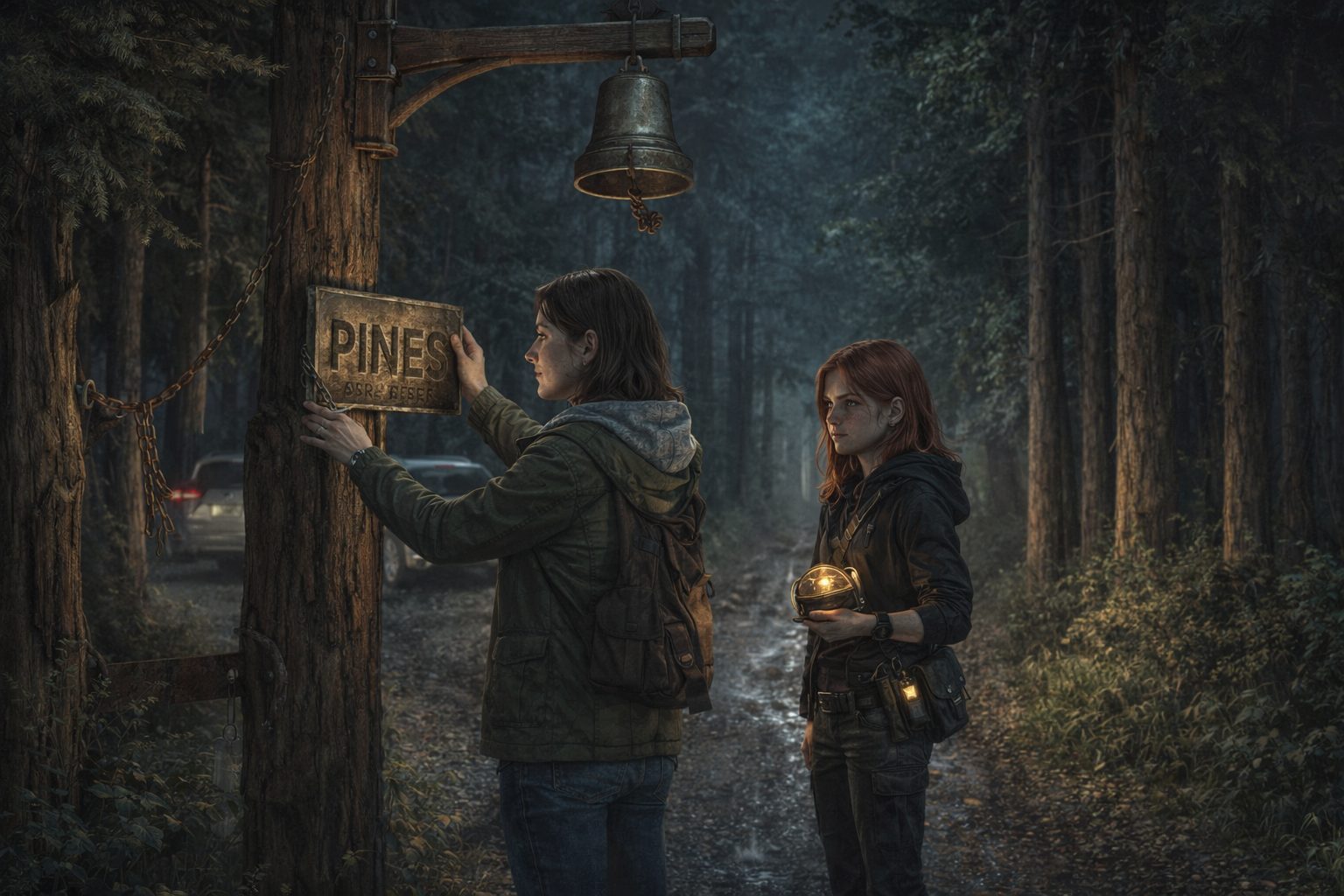
Then the chain hanging uselessly between the posts gave a small jerk and dropped, as if it had only been pretending to hold anything back. Pine branches shifted. The darkness beyond the gap seemed to pull itself into straighter lines. What Ivy had taken for nothing but shadow deepened, lengthened, and became recognizable.
Gravel.
Tyre ruts.
A narrow track running between the trees.
Amber made a tiny sound.
Dad didn’t say anything at all. Which, for Dad, was practically a speech.
In Ivy’s hands, the Compass needle steadied.
It pointed straight up the track.
Mum took the map from Amber and flipped it open against the post. Red lines bled slowly across the paper, threading inland from the road they knew onto a spur that had not existed a minute earlier. Near the new line, in small grey writing that darkened as they watched, appeared three words.
OPEN WHILE SILENT
Nobody said anything.
Because what was there to say, really.
That was awful.
That was helpful.
That was definitely worse than a normal map.
Dad was the first to recover. “Absolutely not on foot.”
Mum looked at him. “I wasn’t suggesting it.”
“We are not leaving the caravan on the roadside and taking the children into magical pine nonsense in the dark.”
“I still wasn’t suggesting it.”
His eyes went to the track, then to the RAV4, then back again, and Ivy could practically hear the gears grinding in his brain as he measured width, turning circle, tree clearance, grade, and the many ways this could ruin his week.
“It is too narrow,” he said.
As if the track had heard him, branches along the entrance shifted once more. Not much. Just enough to show there was room. Enough for the RAV4. Enough, infuriatingly, for the caravan too.
Dad stared at it.
“You have got to be kidding.”
Mum reached out and laid two fingers briefly against his sleeve. “If it’s open now, I don’t think it stays open because we’re feeling sensible.”
That landed. Ivy could tell by the way his jaw tightened.
The bell gave another dead tap overhead.
Not a ring.
Dad muttered something about filing a complaint with reality, turned on his heel, and headed back for the car.
Five minutes later they were moving.
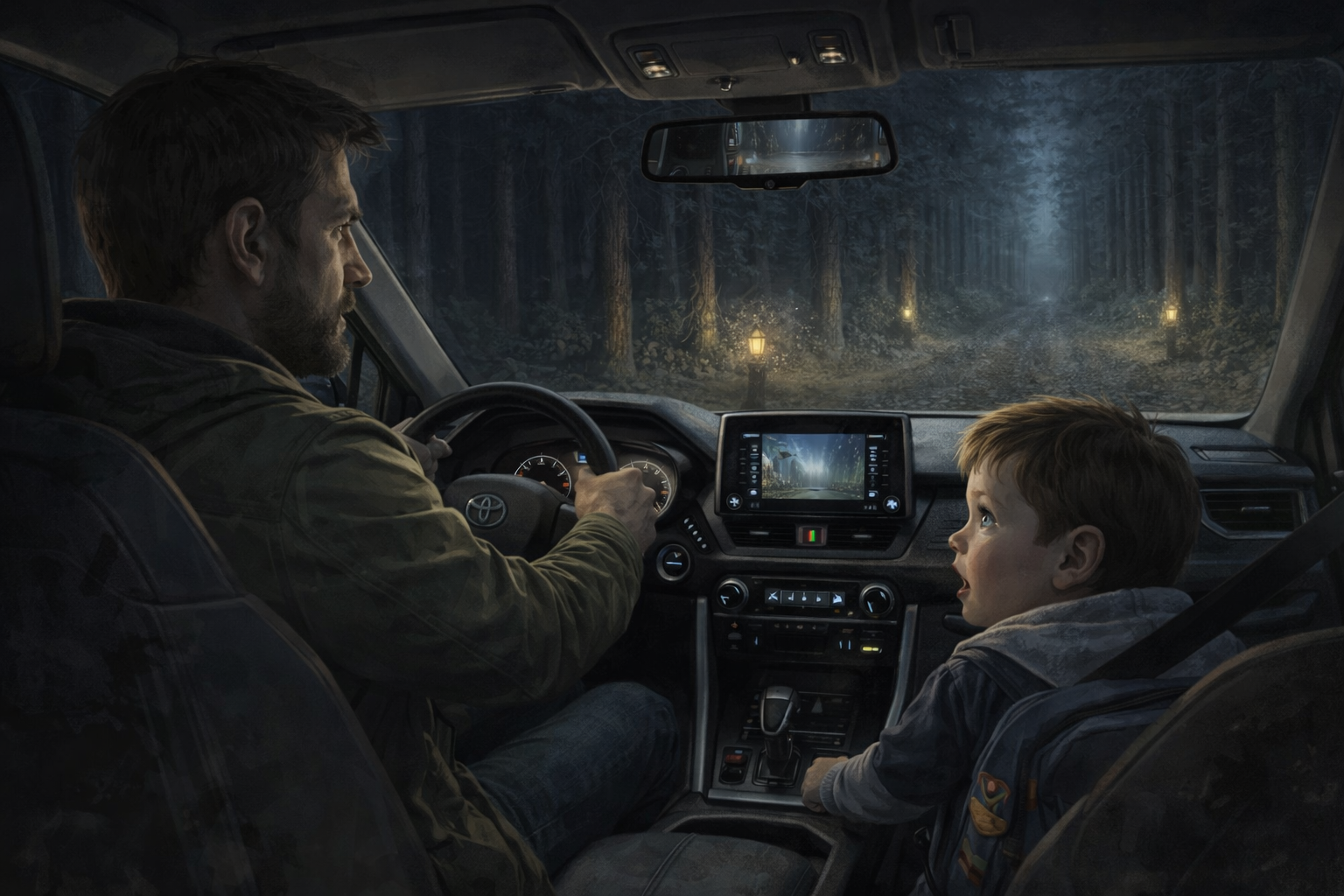
Slowly. Very slowly. Dad had both hands locked on the steering wheel, shoulders up around his ears, concentration so fierce it was almost visible. The RAV4 nosed off the ordinary roadside and onto the hidden track. The caravan followed with a low creak and a soft rattle of cups from somewhere in its cupboards.
The moment they passed between the posts, the sound of the sea vanished.
Not faded.
Vanished.
It was so sudden Ivy actually turned in her seat to check if the beach had somehow gone.
All she could see through the back window was the pale blur of the road entrance and then darkness folding over it like water closing.
“Cool,” Oakley breathed.
“No,” Dad said at once. “Not cool. Deeply concerning.”
The track bent left and ran under the pines.
At first it looked like plantation forest, just as it had from the road. Straight trunks. Needles underfoot. Regular rows.
Then the rows stopped behaving.
Trees that should have lined up no longer did. Some were too wide. Some leaned at wrong ages. Ferns began appearing where there should not have been ferns, and low mist threaded between the roots even though the air had been clear five seconds earlier. The headlights kept finding things that did not belong in a simple forestry access road: a white-painted marker stone half-buried in moss, a lantern symbol cut into timber, a weathered post with its number scraped away until only the pale shape of it remained.
Dad noticed that last one too.
“Of course,” he said grimly. “Erasing infrastructure. Apparently that’s this week’s theme.”
Mum, watching ahead, said, “Keep left.”
“There are no lane markings.”
“I know. Keep left anyway.”
The Compass, balanced in Ivy’s lap now, gave a small obedient twitch to the same side.
Amber leaned between the front seats. “It feels longer.”
Because it did.
The track should have opened into some small reserve by now. Or looped. Or ended in a gate. Instead it kept going, curving softly through trees that had no business being this old this close to the road.
Oakley pressed his forehead to the window. “The outside got bigger.”
No one told him he was wrong.
A single wet footprint appeared in the headlights on the gravel ahead.
Child-sized.
Dad braked so fast everyone lurched.
The footprint sat there for the length of one breath, filling slowly with a sheen of dark water, then faded back into dry stone.
Amber made a small, broken sound.
Ivy gripped the Site 23 tag until the edge bit into her hand.
Dad put the car back into gear.
No one suggested turning around. Not because they were brave. Because the footprint had made it worse somehow. Worse in a direction that meant leaving would not feel like leaving at all.
The track finally widened without warning and gave them a clearing.
Dad stopped in the middle of it and let the engine idle while all of them stared.
It was not a campground.
Not exactly.
It was some cousin of one. Some strange old overlap between picnic reserve, roadside stop, and something more formal than either. There was a loop of gravel around a broad central space lined with pine needles and low ferns. A shelter stood to one side, timber-framed and open-fronted, with long tables underneath and old hooks in the beams where lanterns might once have hung. Opposite it stood a noticeboard beneath a shingled roof, its glass clouded and cracked. Beyond that, deeper between the trees, rose a second archway painted long ago in colours that had mostly weathered off.
Mostly.
Even in the dim light, Ivy could see traces of red and gold on it.
And beyond that archway, far back between the trunks, there were points of colour so faint she thought at first they were an afterimage. Then one moved.
A tiny bulb of green.
Then yellow.
Then gone.
Amber saw them too. “I don’t like that.”
Which was how Ivy knew Amber really didn’t like it, because usually she would have said something far more charitable, such as that it looked sad or lonely or possibly misunderstood.
Dad killed the engine.
The sudden quiet had layers in it. Pine hush. Cooling metal. The faint tick of the caravan hitch. Something else beneath all of that, farther in: not music exactly, but the idea of music waiting for permission.
Mum spoke first. “We stay close.”
Dad turned in his seat. “Five minutes.”
“Ten,” said Ivy, before she could help it.
“Five.”
“Eight.”
Dad gave her a look.
“Five,” Mum said. “And if anything here starts acting too interested, we leave.”
They got out.
The air inside the clearing was colder than the beach had been, but dry. Pine needles cushioned their steps. Somewhere high above, branches moved against one another with a whispering sound like paper rubbed together in the dark.
Dad did a fast circuit of the vehicle and caravan, checking the hitch, the tyres, the ground under the wheels. Practicality: the man’s chosen religion. Ivy could see why he was doing it. If the place decided to get clever, at least they would know whether the caravan was physically stuck or merely spiritually inconvenient.
Mum headed for the noticeboard with the map bundle under one arm.
Ivy went with her.
Amber drifted toward the shelter, drawn by something Ivy could not yet see. Oakley followed Dad for six steps, got distracted by a pine cone the size of his head, and squatted beside it like he had just discovered alien technology.
The noticeboard’s glass was cracked in a spiderweb across one corner, but one side hung open. Inside, most of the paper notices had rotted into beige curls. One old map remained pinned behind the grime. Its colours were mostly gone. Its labels were worse. Whole words had been eaten out of it, leaving blanks and broken stubs of lettering.
But the shape was clear enough.
Loops. Bays. A central shelter. A bell marker near the entrance.
And, deeper in, past the second arch, a larger area marked only by a faded cluster of circles and tiny flags.
The paint there had been scratched so hard the wood showed through beneath.
Mum touched the map lightly. “Don’t.”
Ivy froze. “I wasn’t—”
“I know. Just don’t.”
The Lantern Compass had gone warm again. Its needle did not point toward the faded flags. It pointed to the right-hand side of the board, where a narrow timber box was bolted below the map.
The box door hung open.
Inside lay a roll of cloth.
Not paper. Cloth.
Faded cream once, now gone the colour of old tea. Someone had embroidered on it in dark thread: pines, bell-shapes, lantern marks, crossing lines. A route chart, maybe. Or a record. The stitches were tiny and careful, though several rows had been ripped loose as if clawed.
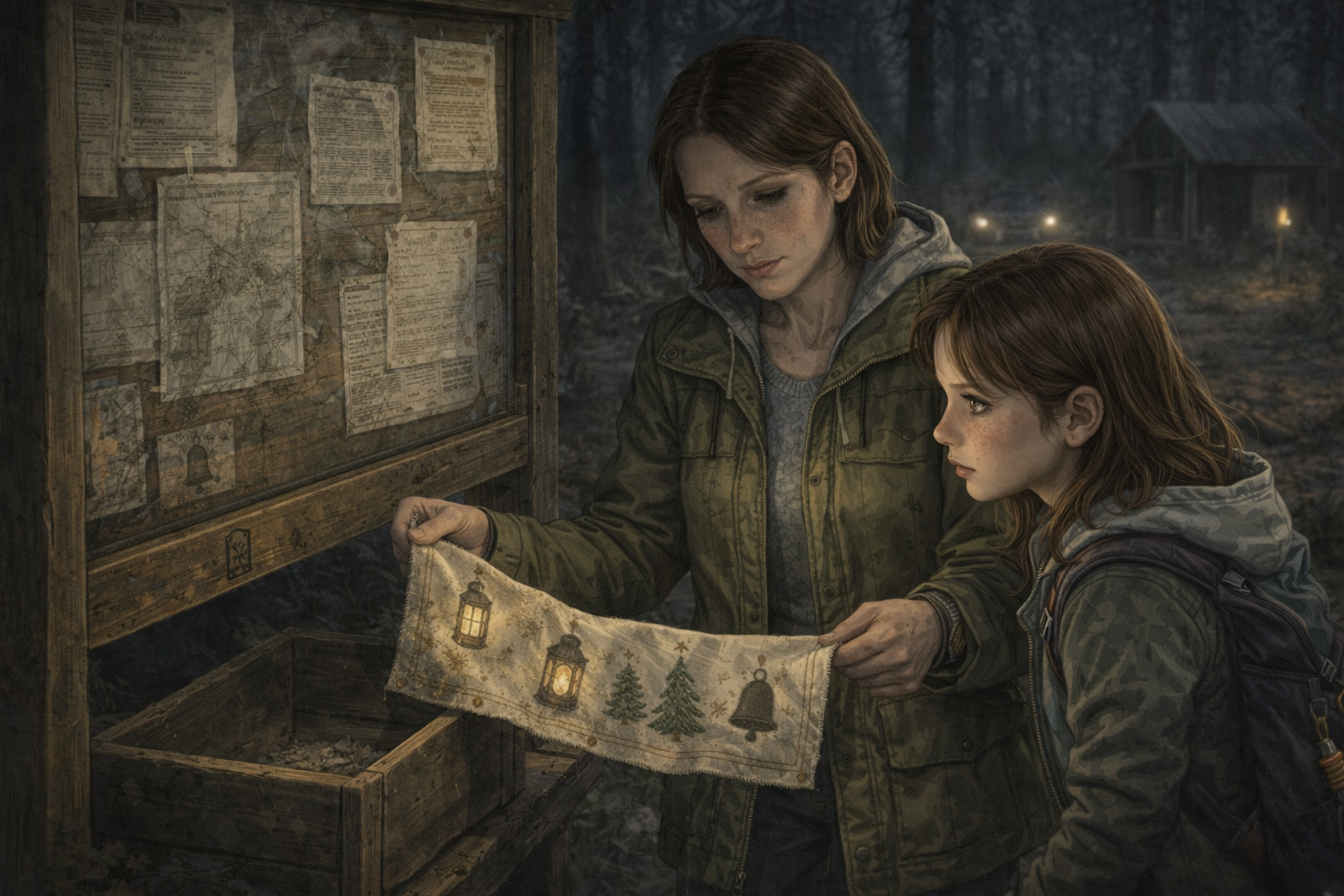
Mum drew in a sharp breath.
That was the first moment Ivy felt it: not fear exactly. Recognition, second-hand. The kind that jumps from one person into another before it has a name.
“This,” Mum said quietly, “is Erin territory.”
Ivy looked at her. “You think she knows that pattern?”
“I think your auntie has at least six boxes of old family sewing things and the annoying habit of going quiet exactly when she knows something useful.”
That was so accurate it briefly improved the situation.
Mum reached for the cloth.
The noticeboard to their left gave a soft scraping sound.
Letters were disappearing.
Not quickly. Not with a dramatic flourish. They were just… thinning. The painted remains of some old rule-board or welcome sign were fading as they watched, as if something invisible had started licking them away.
Ivy stepped back hard enough to hit the post behind her.
“Dad,” Mum called, not loudly but with enough steel in it to change the air.
He was there almost immediately. “What?”
She pointed.
He watched two more letters vanish.
“Oh, good,” he said. “Excellent. The road malware is here.”
Amber, from the shelter, said, “I found something.”
Her voice made all three of them turn.
She was standing under the timber shelter beside one of the long tables. At her feet, in the soft mat of needles and dust, ran a trail of small damp prints.
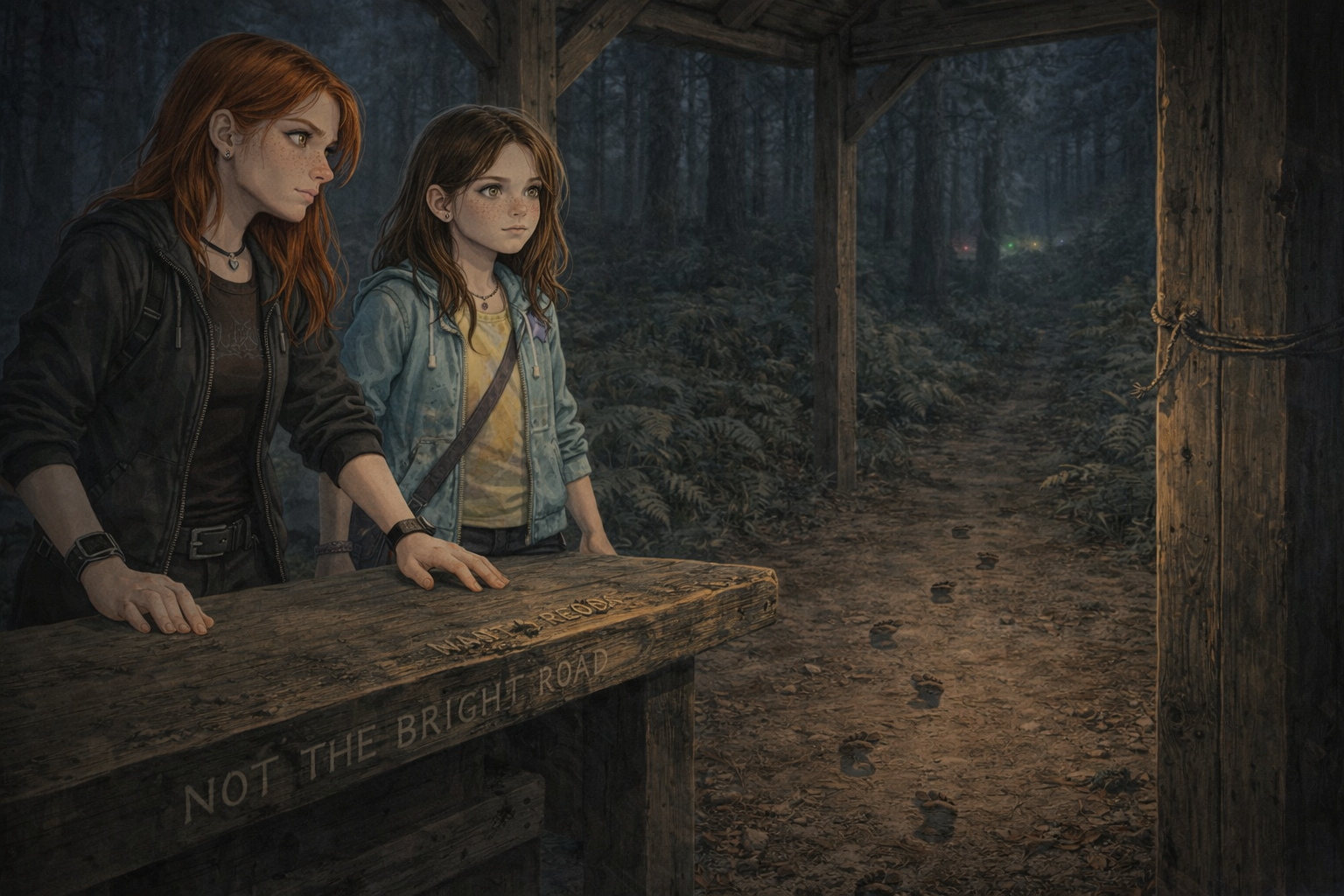
Not many. Four. Maybe five.
Child-sized.
They came out from under the table, crossed the shelter floor, and stopped at one of the back posts.
Just stopped.
As if whoever had made them had leaned there, watching, and then ceased to be a problem of feet.
Oakley looked up from his pine cone with complete satisfaction. “Toast Boy was waiting.”
Dad opened his mouth, shut it, then tried again. “Marvelous.”
Amber was staring at the post.
Something had been tied around it, once. A length of faded red-brown thread, now mostly snapped. One end still clung to the wood.
Mum moved closer. The thread was not plain. Tiny stitches in dull gold ran along it in repeating shapes—lanterns, knots, bells.
It matched the cloth in the noticeboard box.
“Don’t touch that one yet,” she said, more to herself than anyone else.
A new sound floated through the trees beyond the second arch.
Three bright notes.
Not from the cracked bell at the entrance. These were lighter. Almost playful.
Then a thin shiver of bulbs came alive far back between the trunks. Red, gold, green, blue. Too distant to show what they belonged to. Close enough to feel them watching.
Ivy’s skin tightened.
The obvious path was the one straight ahead, past the faded arch and toward those lights.
The Lantern Compass swung sharply away from it.
It pointed instead toward the side of the shelter, where a much narrower track slipped off into the dark, nearly hidden by fern and shadow.
Honest road, Ivy thought suddenly.
Not bright road.
Something moved at the edge of that side track.
A figure. Small. Still.
Boy-shaped.
Her breath caught. She knew that height. That waiting way of standing.
The face never came fully clear. It was all wrong for that. Pine shadow across it. Distance. The impression of pale eyes or maybe just reflected light.
But the hand lifted.
Not waving this time.
Pointing.
Away from the distant bulbs.
Toward the narrow dark path and the silent threads tied around the post.
Then the shape was gone.
“Ivy?” Mum said sharply.
She hadn’t realized she had stepped forward.
“He was here.”
Dad was already looking where she looked, but there was nothing there now except trees and the side track disappearing into them.
Amber had gone pale in that strange, open way she got when she was frightened and trying not to damage anyone else’s fear by adding to it. “Did he look wrong?”
Ivy swallowed. “No.”
That's what was weird
No. He hadn’t looked wrong.
Not like the voice on the beach. Not hungry. Not almost-right.
Just tired.
The lights beyond the second arch brightened another fraction.
A strip of old bunting, invisible a moment ago, stirred into view between the trunks. Far off, something spun once and flashed gold.
Dad saw that and made his decision with visible relief. “Nope. Finished. Whatever Disneyland from hell is doing back there, we are not doing it tonight.”
The bright lights gave a soft chiming laugh of music, as if offended.
The noticeboard scraped again.
More letters vanished.
Mum moved fast then. She did not take the whole embroidered cloth. She studied the roll, found a section already torn loose at one edge, and eased only that free—a narrow strip no longer than her forearm, patterned with pine boughs, a bell, three crossed lines, and a lantern stitched at the corner.
The instant it came free, the cracked bell at the entrance gave a dead strike from somewhere back through the trees.
One note.
Failed again.
Not ringing.
The distant coloured bulbs shivered brighter.
Dad took that personally. “In the car. Now.”
Nobody argued.
Oakley abandoned the pine cone with deep sorrow. Amber grabbed the clue bundle from Mum before it could spill. Ivy backed away from the shelter without taking her eyes off the side track, half hoping the boy would appear again and half terrified that something else would.
Nothing did.
But as she turned, she noticed one more thing.
Carved into the side of the shelter table, nearly hidden by age and resin, were four words scratched by something sharp and impatient:
NOT THE BRIGHT ROAD
She almost said it out loud.
Then Dad called her name—her real one, ordinary and annoyed and alive—and that was enough to snap the moment cleanly in half.
They piled back into the RAV4. Doors slammed. Dad started the engine. Gravel crunched under the tyres as he reversed with more skill than any human should reasonably possess while towing a caravan in a place that definitely did not want to appear on insurance paperwork.
The bright lights ahead gave one last teasing shimmer through the trunks.
For a second—one horrible, magnetic second—Ivy could see the shape of something beyond them.
A striped tent roof.
A wheel rimmed with bulbs.
A line of hanging flags moving though there was no wind.
Then the Compass in her lap knocked hard against her wrist, dragging her attention sideways toward the dark side track instead, and the view broke up into trees again.
Dad got them turned.
The track back out felt shorter.
Of course it did.
Places like this were rude on purpose.
The marker posts flashed by in the headlights: lantern, scrape, blank number, moss. At the entrance the cracked bell hung over the gap exactly as before, cloth wrapped hard around its clapper. As the RAV4 passed beneath, it knocked once against its own broken mouth.
Dead. Muffled. Wrong.
The moment the caravan cleared the posts, the sea came back.
Surf. Wind. Road noise. The ordinary world slammed over them all at once so hard Amber actually gasped.
Dad pulled straight into the gravel pull-over and stopped. Nobody moved for a second.
Then Oakley said, with immense satisfaction, “We escaped the tree trap.”
Dad leaned forward until his forehead touched the steering wheel.
“Correct,” he said into it. “That is, somehow, exactly what we did.”
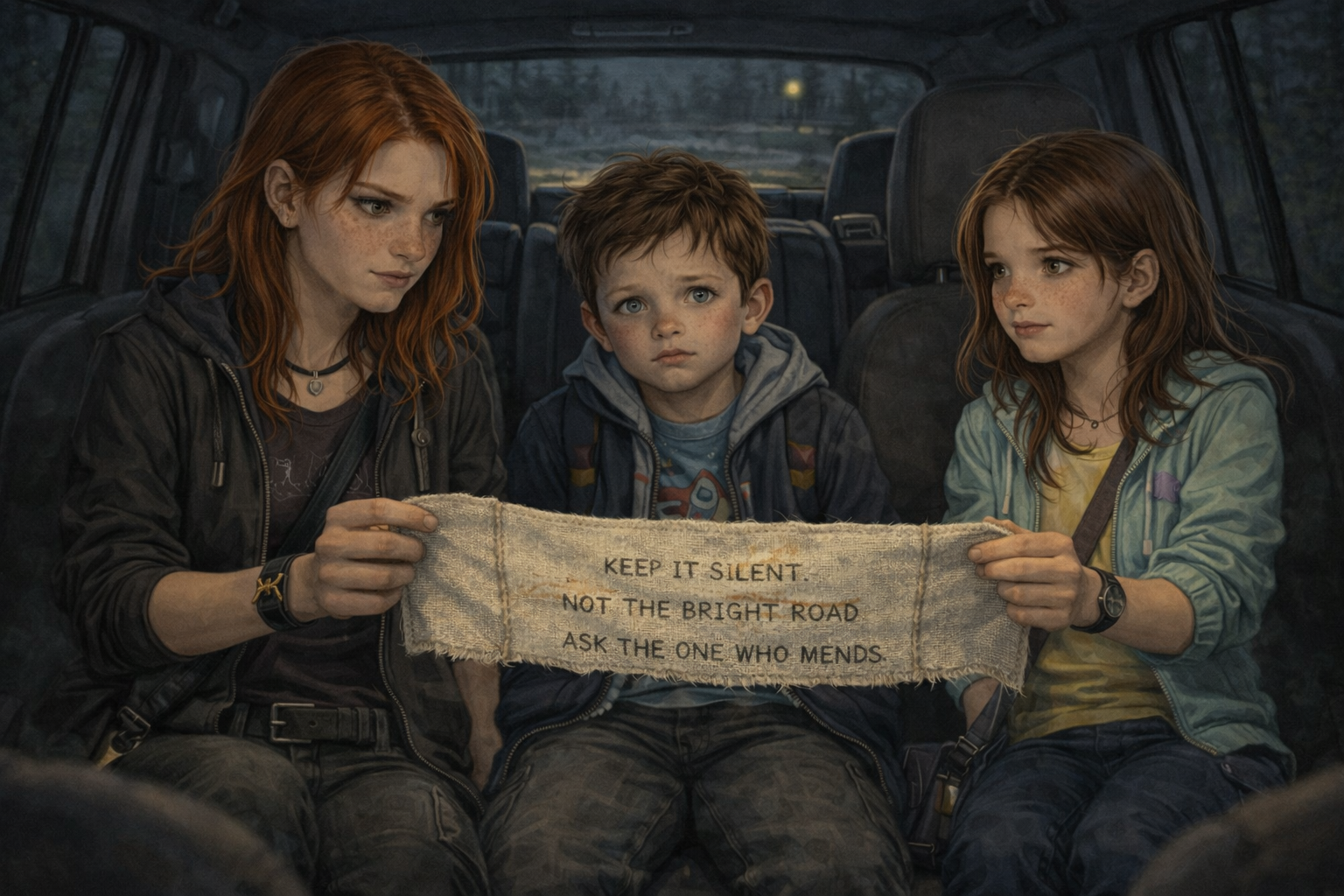
Mum was already unfolding the torn embroidered strip in the glow from the dashboard. The thread looked older out here. Stranger too. Not because it was magically glowing or doing anything dramatic. Because it was handwork. Real handwork. Tiny stitches laid down by somebody patient enough to believe thread could hold a road in place.
Amber leaned over it. “There’s writing.”
So there was.
Not embroidered. Ink, faded almost to nothing along one edge. Just enough remained to make out a few words.
…KEEP IT SILENT…
Below that, smaller and shakier:
…NOT THE BRIGHT ROAD…
And underneath, in a hand that looked different again, one sentence so faint Mum had to tilt the cloth twice before it resolved.
ASK THE ONE WHO MENDS
Silence filled the car.
Then Dad lifted his head off the steering wheel and stared at Mum.
Mum stared back.
Neither of them said Auntie Erin’s name.
They didn’t need to.
Ivy looked down at the Site 23 tag in her hand, then at the embroidered strip, then out toward the line of pines across the road.
From here the gap was gone.
There was no entrance. No posts. No cracked bell. Just a dark stand of trees moving in the wind above a shabby verge.
If not for the sand still drying on their shoes and the strip of stitched cloth in Mum’s hands, the whole thing could have passed for mass hallucination.
Except for one thing.
Far back between the trunks, where there should have been only dark, a single green light blinked on.
Off.
On again.
Gone.
Dad saw it too.
His voice came out tired and flat and entirely certain. “Right. New family rule. Nobody goes back in there tonight.”
Nobody argued.
Even Ivy.
Especially Ivy.
Because she could still see the small figure at the edge of the side track in her head, hand lifted, pointing away from the bright lights and into the dark.
Not the bright road.
The honest road.
The one somebody had tied shut on purpose.
And somewhere far behind the ordinary sound of the surf, just barely there and not there, she thought she heard the shape of music waiting for a bell to ring properly at last.